










Tiny Epic Tactics Deep Dive
What the Community Thinks About Tiny Epic Tactics
Reviewers describe Tiny Epic Tactics as a compact tactical skirmish from Scott Almes and Gamelyn Games, in which each player leads a four-unit team across a stacked, three-dimensional map. The shared view is that positioning and timing matter more than dice, and that the best moments come from combining unit abilities with tactic cards. Meeple University frames the game as a blend of tactical combat and area control, and its rules and playthrough videos are the most detailed walkthroughs of the design.
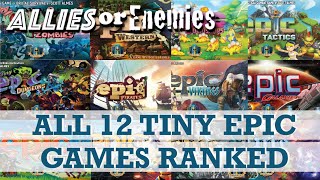
Opinions diverge on pace and tone. Allies or Enemies ranked the game last among the twelve Tiny Epic titles they had played, praised the character options, but found the game quick and lighter than they wanted. Junkets Games played a full three-player match that was decided by a single point, and treated the close result as the product of a few specific moments that could have gone differently. Tabletop Toki expressed fond memories of the game, although they admitted it had not been played as often as they would have liked.
Core Mechanics That Define Tiny Epic Tactics
Action Economy and the Weakened Condition
Each turn a player takes three actions, divided among their units and chosen from movement, melee attacks, missile attacks, spellcasting, and the special ballista shot. A unit can take a second action in the same turn, but it then receives a weakened token that prevents it from acting or counterattacking. Recovery costs two health or a full turn without activating that unit. Watch It Played also explains that every attack type counts as the same kind of action, so a unit cannot pair a melee strike with a damaging spell. Meeple University advises players to attack only where a counterattack is unlikely, because any damage taken allows the target to respond immediately.
Control Points and Flag Timing
Victory depends on three colored control points. A point begins to trigger when a player has more units across its six control spaces than any rival and has a unit on the larger trigger space at the start of their turn. From then on, majority control advances the flag each turn, and the player who pushes it to the end of the track claims it for five points. Meeple University's overview stresses that the biggest points go to the player who is last to capture a flag rather than the first, which makes timing the central decision of the game.
The Tiny Epic Tactics Experience
Confrontational Pressure
Reviewers consistently describe a table that rarely slows down. Allies or Enemies called the game aggressive from start to finish, and the Junkets Games match shows the pattern: units dash through portals to reach rear positions, a fireball splashes into neighboring allies, and knockback can drive a unit into water, a wall, or another figure for extra damage. Every attack invites a counterattack, so opening a flank is never free, and a captured unit leaves the board permanently, which keeps the stakes visible.
Cerebral Timing
Beneath the aggression is a timing puzzle. Meeple University contrasts the game's tactical pace with the slower, long-term defense of deeper area control titles, arguing that players grab points while a control point is live rather than holding ground for many turns. Tactic cards add another layer, since a card can be revealed on an opponent's turn when its condition is met, allowing a player to plan a surprise several rounds in advance. The satisfaction comes from landing the final flag advance at the right moment.
What Makes Tiny Epic Tactics Stand Out
Character Powers and Tactic Cards
Reviewers repeatedly point to how unit and tactic cards combine. Meeple University's overview notes that each character class offers several unique cards, each with its own movement, stats, and special abilities, and that these abilities are the main way players take surprise actions or extra actions without weakening a unit. Meeple University's rules video adds that a tactic card can often grant a free action even to a weakened unit. Junkets Games admitted that its own match underused the tactic cards and said future games should lean into them more, which underlines how much of the design rewards planning around them.
A Box That Doubles as the Battlefield
The physical presentation also earns praise. Meeple University's overview highlights that the game box and its inserts form the sprawling three-dimensional map and then pack away into a standard Tiny Epic box. Tabletop Toki noted that the box pieces flip over to create different leveled terrain setups and double as practical storage. Together with the elevation rules, portal network, and terrain bonuses, the board becomes part of the strategy rather than a backdrop.
Potential Drawbacks
Early Lethality and Pace
A recurring concern is how quickly play can turn against a newcomer. Allies or Enemies said the game moved quickly and that their units were eliminated before they could learn how each character worked. That reaction follows from the design, because a unit reduced to zero health is captured and its card scores for the captor, so an early loss can swing the scoreboard. Tabletop Toki's fondness for the game came with the admission that it had not been played often, which suggests that the pace and learning curve may keep some groups from returning to it.
A Slow Swing for New Players
Meeple University's review observes that it takes time to understand the turn-based combat, because a charge into an opponent can leave a unit weakened and immobile, which can cost more than the attack gains. The Junkets Games match illustrates the same point from another angle: a single missed knockback or capture attempt can leave a player well behind, and the tactic cards reward reading several turns ahead. Players who are comfortable with that planning will find the swing rewarding, while others may need a few games before the rhythm feels natural.
If You Enjoy Tiny Epic Tactics
Players who enjoy the game's unit-based tactics will find overlap with the titles reviewers compare it to:
- Final Fantasy Tactics: Players who enjoy Tiny Epic Tactics's elevation rules and weakened-unit tempo will find similar satisfaction in Final Fantasy Tactics, the video game that Meeple University and Allies or Enemies both cite as a reference point.
- Shining Force: Allies or Enemies places the game alongside Shining Force when describing its squad-based grid fighting, so fans of positioning-heavy battles should feel at home.
- Fire Emblem: Tabletop Toki recommended the game to a family member who was enthusiastic about Fire Emblem, pointing to its appeal for players who like character-driven tactical battles.
- Overwatch: Allies or Enemies likened the control point maps to those in Overwatch, so players who enjoy contesting objectives will recognize the area control rhythm.
What Reviewers Are Saying
"I think that there were several moments of this game where things really could have changed, one of them really jumps out to me, and that is when the green player decided not to try and capture our red ghost rogue. I think that was definitely a mistake on their part."
Junkets Games
"It takes a while to get the swing for how the turn-based combat yet works because you can charge in and attack somebody, but then you're weakened and frozen there and it actually harms you quite a lot."
Meeple University
"My people got killed off too fast before I really got a sense of how to use them, and my feelings got a bit hurt, so this was just a tricky one for me."
Allies or Enemies