











Tiny Epic Western Deep Dive
What the Community Thinks About Tiny Epic Western
Reviewers tend to regard Tiny Epic Western as one of the stronger entries in the Tiny Epic line, but they disagree about how well its poker-based core suits different groups. Meeple University says its hosts have always had the most fun with it and calls it the most Euro of the Tiny Epic games. Drive Thru Games describes it as pretty fun and singles out its poker mechanic as a cool touch. The host of Jung its games recalls making a playthrough video shortly after the game launched on Kickstarter, and says the publisher liked it enough to place that footage on the Kickstarter page.
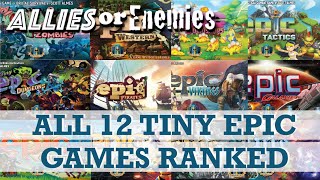
The most skeptical voice comes from Allies or Enemies. Ranking all twelve current Tiny Epic releases, they place Western eighth, call it probably the most divisive game the series has produced, and argue that its results lean heavily on luck. Their enthusiasm for its distinct western-town feel is real, however, and they describe the design as solid even when the outcomes frustrate them. Getting Games sits closer to the praise side, calling the design mechanically sound after playing it twice at a convention and once more as a print-and-play three player game.
Core Mechanics That Define Tiny Epic Western
Worker Placement
Players place Posse members onto the circular spots that surround each location card, and each placement triggers that location's action. Some spots are split by a slash, so a Posse member can sit on the safe side for a guaranteed benefit or on the other side as a bet that the player holds the strongest poker hand for that location. Getting Games explains that each location is flanked by two face-up poker cards, and that a player's own card is combined with those two to form a three card hand. Allies or Enemies frames the same system as a kind of three card stud played against the table, with one shared card and one secret card in each player's hand. The result is that the action you choose and the bid you make are the same decision, and reviewers repeatedly return to that tension when describing turns.
Duels add a second layer to placement. When two players share a single spot, they roll dice, and the winner takes the Wanted card, which pays a resource at the end of the round and is worth two victory points at game end. Getting Games notes that a defender can re-roll by spending Law, while an attacker can spend Force, so the placement itself becomes a question of which resources a player is willing to give up.
Resource Management
Law, Force, and Money act as the currency that funds nearly every meaningful choice. Buildings are purchased with specific combinations of these resources, and the influence tokens that track them sit on the player board with a cap of six. Getting Games describes the economy as tight, with a player often down to a single coin and very little law mid-round after paying for buildings and duel re-rolls. Because one resource can be spent to re-roll a duel, buy a building, or activate a location, reviewers describe each allocation as foreclosing other options. Purchased buildings also feed the scoring system, since majorities on mining, railroad, and wagon wheel icons determine which players earn points at the end.
The Tiny Epic Western Experience
Interactive and Dynamic
Western feels like a table of players reading each other. Reviewers describe the poker reveals, the decision to hold back a card, and the uncertainty of a duel as the moments that make the game social, even though the rules are compact. Allies or Enemies notes that a lot of the game comes down to what a player's hidden card might be, which turns every placement into a small bluff. Getting Games describes a shootout where a player chose not to reveal a card because the required re-rolls would cost resources needed for the buildings they wanted, and the tension of that choice is the kind of decision that makes reviewers talk about the game after it ends.
Triumphant
When the cards line up, Western delivers a clear sense of victory. Allies or Enemies says the game feels real good when a hand works and really bad when it does not, which makes the big wins stand out. Getting Games shows the same pattern in its three player playthrough, where a late round Town Hall straight gave the host first choice of buildings. The feeling is less about grinding out a slow plan and more about landing a well-timed bid that changes the round.
What Makes Tiny Epic Western Stand Out
Asymmetric Player Powers
Reviewers consistently point to the asymmetric powers as a reason the game feels different from one table to the next. Getting Games walks through three of them: the Gambler, who draws an extra poker card when short on Posse members, the Banker, who gains influence for every two buildings built, and the Cowgirl, who adds to dice rolls as Force accumulates. Getting Games lists asymmetric powers among the aspects that add flavor to the game, and each one shifts the way a player approaches placement and bidding.
Tight Victory Point Structure
Meeple University praises the scoring as the most Euro part of the design. Reviewers see the game as a low-scoring affair where a wide range of locations and actions all feed into a small number of point sources, which keeps the outcome close. The host describes the experience as a lot to keep track of inside a single placement, but says the choices in each placement carry weight.
Potential Drawbacks
Luck in Duels and Poker Hands
Luck is the most frequent criticism that reviewers raise. Allies or Enemies argues that the balance depends heavily on the cards drawn, and that the game can feel very rewarding or very frustrating depending on the run of a session. Getting Games points out that dice randomness remains in duels even with the re-rolls added in a revision, so a player with few resources can still lose a shootout they expected to win. Reviewers who value skill-based decision making may find these moments harder to accept.
Limited Scoring Routes and Print-and-Play Limits
Meeple University notes that there are not many different ways to earn victory points, and that the game sits at the low end of the scoring range, which some players find restrictive. Getting Games also cautions that its print-and-play version lacks the full art package, so the experience at home may not match what the published game looks like on the table. Getting Games further observes that board revisions tightened competition for the best locations, which pushed players into more duels. Some will welcome that tension, but others may find it narrows their options.
If You Enjoy Tiny Epic Western
Players who enjoy Western's compact worker placement and the way a single action can double as a bid will find a similar kind of decision making in Tiny Epic Galaxies, which Allies or Enemies ranks first in their list. Its follow mechanic forces players to spend a valuable resource to copy an opponent's action, which mirrors the way Western asks players to weigh every resource against a placement. Players who want a more cooperative experience in the same series can look to Tiny Epic Defenders, which Allies or Enemies praises for the simplicity of its cooperative play, or to Tiny Epic Zombies, which Allies or Enemies describes as a strong co-op game because its three quests per game make each session feel different. Players who want a bigger tactical challenge in a small box might consider Tiny Epic Dungeons, which Allies or Enemies ranks highly for its dungeon crawling depth and character options.
What Reviewers Are Saying
"There's not a lot of different ways to get victory points. It's like a low-scoring game, and yeah, just in general I can find that quite interesting, where there's lots of different actions and places you can go, but it all folds into just a few things that are worth points."
— Meeple University
"It feels real good when it works, it feels really bad when it doesn't, so you just got to be okay with having a game that's gonna have that much luck in it."
— Allies or Enemies
"I'm confident that through all the tweaking that they're doing and I'm sure a little bit more as they do this full print and play trial thing they're going to tweak it in ways that are really going to make it a very solid package. So in general I've been quite impressed with it."
— Getting Games