/pic5052906.jpg)
Tournament at Avalon takes players to the land where Excalibur was forged, building on the innovative mechanisms of Tournament at Camelot with new characters, cards, and mechanisms, allowing players to focus on informal diplomacy or alliances alongside the standard combat of the original game. It's a deep, challenging experience all on its own, with extra depth and complexity for players who own both games!
In the game, you play as a legendary character, battling opponents with weapon cards: arrows, swords, deception, sorcery, and even alchemy. The more you injure your opponents, the better you fare in the tournament. However, even the most injured characters can make a complete comeback with the grace of Godsend cards and the aid of their special companions. This trick-taking game ends when one opponent has been injured to the point of death. The player with the most health is then declared the tournament victor!
In Tournament at Avalon, you also have cards representing the legendary enchantress Morgan Le Fay and a new set of location panels that grant additional advantages to a player when they are the host of a tournament round. If you have Tournament at Camelot, you can mix and match your favorite cards, playing with either ruleset or combining the two games to play an epic "Chaos of Battle" tournament with seven or eight players!
—description from the publisher
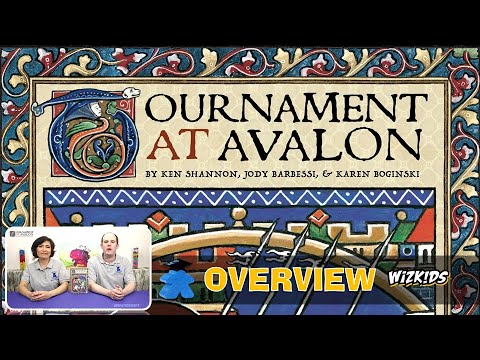
- Unfortunately we haven't had a chance to play it at this stage
Mechanics (from transcript analysis)
- Trick-Taking
Video topics + discussion points
Quotes (from this video)
- there's a lot of jargon a lot of terms in trick-taking games
- so a standard trick-taking game each player will be dealt a hand of equal size and then in a trick one player chooses a card any card from the hand to lead
- and then after everyone has played a the right suit not direct numbered oh yeah the number number doesn't matter it just has to be matching the lead suit
- so essentially once all the cards are played whoever's play the highest Trump wins the trick
- players are only really allowed to communicate by the card they play
- it's called an evasion style of trick-taking game
- and the most basic game is you've got a hand and whoever takes the most track tricks wins
- the difference between old trick-taking games and modern trick-taking games is more chaos more options and therefore more strategy or more tactical play on the cards you've got
- it's kind of the first deck builder
- so the premise there is that you get your cards and you work out how many tricks you think you'll be able to take with those cards
- often I see the question what is the best modern trick-taking game I haven't found anything that I've enjoyed more than five hundred
- Becoming more and more popular these days as well
- I quite enjoyed the new efficient so be I should try to play the old-fashioned as well
References (from this video)
Mechanics (from transcript analysis)
Video topics + discussion points
Quotes (from this video)
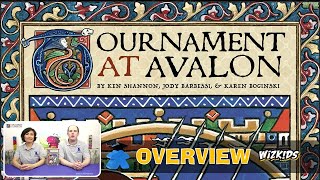
- table talk is actively encouraged in tournament at Avalon
- an ideal game for players who enjoy negotiation
- the game can also be combined with the cards from tournament at Camelot to create a deck large enough to play with seven or eight players
References (from this video)
- Table talk is actively encouraged, enabling negotiation at the table.
- Alliance-building and backstabbing create dynamic player interaction.
- Multiple catch-up mechanics and trailing-player bonuses balance the game.
- Unique protagonist abilities add variability and strategic depth.
- Special alchemy and other cards adjust stakes and add tactical options.
- Potential for larger player counts by combining Camelot cards.
- set in the after EURion legend
- Tournament at Camelot
- Hearts
Mechanics (from transcript analysis)
- card passing — Each round, players are dealt 12 cards and must pass three to a neighbour.
- deck expansion with Camelot — The game can be combined with Tournament at Camelot cards to support seven or eight players.
- Health tracking — Players lose health when they take tricks; 5 health for a basic card, 10 health for a poisoned card.
- Protagonist abilities — Each player has a protagonist with a special ability (e.g., Sir Percival immune to arrows and redistributing them; Elf Queen can force players to play blindly).
- special alchemy cards — Wild alchemy cards offer choices and can affect tricks and outcomes.
- special cards effects (Morgan la Fey, Mists of Avalon) — Morgan la Fey reverses a trick so the highest card wins; Mists of Avalon discards the lowest card granting the trick to the next lowest.
- tie cancellation — If two players tie, their tied cards cancel and the next lowest card wins.
- Trick-Taking — Tricks are played under no Trump rules; players must follow the lead suit or play a wild alchemy card; the lowest legal card wins the trick.
- trick-taking (no trump) — Tricks are played under no Trump rules; players must follow the lead suit or play a wild alchemy card; the lowest legal card wins the trick.
- Unique Player Powers — Each player has a protagonist with a special ability (e.g., Sir Percival immune to arrows and redistributing them; Elf Queen can force players to play blindly).
Video topics + discussion points
Quotes (from this video)
- table talk is actively encouraged in tournament at Avalon
- an ideal game for players who enjoy negotiation
- the game can also be combined with the cards from tournament at Camelot to create a deck large enough to play with seven or eight players
References (from this video)
- Aggressive and cutthroat gameplay
- Adds chaos with gods and abilities
- High player interaction
- Can be a little long, sometimes over an hour
- One player found it confusing initially
- trick-taking with aggression
- The Crew
- Tichu
- Cosmic Encounter
- Origin Story
Mechanics (from transcript analysis)
- Card Drafting — Implied by upgrading superheroes and drafting cards.
- Combat — Players do damage to each other.
- Trick-Taking — Core mechanic is trick-taking.
- Variable player powers — Character abilities influence gameplay.
Video topics + discussion points
Quotes (from this video)
- Meaningful strategic decisions that then feed into a lot of random outcomes and very entertaining random outcomes.
- The game does the best like chain reaction type experience that I think I've seen in a game.
- It feels like Ethnos meets Quacks of Quedlinburg.
- It's got the same element as a game like Quacks where you might just have a bad round drawing. But it feels even worse in this game because you're playing a big two plus hour game and have a bigger overarching strategy. So for it to really not pan out it stings more.
- Number one goes to Arcs.
- This is the marriage of those two [heavy conflict interactions and trick taking].
- When you're able to pull something off, it feels like this game is so satisfying.
- Having the cards push you in different directions and like I can't do what I want, but how can I make something work? I find a lot more kind of compelling and replayable.
- It is a very rewarding game.
- I think he even recently said it's his top game.
- So much so that he was the one that requested to put it on our wedding registry.
References (from this video)
- Unique Arthurian theme, social interaction
- Variety with character abilities
- Niche appeal; may be less accessible to casual players
- social trick-taking and negotiation
- Arthurian tournament theme
- competitive yet lighthearted
- Teach You (The Mind Games)
- Poker-style trick-taking
Mechanics (from transcript analysis)
- negotiation_and_alliances — Players form and break alliances as the game unfolds.
- trick_taking — Hero/character cards lead to trick-taking rounds with special abilities.
Video topics + discussion points
Quotes (from this video)
- it's so nostalgic that it's like so much of me wants to own it
- I think this quite possibly could be my top game
- the Mind Games I really like the mind games
- the combination of bag building and push your luck is just really nice
- we'll be seeing Twilight Imperium on Caitlyn's no we will not
References (from this video)

- Innovative integration of trick-taking with ambitions
- High interaction and clever puzzles
- Enjoyable with a strong, engaged group
- Complex teach for new players
- Performance depends on the right group size and dynamics
- Mind-games and strategic deception
- Trick-taking tournament with magical powers
- Clever, competitive mind games with evolving powers
- Tichu
- Root
Mechanics (from transcript analysis)
- card powers / twists — Special abilities and unpredictable interactions via card play
- high interaction / player-versus-player tension — Active interference and counterplay between players
- Positive Player Interaction — Active interference and counterplay between players
- Trick-Taking — Players bid on and play tricks while ambitions drive scoring
- trick-taking with ambitions — Players bid on and play tricks while ambitions drive scoring
Video topics + discussion points
Quotes (from this video)
- the dynamic map element, which that's unique to Catacombs, the other ones just have a static board, is a huge part of the fun of the experience.
- it's a game that allows as much thinking as you want.
- there's nothing like it.