/pic2375943.png)
In Traders of Carthage, players are merchants who are attempting to ship four different types of goods from Alexandria to Carthage. Players affect how quickly or slowly the ships move and can trigger pirate raids that may cost their opponents their goods. (Traders of Osaka moves the gameplay to a new continent and era, with players now trying to deliver cargo from Osaka to Edo, but otherwise gameplay remains the same.)
The game has a small board that shows the route the ships will follow, marking safe ports and dangerous waters. The board also has two spaces for the draw pile and discard pile and shows where the Market and Farm cards are laid out. The game also contains a deck of cards that have multiple uses, 48 achievement tokens for when goods are sold, four ship pieces to mark how far the ships have sailed, four trader pieces to indicate a player's scoring pile, four reservation pieces for players to mark cards they wish to purchase or take on a later round and a rulebook.
The game is a set collection game at its core. Players are attempting to collect sets of goods that will allow them to collect cards that will be worth points at the end of the game.
During the game, the cards can be used to represent goods when laid out in front of players, to represent gold to purchase goods when played from their hands or urns which players will use to protect goods from pirates. Deciding how to use the cards and when is the basis of playing the game.
On a player's turn, they can do one of three things: Buy Goods, Get Coins or Reserve a Card.
Buying goods has the player buying cards from the Market. There will be a number of cards laid out, face up, in the Market. Each card has a gold value in the corners and indicates how much a card is worth (either 2, 3 or 5). When a player buys goods, they must buy all the cards in the Market, using cards in hand to pay. If a player cannot afford the whole Market, they cannot do this action. Any cards purchased this way are laid out, face up, in front of the player. These goods are now aboard the ship of the matching color. Then the player moves each matching ship either 1 or 2 spaces towards Carthage (1 space if 1 card of that color was purchased, 2 spaces if 2 or more cards were purchased). If a ship moves onto Carthage, a payout occurs and pirates attack (this will be explained in detail later). If the Market is bought out or if the current player can't take or buy market cards (due to reservation pieces), the cards in the Farm (3 face up cards) are moved to the market. 2 cards are drawn from the draw pile and are added to the Market. Then 3 new cards are drawn for the Farm and are placed face up.
Getting coins has the player taking a single card from the Market and placing it in his hand. That card is now money, its value indicated by the gold value in the corners. This is the only way players can increase the amount of money they have.
Reserving a card has the player placing their Reservation piece on a card in the Market or in the Farm. This card is now unavailable to all other players. The Reservation piece is now committed to that card and can't be taken back until the owning player acquires the reserved card either as money or as a good. The owning player may take the card on his next turn or leave it, assuming there is another legal play he can do.
After taking his turn, the next player takes his action, and so on until the game ends.
If a payout occurs, each player that has goods on that ship takes part. First the players count how many of that colored good they have. Then they look at the value of the goods and determine which has the highest value. They take that value and multiply it by the number of cards in the set, rounding up to the nearest 5 or 10. For example, if a player has 3 yellow goods and the highest value is 3, they would multiply 3 by 3 to get 9, then round up to 10. The player then takes that value and divides by 5. The result indicates how many cards of that set the player keeps. Keeping with the example, the player would divide 10 by 5 to get a result of 2. This means the player keeps 2 out of the 3 cards from the set. Players keep the lowest valued card first and work their way up until they have the reached their limit. These cards are placed face down near the players with their trader piece on the pile, indicating this is their scoring pile. At the end of the game each card in the scoring pile is worth 1 point. This procedure is completed for each ship that reached Carthage. Then those ships are moved back to Alexandria, ready for another voyage. Each player that had a payout then takes 1 achievement token for each color they scored (not each card they scored).
When during a payout, any player that scores and has matching achievement tokens to the scored goods, will add the amount of tokens they have to the highest value card in the set. They then figure out how many cards they keep. For example, if a player has 3 blue cards with the highest value being 5. The player also has two blue tokens. The player would add 2 (for his tokens) to 5 for a value of 7. Then he would multiply 7 by 3, getting 21 and round up to 25. After dividing 25 by 5, the player can keep 5 cards. If a player gets to keep more cards than in the set, as in this example, they keep the entire set and draw cards from the top of the draw pile to make up the difference. These drawn cards are kept face down and are added to the score pile.
After the payout, any ships that are in the two Pirate spaces are attacked. Affected players may now discards cards from their hand to protect their goods on those ships. Each card has either 2, 1 or no urns on them. When you discard a card with 2 urns, two goods of that color are protected from the pirates. For example, if a player has 2 blue goods and discards a blue card with 2 urns, then he may choose which two cards are protected. After all players have finished discarding cards (which is voluntary; players are not required to protect their goods), the attacked ships are moved back to the nearest safe port and may move again towards Carthage.
The game ends once a player has 8 or more Achievement tokens. The winner is the player with the highest score (number of cards in their score pile). If there is a tie, the tiebreaker is the number of Achievement tokens the tied players have. If there is still a tie, then the game ends in a tie.

Traders of Osaka Review
- Fun remake of a popular game
- Risk of losing goods to the black tide
- Trading goods across seas
- Edo to Osaka
- Trader of Kartage
Mechanics (from transcript analysis)
- Insurance — So, you can put some insurance just to be sure that your uh goods can go through uh up to Osaka.
- Market manipulation — And you're trying to buy the market to make them uh go through all the seas uh through Osaka.
- Push Your Luck — But if one of the boats as soon as there one boat at Osaka then we will count the points. But if there's a boat on uh caught on the black tide, well, they will lose all of their goods.
Video topics + discussion points
Quotes (from this video)
- It's a really mind-wing game. It's very different and original just like tragedy duper was last year.
- So you will try to give me gold just to mess my memories because I can also look into your memory just to get to know what are your plan. So it's really strategic.
- That's one of my favorite remake like you said.
- So, it's a cooper cooperative games apocalypse chaos.
- It's a dice game. It's a push your luck game.
- And the look of it is amazing. Yeah, the artwork's really nice there. Great job.
- It's a scenario based western team uh far west. Really really you feel it when you play.
- We are launching here at Genco, but it's sold out. So don't run to our booth for this one. It's sold out.
- So they are joining our teams. So it's a it will stay a separate studio like PZO game is and we they will launch amazing game and we will help them take care of all the logistical part, marketing part and communication part.
References (from this video)

- simple, elegant design
- strong indirect interaction and scoring mechanism
- indirect interaction through commodity trading
- economy-driven card decisions with indirect interaction
Mechanics (from transcript analysis)
- card purchasing to gain commodities — decisions about when to buy cards to obtain commodities for sale
- indirect player interaction and scoring — scoring uses a quirky mechanism that multiplies cards by the highest value and divides by five, rounded up
Video topics + discussion points
Quotes (from this video)
- by far in a way the most important life-altering thing that's happened to me in the last month is that I proposed to my then girlfriend now fiance Jessica
- I'm getting married
- I am pretty excited that I just finished recording my first question and answer Vlog
- the last one was in Alien Frontiers
- Welcome to the dungeon is a great idea
- it's gorgeous but it's not the most engaging thing ever
- I prefer this over Race for the Galaxy
- it's a cool pyramid building engine building out the Wazoo game with an auction mechanic that seems a bit thrown on
References (from this video)

- Turns are conceptually simple but offer meaningful decisions
- Pace is generally quick and turns feel like quick math decisions
- Push-your-luck element with market purchases and ship outcomes adds tension
- Three-player game in particular feels tighter and more engaging than 2- or 4-player variants
- The scoring math for selling goods is convoluted and can be hard to teach
- Typography and iconography on cards can be hard to read at a glance
- Some players find the replayability only tolerable and the game can feel repetitive
- The game can run longer in 4-player games and the reservation token can backfire
- trade, shipping logistics, market manipulation, weather/sea hazards
- Japan, ships along the coast, markets, harbors (Osaka and Edo) with ships moving between ports
- instructional gameplay demonstration with review
Mechanics (from transcript analysis)
- Black Tide and insurance — A Black Tide event can push ships back to Edo and cause players to lose goods; some cards have Insurance icons that can protect certain goods
- Card/Chit Market — To buy goods on the market, you must discard cards from your hand whose values sum to the market total; you cannot selectively choose cards to reach the total
- End condition ( Payday ) — Game ends immediately at Payday if a player has eight or more bonus chips; then points are tallied from cards and winnings
- End Game Bonuses — Game ends immediately at Payday if a player has eight or more bonus chips; then points are tallied from cards and winnings
- Insurance tokens — Insurance icons on cards can be used to protect goods during the Black Tide, at the cost of losing some buying power
- Market draw to cash — You can draw a card from the market into your hand, where the card's value becomes money for future purchases
- Market purchase (card-discard cost) — To buy goods on the market, you must discard cards from your hand whose values sum to the market total; you cannot selectively choose cards to reach the total
- Market replenishment (Farms) — After purchases, the market is replenished: cards shift down and new cards are drawn for the market and for future Farms
- Reservation tokens — You can place a reservation token on a card (in the market or future farms), blocking other players from taking that card until the market refills
- Selling goods and scoring — When selling at Edo, the price is calculated from the highest card value among the sold goods, plus any yellow bonus chip, multiplied by the number of cards sold; the result is rounded to the nearest five divisor, then divided by five to yield victory points
- ship movement — After market actions, ships along the coast (red, yellow, green, etc.) are moved according to the purchased cards; movement values depend on card colors and counts
Video topics + discussion points
Quotes (from this video)
- the market does not automatically replenish that happens at predefined times which I'll get to in a minute
- I wasn't really expecting a push your luck vibe to this game but I think it's there
- the first thing that happens is that each player is going to sell all of their yellow Goods because the yellow ship is the only one that went into Harbor
- most turns are pretty quick
- you have a lot of really cool decisions to make
- the math you have to do when you are finally selling your goods
- this has gone over kind of average with my play group
- I would suggest you give this game a try if it sounds interesting but this is not a wholehearted endorsement
References (from this video)
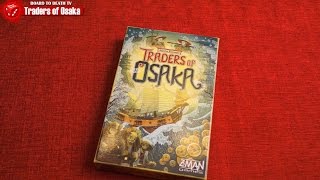
- fast and approachable play with a focus on tactical decisions
- clear path to victory with accessible mechanics for new players
- strong replay value due to color-based strategies and token options
- quality components and a compact package that plays well as filler or family game
- engaging for both core gamers and casual players without brain-melting complexity
- board art not as striking as the cover art
- color dominance can skew the market slightly and affect balance
- end-game scoring can feel intricate for absolute newcomers
- economic competition, set collection, and risk management in a trading environment with sea perils and token-based scoring
- Osaka during a historical Edo-period inspired merchant trade era, focusing on merchants shipping goods and navigating market forces
- tight, tactical, and competitive with minimal storytelling but strong theme through color-coded goods and ship tracks
Mechanics (from transcript analysis)
- buy Goods / market economy — Discarding gold allows players to acquire non-reserved cards from the market, which then contribute to monetary value.
- color dominance risk and offset options — Dominant colors can shift value across rounds; players can reserve high-cost cards to remove scoring advantages from leaders.
- End Game Bonuses — When a ship reaches the end of its track, a payday occurs where color-based goods and tokens are converted into victory points.
- endgame payday scoring — When a ship reaches the end of its track, a payday occurs where color-based goods and tokens are converted into victory points.
- Hand Management — Players draw cards to reach a target monetary value, balancing what to keep, play, or reserve for future turns.
- hand management / draw until gold — Players draw cards to reach a target monetary value, balancing what to keep, play, or reserve for future turns.
- insurance vs Black Tide — Players can insure goods by discarding matching color cards, mitigating losses when the Black Tide event reshuffles or sinks goods.
- low downtime, high engagement — The design minimizes downtime, keeps players engaged with visible market shifts, and ensures continuous interaction.
- reserve a card — Players may place a card on reserve to secure it from the market, creating timing pressure and blocking opponents.
- Set Collection — Players collect goods of different colors to complete color sets and maximize scoring value based on tokens and color counts.
- ship track advancement — Purchased goods of a given color advance the corresponding ship on a track, offering strategic progress and potential bonuses.
- Track Advancement — Purchased goods of a given color advance the corresponding ship on a track, offering strategic progress and potential bonuses.
Video topics + discussion points
Quotes (from this video)
- Traders of Osaka offers enough tactics and strategy to make it enjoyable for a quick game for core Gamers while being simple and inviting enough for beginner Gamers who don't want their brains to melt the first time playing a board game or even as a family game to get the young ones thinking
- it's a quick strategy game with very little downtime between players and always invested in what other players are doing
- Traders of Osaka has that classic feel to it that I think anyone can enjoy
- I think tactically the game offers some choices to offset that you can reserve High cards to remove those points from the eventual scoring player
- I wish they would have put a little more effort on the board art as they had done on the cover art
- 8 out of 10