
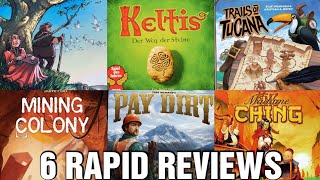









Trails of Tucana Deep Dive
What the Community Thinks About Trails of Tucana
Reviewers present Trails of Tucana as a light flip-and-write game with more puzzle inside it than its box suggests. Designed by the creators of Avenue and Doodle City, it earns its praise for being easy to teach and quick to finish. The Get into games channel calls it a simple game that you take to the table, finish, and move on from, and the Allies or Enemies hosts recommend it as a gateway game for new players. The Board Game Geek Podcast praises the game's variability and its presentation. Reviewers agree on the core appeal: a few shared card flips, a private map, and very little downtime.
The criticism is narrower and mostly comes from first impressions. The kovray hosts found their first session frustrating because they drew sand and rock terrains several times in a row, and they felt the game gives players no way to re-flip cards or shift their plans. Get into games raised a different concern, arguing that the game does not carry a large amount of theme. Even so, the community tone is warm. Reviewers return to the game repeatedly, and the Allies or Enemies hosts describe a set of house habits that their group has built up around playing it.
Core Mechanics That Define Trails of Tucana
Network and Route Building
Each player has a private map of the island Tucana, with villages and sights placed differently on every sheet. Players draw trails that gradually grow into a network of roads, and they score by connecting matching harbors and by linking sights to harbors. Being the first to connect a pair of harbors earns a bonus. Allies or Enemies notes that the trails pick up the various features found along the way, and that the island map is double-sided, so a group can start on the small island and move to the larger one afterward. Because every player builds a separate network from the same card flips, the same public information produces very different maps, which is why reviewers describe each game as a new puzzle.
Flip and Write Simultaneous Drawing
Each turn, one player flips over two terrain cards, and everyone then draws a trail between two neighboring spaces that show those terrains. Reviewers consistently point to the simultaneity as the engine of the experience. Because everyone draws at once, the table never waits on one player, and the shared reveal still gives each person a different problem to solve. The designers also vary how often each terrain appears in the deck, so mountain cards are rarer than desert cards. Players must plan for that imbalance and try to keep their options open for whatever combination comes up.
The Trails of Tucana Experience
Breezy and Unfussy
Get into games captures the feeling best when it describes the game as one you take to the table, get done, and move on from. The reviewer says the game is not overly complex and that it fits a happy, low-stakes session. The experience stays light even when the scoring rewards careful planning, and that sense of effortlessness is the reason reviewers keep returning to it on busy nights.
Fast and Snappy
The pace of play is the element reviewers mention most often. Allies or Enemies stresses that because everyone draws their lines at the same time, there is no waiting period, and the game flows rapidly from one reveal to the next. The hosts describe the feeling as a race, with each player trying to connect the most valuable routes before the others. Reviewers agree that a session moves quickly enough to be played again on the same evening.
What Makes Trails of Tucana Stand Out
The Bingo Feeling of the Terrain Flip
Allies or Enemies compares the terrain flip to bingo, because players are always hoping that a particular terrain will come up on the next reveal. The person who flips the cards becomes the focus of the table, and every reveal produces a burst of anticipation or disappointment. This shared tension, plus the emotional investment players bring to each flip, is one of the features that reviewers say sets the game apart from many other roll-and-write titles.
A Double-Sided Map and Replay Traditions
Allies or Enemies calls the map making instinctively fun, noting that nearly everyone enjoys drawing a map. The double-sided island board lets a group finish one session on the small island and then turn to the larger one on the other side. The same channel describes how its group built its own house traditions around the game, including songs that accompany the terrain cards and friendly teasing when a flip is not the one the table wanted. Those additions keep the game fresh for a group that has played it many times.
Potential Drawbacks
Luck and Blocked Routes
The most detailed criticism comes from kovray, whose hosts describe a first game in which they drew sand and rock terrains again and again and could not connect the paths they needed. They admit that the chances of that happening are low, yet the outcome still felt frustrating because the game gives players no way to re-flip cards or shift things around. One host liked that the game offers both a shorter and a longer version, and said that the lack of flexibility is a way the game could improve.
Limited Theme
Get into games is candid that the game does not carry a large amount of theme. The reviewer compares the feeling of play to an Indiana Jones style puzzle rather than a story, and jokes that the bird-themed flavor is limited, saying the game has not enough toucan. Players who want a narrative or a strong setting may find the abstract map more functional than immersive.
If You Enjoy Trails of Tucana
Players who enjoy Trails of Tucana's route building will find similar satisfaction in Next Station London, which Get into games describes as delightfully simple and a game that makes people want to return to beat their high score. Players who appreciate the shared-card puzzle will also find a kindred spirit in Rolling Realms, which Get into games describes as infinitely scalable and a game that can be played almost anywhere. For a more demanding alternative with a similar spatial focus, kovray calls Hadrian's Wall a fantastic game, and it is the title that channel returns to when it wants a deeper flip-and-write experience.
What Reviewers Are Saying
"What I really like about this is the simplicity of the game. It's not overly complex. It's take it to the table, you get it done, you do it, happy days, you move on."
— Get into games
"One of the things that works so nicely about it is everybody is drawing their lines at the same time, and so without having that down time it just flows really quickly."
— Allies or Enemies
"I think the reason I didn't enjoy it is because I went in thinking that I could do that, and then I ended up not being able to do it. There's not really a way to re-flip cards or shift things around, so maybe that's another way that game can improve."
— kovray