/pic4336095.png)










































Trajan Deep Dive
What the Community Thinks About Trajan
Trajan holds a remarkable position in the board gaming world, it's one of designer Stefan Feld's most celebrated games and consistently ranks in reviewers' personal all-time top lists. From casual enthusiasts to dedicated euro game aficionados, reviewers describe a deep, rewarding game that reveals new layers with each play. Many note that Trajan wasn't an instant love but grew into something they now consider essential to their collections. The game generates intense appreciation, with reviewers using words like "genius," "masterpiece," and "phenomenal" to describe its mechanical elegance. One consistent theme emerges: Trajan rewards players who embrace the complexity and punishes those seeking quick, easy decisions.
Core Mechanics That Define Trajan
The Mancala Action Selection System
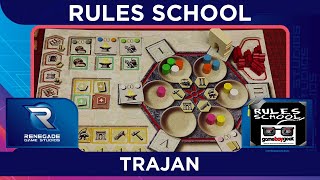
At the heart of Trajan lies an ancient mechanism adapted brilliantly for modern board gaming, the mancala. Each turn, players pick up all pieces from one of six bowls on their personal board and distribute them clockwise, one piece per bowl. Whichever bowl receives the final piece determines the primary action. This deceptively simple system creates profound strategic depth. The mancala forces players to think multiple turns ahead, planning not just what they want to do now, but where future token distributions will land. Every placement reverberates through the game's economy. Reviewers call this mechanism "incredibly satisfying" because pulling it off successfully, hitting the exact bowl you need while setting up future combos, delivers genuine intellectual reward. The spatial puzzle of managing the mancala never becomes repetitive across plays.
Multi-Action Mini-Games with Synergies
Trajan connects its mancala engine to six distinct action spaces representing mini-games: shipping (tableau building), military (moving a general across the map), construction (placing workers), senate (climbing tracks), forum (anticipating public demands), and tragedy prevention. Each feels almost like its own complete game, yet they interconnect seamlessly. The genius lies in how these mini-games reinforce each other through a token bonus system, if a player's colored markers match the bonus token on a bowl, they gain bonus actions and points. Successful strategies often involve orchestrating the mancala to trigger combinations: hitting the construction action with the right colors to unlock a forum bonus, then using those points to climb the senate. Reviewers describe this as point salad done right, there are so many ways to score that multiple viable strategies coexist, yet all require careful orchestration through the mancala.
The Trajan Experience
Intense, Brain-Burning Puzzle Solving
Trajan delivers what reviewers call a "brain burner", the kind of game that demands full mental engagement. Players must visualize the consequences of token placement, trace multiple action paths simultaneously, and wrestle with genuinely difficult decisions. This isn't a game for passive play or conversation during turns; it requires focus and planning. One reviewer noted that initially, the intensity felt exhausting, but with practice, the same brain-burning quality became deeply satisfying. The game rewards meticulous players who enjoy mapping out strategies and seeing them execute perfectly. The cognitive load creates a sense of accomplishment unmatched by lighter games. When a carefully planned combo sequence comes together, the payoff feels earned rather than lucky.
Tight Resource Economy and Meaningful Constraints
The timer mechanism in Trajan embodies constraint as creative force. Every time a player scoops tokens from their mancala, they advance a timer based on the number of tokens moved. At the end of each era, public demands must be satisfied, if the timer has advanced too far, penalties apply. This creates perpetual tension: players want to take powerful, multi-token actions but must consider the cost to the timer. Additionally, the set of available actions is limited; tokens in bowls dwindle as the game progresses, making early positioning choices irreversible later. This scarcity forces hard decisions. Reviewers emphasize that you cannot waste any turns, the game's tightness means every decision carries weight. This economy prevents runaway leaders; behind players can catch up through efficient mancala manipulation while ahead players must carefully defend their position without overextending the timer.
What Makes Trajan Stand Out
Mechanical Elegance in Theme and Function
Trajan's mechanism and theme align perfectly. The historical setting of ancient Rome and the senator's career path aren't mere window dressing; they provide narrative coherence to the otherwise abstract system. Players participate in trade, military campaigns, construction, senate politics, and public forums, activities an actual Roman senator would undertake. Yet the theme never gets in the way of the mechanical purity. One reviewer described it as a "stuffy themeless euro," a backhanded compliment acknowledging that mechanics matter more than aesthetic immersion, yet the theme doesn't detract from enjoyment. This balance is rare. The game prioritizes design elegance: nothing unnecessary exists in the ruleset; every component serves a purpose. The mancala becomes not just a mechanism but a thematic representation of a senator managing their influence and obligations.
Endless Strategic Depth and Replayability
Trajan offers remarkable strategic flexibility. The six action spaces can be prioritized in countless ways, creating wildly different games. One player might dominate the military and forum, another might focus on shipping and construction. Yet both can win through careful planning and token manipulation. Reviewers note that this game never plays the same way twice, the interaction between players' timer advancement, available bonuses, and card variations ensures novelty across hundreds of plays. The game rewards mastery; experienced players consistently outperform newcomers by understanding optimal token flows and synergies. However, luck plays no role, the winner earns the victory through superior planning and execution. This combination of consistency (no randomness) with endless variation (in strategies and optimal paths) explains why Trajan appears on so many all-time lists. Players who loved it ten plays ago still discover new approaches in play number fifty.
Potential Drawbacks
Demanding Cognitive Load and Analysis Paralysis Risk
Trajan's depth comes at a cost: it's demanding. New players often feel overwhelmed by the number of action options, the need to plan multiple turns ahead, and the interaction between the timer and token distribution. The game punishes Analysis Paralysis hard, players who spend too long calculating optimal paths slow the game significantly. Reviewers mention that playtime can extend well over the two-hour mark with inexperienced groups, especially at four players. Additionally, the deterministic nature means there's a right way to play optimally, and experienced players can make newcomers feel hopelessly outmatched. If a player prefers games where they can switch off mentally or enjoy social conversation throughout, Trajan's intensity makes it an uncomfortable choice. The game demands full engagement; you cannot multi-task or half-pay-attention without significantly diminishing your chances and the experience.
Aesthetic Presentation and Thematic Disconnect for Some
Trajan's presentation is austere. The board lacks visual drama; components are functional rather than gorgeous; the ruleset and complexity can feel intimidating when first opened. Reviewers describe it honestly as "stuffy" and "crawled out of a cave", acknowledging that looks alone won't sell the game to casual players. The theme, while coherent with mechanics, isn't exciting in the way games about space exploration or fantasy quests might be. For players seeking narrative immersion, the game's dominance of mechanical puzzle-solving over story can feel dry. Players who love beautiful production, rich thematic narratives, or faster gameplay will likely bounce off Trajan regardless of its mechanical quality.
If You Enjoy Trajan
Board gamers drawn to Trajan typically gravitate toward other Stefan Feld games that share his design philosophy. Castles of Burgundy, while using dice rolls instead of mancala, delivers similar brain-burning euro play with multiple scoring paths and optimization puzzles. Bora Bora offers Feld's signature tightness and difficult decisions in a different strategic space. The Oracle of Delphi provides racing and routing mechanics with satisfying puzzle elements. Beyond Feld, Concordia and Puerto Rico deliver similar action selection depth without randomness. Keyflower combines worker placement with auction mechanics, while Caverna offers a comparable sandbox strategic space.
What Reviewers Are Saying
"Trajan is almost a series of mini games that use a Mancala action selection. All these actions work differently. There's shipping, military action, construction route, another bonus tile from the tangent, tiles from the forum, or advance your political career through the Senate action. Since I first played Trajan over a decade ago, it has always been in my top five games, and each time I play this, I remember just how much I like this game and why it's my number one game of all time."
— The Dice Tower
"When I did start to feel it, to understand what the game was about, it really did start to resonate with me. I started to think this game is so clever. There's nothing else really like it out there. Yes, it's punishing, but that is where the fun lies. By the end of the game you just feel like you've been dragged through a hedge. Trajan at number two is a game that objectively is so good and one of the best games ever made."
— Chairman of the Board
"If you like weird funky mechanics, like heavy euros or medium euros, and you just like exploring new things, this is one that I think is gonna reward that. Once everybody's able to get through all of those barriers that the game's putting in the way of player interaction, I think on purpose, it becomes really pleasurable to play it against other players who have the same experience of the game with you. Just a really weird, funky, crazy game and I really do enjoy it."
— Drive Thru Games