/pic3727022.jpg)
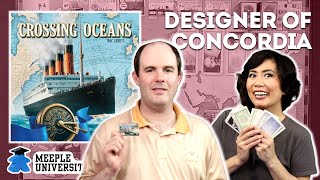
From the opening of the Suez Canal in 1869 to the beginning of WWI in 1914, there was an amazing development of bigger, faster, and more modern steamships. Whereas in 1870 there are still many clippers around and the good old paddle steamer "Scotia" sails the North Atlantic, sea trade is dominated by the end of this era by huge vessels like "Mauretania"(Cunard), "Olympic"(White Star), or "Imperator"(Hapag).
In Transatlantic, 2 to 4 players lead their own shipping companies, which transport freight, mail, and passengers around the globe. They purchase new steamships from the market, each of them historical with their individual technical data (tons, knots etc.). Competition is tough, especially in the North Atlantic where winning the "Blue Riband" is not only a matter of prestige, but may also be a profitable investment. In order to let a shipping company flourish, purchasing the best steamships is not enough, if one fails to acquire enough coal bunkers and trade posts as well.
The game is driven by cards; on each turn, play one card and execute the related action. As new cards enter the game, build your individual deck of cards with new or improved possibilities. The task is to manage your merchant fleet most efficiently. It's a maritime strategy game with low luck, lots of interactive choices, and tough decisions.



- promising return to a beloved concept
- map-based, revised rules
- re-implementation with a map and streamlined rules
- Transatlantic (original)
- Concordia
Mechanics (from transcript analysis)
- card play with map — ships sail to ports; contracts give bonuses; score via multiple goals
- map-based route planning — ships sail to ports with contracts and score-based goals
Video topics + discussion points
Quotes (from this video)
- "it's heavy but it only has one resource and that's money"
- "it's fully cooperative and you all play as robots that are trying to essentially take down the human corporations"
- "this is now a multiplayer experience it's not just two players"
References (from this video)
Mechanics (from transcript analysis)
Video topics + discussion points
Quotes (from this video)
- this is kind of an updated version of transatlantic
- it's a game of picking your actions at the right time
- there's a rondle for actions
- the blue band was a real award that was given for the fastest transatlantic Crossing
- this is a passion project
- there's a lot of shipping history in this game
- everyone goes into specialization
- the money... they almost fail Unfortunately they are fake because they all have the same serial number
References (from this video)

- Extensions add new action options or upgraded versions of existing actions.
- Fleet extension provides mid-game scoring based on active ships with different flags.
- Blue ribbons (fastest ships in a region) grant additional scoring milestones.
- End-game scoring heavily emphasizes ship deployment, docked ships, and token-based rows, rewarding broad strategic planning.
- Ship agents allow copying of others' actions, increasing strategic depth.
- Scrapping ships yields points from ships in docks and from colored ships, creating a dynamic endgame scoring thread.
- Region scoring and multiple ports offer varied tactical paths and scoring opportunities.
- Commerce and trading houses generate substantial income and can swing the game when used aggressively.
- End-game costs for ships rise over time, constraining late-game purchases and forcing tougher decisions.
- The game features complex resource management (coal, tokens, multiple card types) that can be challenging to track.
- High dependency on correct timing of director/extension cards, which can be risky and punishing if misplayed.
- shipping companies compete to acquire ships, transport goods across the Atlantic, and accumulate victory points and money
- around the turn of the 20th century
- teaching-through-play during a live playthrough
Mechanics (from transcript analysis)
- blue ribbons and fastest ships — Certain ships can earn blue ribbons (fastest in a region), awarding additional points.
- card-driven ship market and deployment — Players purchase ships from a market and deploy them to various ports on the Atlantic map.
- cargo and specialized cards — Cargo and other specialized cards create varied income and region-based scoring opportunities.
- coal bunkers and coal management — Ships require coal to activate; coal bunkers are distributed and must be allocated evenly among ships with limits on coal per ship.
- Compound Scoring — Some extensions (like Fleet) provide mid-game scoring based on active ships with different flags.
- director and extension cards — Director cards refresh hands and unlock extensions; extensions add new actions or upgrades to existing ones.
- fleet-style scoring through extensions — Some extensions (like Fleet) provide mid-game scoring based on active ships with different flags.
- Multi-Use Cards — Director cards refresh hands and unlock extensions; extensions add new actions or upgrades to existing ones.
- regions and regional scoring — Activations in regions score money and points; various regional bonuses apply, including oldest foreign ship bonuses.
- scrapping ships and end-of-round scoring — Scrapped ships yield victory points, with additional points from ships in docks and color-based bonuses.
- shipyard action — Shipyard actions allow purchasing ships, after which the market is replenished with new ships.
- Trading houses and tokens — Trading houses provide entry points and money; tokens (mail, passengers, freight) contribute to scoring and income.
- transport actions — Players transport ships to gain income and victory points; some transports require coal to activate.
Video topics + discussion points
Quotes (from this video)
- Transatlantic is a card game
- this is a really good way for us to get money
- the game is going to end once we've gone through this entire deck
- making copy the last card played by an opponent
- blue ribbon now in New York, the fastest ship in that specific region