/pic750583.jpg)
/pic4843828.jpg)
/pic750583.jpg)
































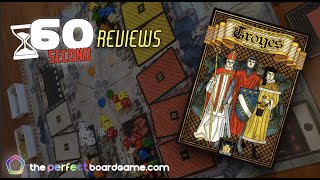








Troyes Deep Dive
What the Community Thinks About Troyes
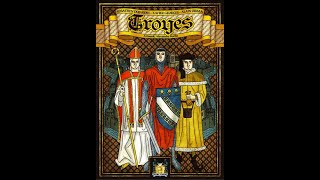
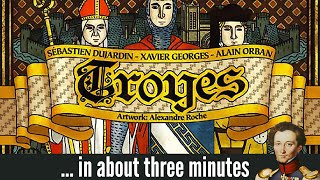
Reviewers who cover Troyes treat it as a mechanically dense dice game that holds up across many plays rather than a casual pickup. 3 Minute Board Games frames it as an older design built around dice drafting and location-based worker placement, where the city's three estates of nobility, clergy, and commoners have to be managed while invaders are kept at bay. The channel praises how little raw luck factors into who wins, arguing that the dice pool rewards players who study the board and plan several steps ahead.
The Board Game Garden places Troyes among a personal list of favorite games and singles out its hidden endgame scoring as the reason for wanting to return to the table, calling the game fantastic even though it has been a while since a play. Chairman of the Board keeps Troyes in an active collection alongside the Ladies of Troyes expansion and reports that repeated plays only deepen the appreciation for it, describing it as a mechanical, dice-driven Euro.
None of the three channels disagree about whether Troyes works as a design. The only real friction 3 Minute Board Games raises is about tone rather than mechanics: the game leans entirely on its dice and location systems, and the historical setting does not carry much narrative weight on its own.
Core Mechanics That Define Troyes
Dice Drafting
According to 3 Minute Board Games, players start each round by placing workers in three main buildings, which determines how many dice each player rolls that turn. Once dice are rolled and placed into a personal area, event cards force players to sacrifice dice to a shared pool of invader dice, with the player controlling the highest roll giving up the most. From there, the action phase turns dice into the currency for nearly everything: white dice build the cathedral, yellow dice unlock location powers when gathered in multiples of four, and dice can be spent to bump an opponent's worker off a building space. Players are not limited to their own dice either; spending money lets a player use a die that belongs to someone else, though the cost rises the larger the set of dice already gathered there.
Hidden Objective Scoring
The Board Game Garden highlights a scoring layer sitting on top of that dice economy: each player holds a personal hidden objective, and because every player's hidden objective is ultimately scored by everyone at the table, working out what an opponent might be chasing becomes part of the puzzle. That secrecy is what The Board Game Garden points to as the part of Troyes worth falling in love with. 3 Minute Board Games describes the same system from the other direction, noting that Troyes hands out secret objectives that steer each game down a different engine-building path, so no two sessions push toward the same combination of locations.
The Troyes Experience
Adapting to a Changing Board
3 Minute Board Games describes Troyes as a game that rewards players who study the board state and make smart decisions about which dice to take, since locations only pay off when picked in combinations that synergize with each other. Because multiple cards can occupy any given location and there is no fixed path through the game, the channel notes that players have to re-evaluate their plans every time a new location card is revealed, keeping the puzzle fresh from one turn to the next.
A Tug of War Over Dice
The dice economy also drives the social texture of a session. 3 Minute Board Games calls taking other players' dice the best thing about the game, saying it adds a lot of tension to the table, since every die claimed from an opponent both advances one plan and sets another one back. That same interaction cuts the other way for some players, who feel the sting of watching their own dice taken away right when they needed them.
What Makes Troyes Stand Out
Secret Objectives That Reshape Every Game
Both channels that discuss Troyes in depth point to its hidden objectives as a defining feature. The Board Game Garden describes trying to read what other players are quietly working toward, since everyone's secret goal is scored across the whole table at the end. 3 Minute Board Games frames the same system as a way of forcing a different engine-building path each time the game is played, rather than settling into one dominant strategy.
Turn Order Without a First-Player Penalty
3 Minute Board Games specifically calls out how Troyes handles turn order in a placement game: the usual advantage that goes to whoever moves first is negated by the invader dice mechanic, since the earliest player in the turn order also has to deal with the toughest consequences from the event cards. That balancing act is presented as one of the design's smarter touches.
Potential Drawbacks
A Historical Setting That Stays in the Background
3 Minute Board Games is direct about where Troyes falls short thematically: it is not a thematically rich experience, and the setting amounts to a veneer over what is fundamentally a game about dice mechanics and how players choose to spend them. Anyone drawn to the game expecting a strong narrative layer about the city itself may come away wanting more.
Losing Dice Can Sting
The same interaction that 3 Minute Board Games calls the best part of the game is also flagged as a potential turnoff. Losing dice to other players is uncomfortable for some, and the channel is upfront that players who dislike having their plans disrupted by an opponent's choices might not enjoy Troyes as much as others do.
If You Enjoy Troyes
3 Minute Board Games draws two direct comparisons for viewers who like what Troyes does. Black Angel is described as a sci-fi game with similar ideas from the same designers, giving fans of the dice system a way to revisit it in a different setting. For a different take on dice placement altogether, the channel points to Circadians: First Light as another game worth trying.
What Reviewers Are Saying
"Troyes is one of those dice games with very little luck involved and it will reward players who can study the board state and make smart decisions about what dice to take. Placing workers in locations means each location choice is important and you want ones that synergize together to create powerful combinations."
— 3 Minute Board Games
"I really love that part of the game. I need to play Troyes again. It is fantastic."
— The Board Game Garden
"Troyes, which I do have the Ladies of Troyes expansion. And again, the more I play this one, the more I just love it. It's such a great, a very mechanical dice driven Euro."
— Chairman of the Board