/pic7243922.jpg)























Tumblin-Dice Deep Dive
What the Community Thinks About Tumblin-Dice
Tumblin-Dice has earned widespread admiration in the board gaming community as one of the most reliable social hits in modern tabletop design. Reviewers consistently praise it as one of the biggest hit filler games, highlighting its ability to transform casual social gatherings into energetic, memorable experiences. The game has proven itself equally effective with complete strangers at awkward social events and with families spanning ages from toddlers to grandparents in their 80s. What makes this recognition notable is not just its entertainment value, but its consistent ability to engage groups regardless of gaming experience or preference.
Core Mechanics That Define Tumblin-Dice
Flicking and Rolling for Compound Scoring
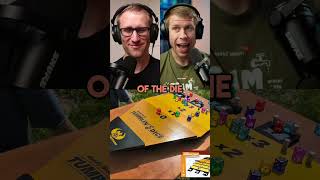
At its heart, Tumblin-Dice asks players to flick or roll dice down a tiered wooden board, where the physics of play collide with arithmetic to create unpredictable outcomes. Players earn points equal to the die face value multiplied by the zone multiplier where the die lands. A six landing in the times-four zone yields 24 points, but a single pip in that same zone earns just four. This compound scoring system is deliberate design, serving a specific purpose: it prevents the game from becoming purely a test of physical skill like Crokinole or similar dexterity games. Instead, it introduces meaningful chance that keeps less-skilled players competitive without eliminating the advantages of refined technique.
Interaction Through Interference
The second defining mechanic is the opportunity for players to interfere with each other's dice. When it's a player's turn, they may choose to knock opponents' dice off the board entirely, negate their points by flicking the die to a lower-scoring zone, or flip a die to a different face value. This creates moments of spectacular chaos and memorable gameplay: a player who set up a high-value score finds their triumph reversed by an opponent's well-placed shot, or a weak roll suddenly becomes valuable after being knocked to a higher-scoring level. This interference transforms what could be a solo puzzle into a shared, interactive experience where every player remains invested in every turn.
The Tumblin-Dice Experience
A Generator of Unscripted Excitement
Reviewers repeatedly emphasize the uncontrolled energy that emerges around the table during Tumblin-Dice. The game has so many moments of unexpected excitement, driven by the uncertainty of what each flick will produce. A perfectly executed shot that lands in a premium zone might yield double the points expected, or the die might tumble one level further and reward the player exponentially. The game thrives on these unpredictable outcomes, creating natural peaks of celebration and commiseration that bind players together in shared reactions.
An Icebreaker and Connector
Beyond mechanics, reviewers highlight Tumblin-Dice's remarkable social function. It serves as a reliable tool for breaking tension in groups where players don't know each other. One reviewer noted that in an awkward social situation where they don't know some of these people, Tumblin-Dice can almost instantly transform it into a fun shared dynamic. The game's physical, action-oriented nature reduces the cognitive barriers that sometimes prevent people from connecting over strategy-heavy games. Players focus on the satisfying feeling of executing a good flick and reacting to the immediate results, rather than planning several turns ahead. This accessibility makes it genuinely inclusive without sacrificing depth for those who want to pursue aggressive strategies or perfect their technique.
What Makes Tumblin-Dice Stand Out
Universal Age Compatibility Rare Among Games
Few games in any designer's catalog can accommodate a two-year-old and an eighty-year-old in the same session, yet Tumblin-Dice achieves this with grace. The young child benefits from the immediate, concrete feedback of dice landing in zones and the joy of causing physical movement on a game board. The elderly player engages with the skill element of directional control and can employ years of coordination experience to influence outcomes. The younger player is never made to feel helpless by the older player's superiority, because the die face ensures that perfect technique doesn't guarantee the highest score. Reviewers have celebrated this multi-generational appeal as genuinely rare and valuable, particularly for family game nights where age spans are typical.
Instant Teachability, Genuine Engagement
Tumblin-Dice can be taught in approximately five seconds: here are your dice, you're flicking, this is what you're trying to do. No reading of cards, no tracking of abstract resources, no asymmetric player powers to understand. Yet despite this extreme simplicity, the game sustains engagement across dozens of plays. The decision-space may be small (where to aim, how hard to flick, whom to target), but each decision matters, and the physics engine of the board ensures sufficient novelty that players encounter fresh board states repeatedly. One reviewer played it over 100 times in a concentrated period with family, and another notes that when the game comes out, groups typically play it multiple times in succession rather than moving on.
Potential Drawbacks
Component Durability and Maintenance
As a dexterity game relying on wooden construction and physics, Tumblin-Dice does face practical challenges. The tiered board requires careful setup; pieces must align smoothly so dice can roll without catching. Over time, repeated flicking, dice bouncing, and accumulating dust or wear can affect the precision of play. The dice themselves, subjected to hundreds of impacts, may eventually become dinged or warped in ways that subtly affect their roll. This is not a game that tolerates neglect; it demands respectful handling and occasional maintenance to remain in optimal condition. Players in high-traffic community spaces or casual gaming environments should be aware that the game requires more care than a card game.
Physical Space and Skill Variance at Higher Levels
While the randomness of the die roll keeps the game competitive across skill levels, players who invest significant practice can develop notable advantages in shot placement and consistency. One reviewer explicitly notes the tension this creates: if you remove the die-roll element entirely, the game could feel a lot more like Crokinole, where the best players win almost every time. For groups with one player who has practiced extensively and others playing casually, this can create a slight imbalance, though the reviewer acknowledges this is an acceptable trade-off given what the die roll brings to accessibility. Additionally, the game requires a clear, level table surface with adequate space for the board and standing room for players to execute their shots. It is not portable to the extent that a card game is, and crowded venues may prove challenging.
If You Enjoy Tumblin-Dice
Those who love Tumblin-Dice often gravitate toward other dexterity games that blend physical skill with chance, such as Strike (another fast dice-flicking game with similar group energy) or Crokinole (for those seeking a deeper, one-on-one skill challenge). Players who appreciate the filler game role that Tumblin-Dice plays may also enjoy compact games like Sushi Go Party, though these rely on different mechanics. For those interested in the compound scoring concept or push-your-luck tension, Quacks of Quedlinburg and Cubitos offer more strategic depth while maintaining the excitement of uncertain outcomes. However, reviewers consistently suggest that Tumblin-Dice is in a category of its own for sheer ability to generate unforced group enthusiasm and cross-demographic appeal.
What Reviewers Are Saying
"This is one of the biggest hit filler games. The energy around the table for Tumblin-Dice is pretty incredible. It takes about five seconds to teach, and it's just fantastic for that quick, exciting experience. You're pretty much guaranteed to have a great time."
— Rolls in the Family
"It's a very simple dexterity game that's sort of barely a game, but I like it. I think it's fun. There's a little bit of strategy of trying to roll it hard enough to land in an area that you want, and you can knock into opponents to knock them off the board or change the face of their die."
— BoardGameGeek
"There's really no other game I have that has quite the age range it supports. We've literally had games with a three-year-old and someone in their 80s in the same game. It just strikes a perfect balance where players who like the skill of it can lean into that, and young people or people who just don't want to care that much can just play, and the randomness allows them to still compete and have exciting moments."
— Rolls in the Family