










































Tzolk'in: The Mayan Calendar Deep Dive
What the Community Thinks About Tzolk'in: The Mayan Calendar
Reviewers who have actually sat down with the gears agree on one thing: there is nothing else quite like this worker-placement game. All You Can Board called it one of the most unique worker placement games in their collection because of the gear system, insisting it is not just a gimmick. Board Game Dad admitted they had avoided the game for years because it looked abstract and simplistic, and only changed their mind after trying it on Board Game Arena, at which point they realized how unique the timing mechanic really is and ranked it as a top worker-placement pick. Tabletop Turtle's Mike and Kim spent much of their review marveling at how differently the game handles time, framing it as an old design that still has something modern worker-placement games do not offer.
Where the channels split is on the feeding mechanic. Mike said outright that they have never been a big fan of the feed-your-worker system and finds the round in which players must feed their workers simply unenjoyable, comparing the idea to Agricola. The All You Can Board host agreed that feeding is probably one of the least favorite parts of the game, though they said they had played enough to manage it by collecting bonus tiles that remove the need to feed. That same reviewer also flagged a pacing problem the other two did not raise: a stretch in the middle of the game that sags compared to the opening and closing thirds, even while insisting the overall experience is still so much fun.
Core Mechanics That Define Tzolk'in: The Mayan Calendar
Dynamic Worker Placement on the Gears
Tabletop Turtle explained that on a turn players either place workers on one of the connected gears or take workers off a gear, and once everyone has gone, the central gear advances one day, moving every worker on every gear forward and changing the actions available to them. Board Game Dad summarized the core tension of this system directly: on your turn you can either put a worker down on a space or pick a worker up, and while a worker sits on the board, the gears are turning and that worker's eventual action is becoming more and more valuable, so a player has to time things just right.
Feeding Workers and Resource Management
Mike described the corn-based feeding system as one where players collect resources and build buildings while gaining favor with the gods, but are then required to pay to feed the workers they have put to work, a requirement they compared to a similar mechanic in Agricola. The All You Can Board host added that the game is not purely punishing about this: there are bonus tiles that let a player avoid having to feed workers at all, which changes how harshly the feeding requirement actually bites once a player knows how to manage it.
The Tzolk'in: The Mayan Calendar Experience
Long-Term Planning and Tension
All You Can Board described constantly having to reconsider a plan already in motion: a worker gets placed with one spot in mind, and then the game evolves over the next few turns so that the spot is no longer wanted, forcing a decision about whether to pull it off somewhere else or abandon the plan entirely, all while trying to think turns ahead in a system where that is only ever partly possible. Mike made a similar point from the other side of the table, noting that this game is very much about putting a worker out with the expectation that it might sit there for four, five, or six turns, which they said creates a lot of interesting decisions precisely because the immediate gratification common to newer worker-placement games is absent here.
A Highly Interactive Worker-Placement Game
Mike argued that the gears create a distinct kind of player interaction: placing a worker can block an opponent from an action, but that opponent is not entirely shut out, because they can still reach the same spot by paying to skip ahead on the gear instead. Mike also pointed out that a player can place or remove several workers from a gear at once, which lets a player deliberately crowd a wheel to deny multiple actions to everyone else, at a cost.
What Makes Tzolk'in: The Mayan Calendar Stand Out
A Mechanism Unlike Any Other Worker-Placement Game
All You Can Board called it one of the most, if not the most, unique worker-placement game in their collection because of the gear system, stressing that the mechanism could easily have been a shallow gimmick and instead holds up on repeated plays. Board Game Dad made nearly the identical point from a different angle, saying there is no other game they have played with a mechanic quite like it, and that the way time itself affects a worker's value is what earned Tzolk'in a spot on their list of spectacularly unique worker-placement games.
Painted Gears and Striking Production
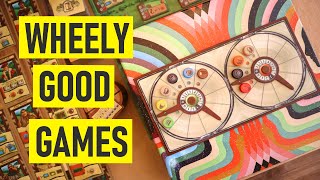
Mike singled out the physical gears as the game's standout component, calling a painted gear breathtaking and saying it elevates the whole game, to the point that they think the hobby of painting these gears has become part of the game's appeal for people who own a copy. Kim agreed the presentation is a treat to look at, adding that the game would stop people at a convention table even if they knew nothing about it going in.
Potential Drawbacks
The Punishing Feed-Worker Mechanic
Mike was the most pointed critic of the feeding requirement, saying they do not want to pay what amounts to worker wages and that no one ever looks forward to the round in which workers must be fed, describing the whole idea as simply never fun. The All You Can Board host did not go quite that far, but agreed feeding is probably one of their least favorite parts of the game, a rare point of agreement between two otherwise very different reviews.
A Sagging Midgame
All You Can Board pinpointed a specific structural weakness: they are far more enamored with the first third and the last third of a game of Tzolk'in than with the middle stretch, where the game can feel like it is largely playing itself while everyone quietly formulates a strategy before the scoring finally starts to matter again near the end.
If You Enjoy Tzolk'in: The Mayan Calendar
Both Mike at Tabletop Turtle and the host of All You Can Board reached for the same comparison when discussing the feeding requirement: Agricola. Mike guessed that the mechanic of paying to keep workers fed traces back to Agricola, and the All You Can Board host made the same connection while explaining how collecting the right bonus tiles lets a player avoid the kind of inescapable feeding pressure Agricola is known for.
What Reviewers Are Saying
"It's not something I'm terribly excited to play, but it is always something that I'm down to play maybe once or twice a year. I do like to bust it out, and I do like to show it to new players whenever I have people who aren't too familiar with board games. I would never go so far as to call this game a gateway game, but it's at a weight of complexity in which I think it's easy to teach."
— Tabletop Turtle
"And then at the end of the game, when you're starting to really care about the scoring, you're like, how much am I going to accomplish, because this game, the dial is getting closer. So I'm using your crystal skulls to get on that one track for the big one grabs, and so that's super interesting."
— All You Can Board
"This is a medium. It's a thoughtful strategy game with very little luck, and I love games that have a deep amount of strategy. In this game, you can either do one of two things: you can either put a worker down on a space or pick a worker up."
— Board Game Dad