/pic6385752.png)





















Unsurmountable Deep Dive
What the Community Thinks About Unsurmountable
Unsurmountable has earned respect from the board gaming community as a meticulously designed solo puzzle experience. Reviewers consistently praise Scott Almes' masterful implementation of a deceptively simple concept: construct a climbable mountain from limited resources under escalating constraints. The game generates a spectrum of reactions, from enthusiastic solo players who relish its spatial challenges to those who find its information density overwhelming. Despite mixed personal preferences, reviewers acknowledge Unsurmountable as a technically sound puzzle that successfully delivers on its premise.
Core Mechanics That Define Unsurmountable
Path Building and Spatial Reasoning
At its heart, Unsurmountable is a route-building puzzle where players construct a pyramid-shaped grid of terrain cards ascending from base camp to summit. Players must establish a continuous path from any bottom edge entry point to the top card, considering card placement constraints, path connectivity, and spatial orientation. Each card features bidirectional pathways that must align with neighboring cards to form a viable route. The puzzle intensifies because placement decisions cascade: early mistakes limit options in later turns, and finding multiple valid paths becomes progressively harder as available space contracts.
Ability Cards and Strategic Flexibility
Rather than always placing the available card, players may discard it to trigger one of four core abilities: rearrange base camp cards for better options, swap mountain cards with base camp reserves, remove problematic cards entirely, or use a helicopter card to reorder the deck. These abilities offer crucial problem-solving tools but come with costs. Removing cards shrinks the pyramid; swapping can disrupt existing paths; rearranging consumes turns. Skilled play involves recognizing when to exercise flexibility versus when placement is mandatory, creating a tension between immediate progress and preserving long-term options.
The Unsurmountable Experience
A Portable, Time-Efficient Challenge
Packaged in Button Shy Games' compact wallet format with just 18 cards, Unsurmountable fits into a coat pocket yet delivers 20-40 minutes of focused mental effort. The game respects players' time investment: rounds progress swiftly once decisions are made, and the puzzle structure naturally escalates difficulty without artificial padding. Reviewers appreciate the portability paired with genuine gameplay depth, making Unsurmountable an ideal pick for commutes, travel, or casual gaming moments that demand intellectual engagement without requiring a dedicated two-hour session.
Difficulty Scaling and Replayability
The base game presents Level One challenges, but Unsurmountable includes four additional difficulty tiers that progressively restrict placement freedom and increase complexity. Higher levels introduce card restrictions, feature limitations, and layered objectives that transform familiar mechanics into substantially harder puzzles. Expansions like Dual Peaks and The Big Climb further extend replayability by introducing second mountains or larger pyramid structures. This scaffolding ensures the game scales from newcomers tackling introductory puzzles to veterans chasing mastery on brutal difficulty levels.
What Makes Unsurmountable Stand Out
Elegant Design from a Respected Creator
Scott Almes has become synonymous with exceptional solo board game design, and Unsurmountable exemplifies his philosophy: distill complex spatial reasoning into a minimal component count without sacrificing depth. The game avoids text-heavy cards and instead relies on symbol-driven clarity, allowing players to focus on puzzles rather than rulebook navigation. Reviewers highlight how every card serves the puzzle rather than padding the game, and how the theme, building a mountain path while weather and circumstance reshape the landscape, naturally emerges from mechanics rather than feeling pasted on.
The Tension Between Simplicity and Challenge
Unsurmountable occupies a sweet spot between elegance and brainburn. Setup takes two minutes, rules fit on a single page, and core gameplay loops require no table bookkeeping. Yet the puzzle difficulty can rival heavier spatial reasoners like Patchwork or Food Chain Island. Community members consistently mention the satisfying paradox: games where newcomers can grasp the objective in seconds but spend twenty minutes wrestling with spatial impossibilities represent the highest achievement in puzzle design. Unsurmountable delivers exactly that balance.
Potential Drawbacks
Information Density and Visual Clarity
While reviewers praise the game's compact footprint, some note that the base camp row and emerging pyramid can feel visually cluttered, particularly during multi-card sequences. The small card size and requirement to track path connectivity across multiple orientations demands focused attention and careful card placement. Players new to the game sometimes struggle to mentally model how upcoming cards will interact with existing layouts. Improved visual organization or larger card versions could mitigate these concerns, though the wallet-game format inherently constrains physical space.
Luck and Variance
Card draw order meaningfully impacts puzzle difficulty. A hand of cards with poor path connectivity or incompatible abilities can force unfavorable ability usage, while well-matched card sequences permit elegant solutions. Reviewers note this variance can occasionally lead to unwinnable positions, particularly on higher difficulties where card restrictions compound the challenge. Some players view unpredictability as thematic realism, mountains are inherently unpredictable, while others prefer puzzles with guaranteed solvability. Multiple difficulty levels and deck composition options allow players to tune variance to preference.
If You Enjoy Unsurmountable
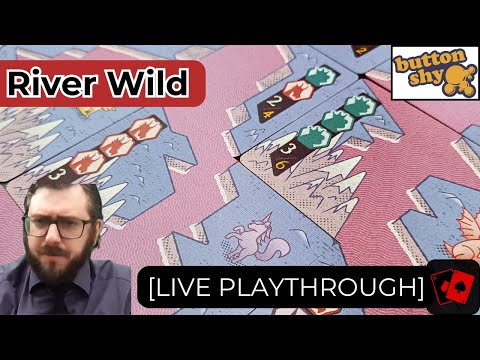
Players drawn to Unsurmountable typically appreciate puzzle-first design where mechanics serve the intellectual challenge. Excellent alternatives include River Wild, a lighter Button Shy tile-placement game where players build river paths with minimal text overhead; Food Chain Island, a card-driven ecosystem puzzle by the same designer with deeper spatial dynamics; Noureopolis and the broader Obelisk game family, which layer spatial reasoning with objective cards in approachable formats; and Tides, a minimalist print-and-play route-building experience. For solo enthusiasts seeking variety, Ugly Gryphon Inn (managing tavern guests) and Rove (manipulating board patterns) represent complementary solo experiences from Button Shy's acclaimed catalog.
What Reviewers Are Saying
"It's a well-designed game, it's playable, it's appropriate in terms of length, and the challenge feels right. I was really expecting to love this one because of how much I enjoy tile-placement games, but it just missed the mark for me because there was a little bit too much going on, it felt kind of finicky."
— Tabletop Tokki
"This is an excellent winter-themed solo game where you can play all alone, and you don't need anybody else who thinks winter games don't exist to play with you. Every single card has a trigger that you're going to be triggering, so it might increase the size of the base camp."
— Foster the Meeple
"It's a solo game where you're building out kind of like a mountain with different pathways and you're trying to get up to the top. It's a very fun solo game that has a yeti on the cover, and yetis only come out in the winter."
— Foster the Meeple