

























Up or Down? Deep Dive
What the Community Thinks About Up or Down?
Up or Down? has landed on tables as a compact, visually striking card game that draws praise for its clever scoring system and its uncanny ability to generate table conversation. Published by Stonemaier Games and designed by Wolfgang Kramer and Michael Keisling, the game earns consistent admiration for its elegant structure and gorgeous elevator art, though reviewers are split on just how much tension they want in their lighter card games. For some, the experience is breezy and social; for others, it tips into a particular kind of pleasing frustration where the card you need is always one step out of reach. That divide, rather than any fundamental flaw, seems to define the game's reception.
Reviewers across the spectrum agree that Up or Down? is easy to teach, plays briskly, and rewards players who understand its dual scoring axes: column length and color concentration. What separates the fans from the fence-sitters is how they feel about a drafting loop that is deliberately indirect. The Dice Tower's Wendy Ye described it as a game you can enjoy while still holding a conversation, giving it an eight because it fills a specific social niche in her collection. The Dice Tower's Joey Evans placed it at a six, calling it fine but not something he would actively seek out. Between those poles, most reviewers land somewhere genuinely warm, appreciating the game for what it is rather than wishing it were something heavier.
Core Mechanics That Define Up or Down?
The Circular Draft
The central mechanism that makes Up or Down? feel distinctive is its card placement ring. On each turn, a player plays a card from hand into a shared circle of cards arranged in ascending order, sliding it into the numerical gap where it belongs. That act of placing unlocks the real payoff: the player then takes either the card immediately to the left or the card immediately to the right of where they just played. That neighboring card, not the card in hand, is what goes into the personal tableau. This indirect drafting loop is the game's beating heart, and reviewers consistently highlight it as the source of both the game's appeal and its friction.
Jamie from Stonemaier Games pointed to the open drafting element as the reason the decision space stays interesting despite the game's light footprint. Because you are trading a card to gain a different card, every placement is a small negotiation between what you have and what you can reach. The Dice Tower's Chris noted that every turn can swing between joy and agony: sometimes the gap in the ring is enormous, letting you drop in almost any card and walk away with something useful; other times the gaps are tight, and the card you need sits just one step beyond what you can access. Board Gaymes James called the intermediary placement a source of strategic depth, because the route from hand to tableau is never direct and requires thinking ahead at least one step.
Compound Scoring and Color Focus
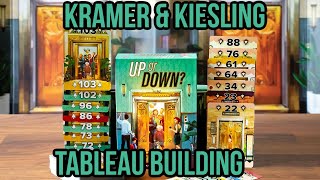
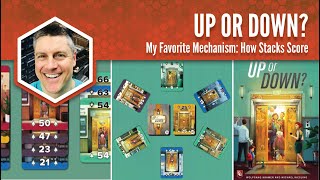
Scoring in Up or Down? is multiplicative in a way that rewards two things simultaneously: building long elevator columns and stacking matching colors within them. Each column scores by multiplying the total number of cards in the column by the count of its most common color. A column of eight cards with five teal cards scores forty points, which Jamie from Stonemaier Games used as a concrete example to show how powerful color concentration becomes. Discarded columns score only one point per card, making it costly to abandon a column carelessly.
Reviewers from Tantrum House noted that the color distribution across the numbered deck is essentially random, which means you cannot fully plan your color focus from the start. You see what comes out, you pivot, and you try to build concentration opportunistically. The Dice Tower's Chris observed that the scoring system is what elevates the game beyond a simple numeric sequence exercise, because it gives you a meaningful secondary axis to track even when the number sequence constrains your placement options. Tantrum House also recommended starting elevators with extreme numbers, either very low or very high, to maximize the room you have to grow before a column locks you out of useful additions.
The Up or Down? Experience
Breezy and Social, With Genuine Tension
Up or Down? occupies a comfortable spot in the lighter-weight card game space. It plays in roughly thirty minutes, scales cleanly from two to six players, and can be taught in a few minutes. Meeple University found the game to be an enjoyable experience across family and friend groups, and The Dice Tower's Wendy Ye emphasized that she enjoys having this style of game in her collection precisely because it lets her be present with the people she is playing with rather than buried in calculation. That accessibility is not accidental: the card play loop is, as Chris from The Dice Tower put it, super simple, and players generally catch on quickly.
Ryan and Bethany Board Game Reviews, who played at multiple player counts, noted that two-player gives you marginally more control because fewer players are disrupting the circle between your turns. At six players, Tantrum House observed there is more downtime as the center display changes more dramatically each round, though the tension of watching a needed card sit in the ring while opponents take their turns persists at every count. At higher player counts, color concentration in a single column actually becomes somewhat more achievable because more cards cycle through the display, giving you more shots at grabbing matching colors.
The Sweet Spot of Satisfying Frustration
Much of what reviewers talk about when they describe Up or Down? is the feeling of near-misses and occasional perfect plays. Ryan from Ryan and Bethany Board Game Reviews put it plainly: getting the exact right card at the exact right moment, when it happens to be the color you need, feels wonderful. The problem is that it rarely happens. More often, the card you wanted was taken one turn before yours, not through malicious drafting but simply because it was also the best available option for the person ahead of you. That involuntary interference generates a recurring friction that some reviewers love and others find tiresome.
Bethany noted that planning ahead is at once tempting and largely futile, because the cards you set up for yourself tend to benefit everyone else. The Dice Tower's Chris found this tension to be a genuine positive, describing the end of the game as particularly stressful in a good way: with your final few cards in hand, you can see what is still in the ring, and you have just enough influence over the last few plays to feel like your decisions matter. Wendy Ye from The Dice Tower captured the game's tonal range well, noting you can engage as deeply as you want or simply enjoy a cozy social game.
What Makes Up or Down? Stand Out
The Elevator Art
Reviewers reach for the word "gorgeous" almost reflexively when describing Up or Down?. The card art depicts an elevator at various floors, and the visual storytelling built into the number range is a genuine point of delight. Joey Evans of The Dice Tower noted that the lower-numbered cards show a janky, spray-painted elevator with broken boxes on the floor, while higher-numbered cards grow progressively more elegant. Ryan and Bethany spent a significant portion of their playthrough narrating the implied story of the cards: a little old lady and her dog appear in the middle floors but are gone by the top, raising the delightful question of what happened to them. That kind of incidental storytelling is rare in abstract card games, and reviewers consistently mention it as a reason the table atmosphere stays warm even when the drafting gets spiky.
The Dice Tower's Chris praised the embossed production quality of the cards themselves and called the art a strong reason he circled the game at Gen Con. Tantrum House acknowledged the subtle color palette, noting that the elevator colors are recognizable without being garish, and praised the range of color values across the six suits as thoughtful for accessibility purposes. The game's components are consistently cited as a strength that makes it easy to return to the table.
Smart Scalability and Flexibility
Up or Down? includes a short and a long game variant that adjust the number of cards used, and reviewers have opinions on which serves the game better. Ryan and Bethany recommended the short version almost universally, arguing that if there is fun to be had, you want to have it quickly and move on before it grows stale. Tantrum House's Will Meadows leaned the other direction, preferring the longer game because it gives more time to build and plan, and the additional cards reduce the feeling of being trapped. That split is useful information for groups approaching the game: the variant choice should match the player group's tolerance for mounting tension.
Meeple University highlighted the game's two-to-three player experience as their personal sweet spot, where lower player counts allow for more tactical thinking about what you leave in the ring for opponents. At that count, you can play somewhat strategically around what you know your opponent needs, a layer of interactivity that becomes nearly impossible to track at five or six. The game adapts structurally to player count by adjusting which numbered cards are included, keeping the card density appropriate without requiring mechanical changes.
Potential Drawbacks
The Frustration Tax
The most consistent criticism across reviewers is that the game's indirect drafting can feel like it works against you more than for you. Bethany from Ryan and Bethany Board Game Reviews was direct: she found herself having more fun analyzing the card art than actually playing the game, because the experience of being thwarted at every turn wore on her. The Dice Tower's Chris noted that his wife and another couple both disliked the game because of how mind-melting the card flow felt when they were not catching on to the rhythm. The game is divisive, and that divisiveness tends to break along tolerance for low-agency moments.
The root of this frustration is structural. Because you never play from hand directly into your tableau, and because the cards next to your placement depend entirely on what others have left in the ring, there are stretches of play where no turn feels meaningful. The Dice Tower's Joey Evans landed at a six partly because the lack of control felt like "just kind of going along for the ride," even if he found the scoring clever. Ryan and Bethany noted that this frustration was equally present at all player counts, though it scales with how many people are disrupting the ring between your turns.
Setup Friction and Rule Absorption
A minor but recurring note from reviewers is the setup cost of adjusting card counts for different player sizes. Because Up or Down? uses different numbered subsets depending on how many people are playing, you need to sort and set aside specific ranges before each session. The Dice Tower's Chris flagged this as genuinely frustrating: pulling the right cards takes time, and the process of dividing the deck before play can slow down the experience of an otherwise quick game. TheGameBoyGeek observed that it takes a moment for the gameplay loop to click for new players, because the idea of playing a card to earn a different card is counterintuitive until you have done it a few times.
Tantrum House noted that the color scoring is something teachers need to remind players about throughout the game, since many players naturally focus on building long columns and forget that color concentration is an equally important multiplier. The game does not do much within its rules to re-surface that reminder, so the teaching player often has to do that work. Once the full scoring picture clicks, the decisions become noticeably richer, but the path to that clarity is not always smooth.
If You Enjoy Up or Down?
If Up or Down? appeals to you, the closest game reviewers compare it to is Oh Hanami, which shares the ascending and descending track concept but allows cards to be stacked on either side of the sequence rather than locking in a single direction. Tantrum House drew that comparison directly, noting that Oh Hanami gives you more flexibility once a direction is established. Players who want a slightly more forgiving version of the numeric drafting loop may prefer it.
Stonemaier Games' Jamie also mentioned The Game as a title with a similar feel, a cooperative card game that also involves placing numbers into ascending and descending stacks, though it operates on entirely different social and competitive dynamics. Players drawn to the puzzle of fitting numbered cards into constrained sequences may find it scratches a related itch.
Up or Down? fits naturally alongside other streamlined card games that prioritize table feel over mechanical density. If you enjoy games where a tight loop of decisions generates outsized emotional swings relative to the complexity of the rules, and where the production quality adds genuine warmth to the table, Up or Down? belongs in your rotation.
What Reviewers Are Saying
"It feels so good when you were able to draft the exact right card you need at the exact right time. Maybe you need the number 29 card and it happens to be red like in our example earlier because you wanted more red cards in that particular column and you are able to put a card down that allows you to draft the 29 red. Oh my gosh, it feels so good. You know that column is going to score a ton of points because you're able to build them incrementally. But on the converse side though, it feels so bad when you can't get what you need, which is more often than not."
— Ryan and Bethany Board Game Reviews
"I think that this is just it's just nice. It's cozy. It's one of those games that has some cool thinkiness to it because as you play a card down, that card stays there and it will be a future card, but it's not going to be a card that you have access to right away because everybody else is going to take a turn and potentially grab that card. You can get as into it as you want to when it comes to like thinking ahead and strategizing, or you can just play a cozy game where you just hang out and talk with people and you play a game."
— The Dice Tower (Wendy Ye)
"I love the tension, especially near the end of the game because you've had all that time to choose what cards are out and you see what's out. Playing the last three cards out of your hand is certainly most stressful. You have three huge good elevators like don't mess this up, don't mess this up. But you do have a bit of control in what will be your last few cards. So, I like that touch. I think that the nice clever scoring make it a fun, charming game for me."
— The Dice Tower (Chris Yay)