/pic8658546.jpg)

















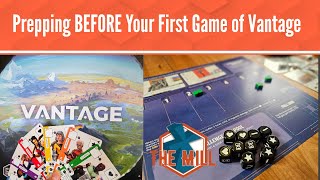


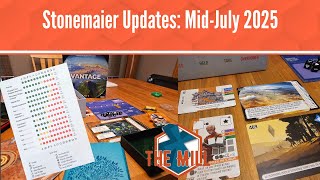

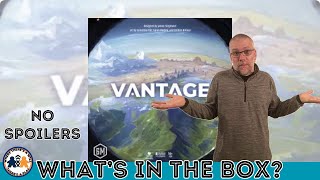







Vantage Deep Dive
What the Community Thinks About Vantage
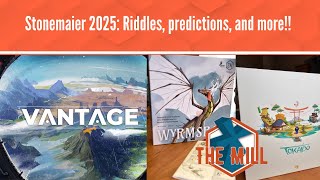
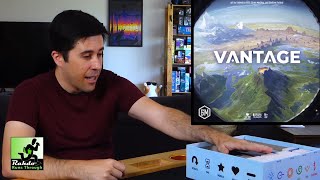
Vantage is a singular vision in board gaming. Reviewers consistently recognize it as a game fundamentally unlike anything else on shelves, and they describe it with palpable respect for its boldness, even when it's not their preferred style. The consensus centers on exploration as the game's true heart, not on winning or losing. Watch It Played calls it a "quest for survival and discovery." Board Gaming Ramblings describes it plainly: "the journey is your destination." The game divides neatly. Those who embrace aimless planetary discovery and are willing to release traditional win conditions find it deeply rewarding. Those seeking clear objectives and points-based progression find it conceptually frustrating, though they acknowledge its mechanical elegance. Nearly all reviewers praise the game's design as intentional and executed exactly as the designer intended, even when it's not their cup of tea.
Core Mechanics That Define Vantage
Dice Placement and Resource Management
Vantage's central mechanical innovation is the dance between challenge dice, player cards, and the shared pool. When you commit to an action, you roll challenge dice from the common pool. The twist is that you then assign these dice to slots on your growing personal grid of cards, each slot with its own restrictions and rewards. Some slots demand specific dice symbols, others are restricted to particular action types, and some grant bonuses like skill tokens or boost cubes. Any dice you cannot place exact a cost to your health, time, or morale tracks. As your grid fills with more cards, you gain more placement options, making future actions less punishing. The pool resets whenever someone needs more dice than remain available, returning all placed dice to circulation. This creates a satisfying push-pull: the more you optimize your card grid, the more freely you can act, but you also need to balance exploration with grid-building. Board Gaming Ramblings notes that this mechanism feels "really nice," capturing how you're committed to each action before knowing its cost.
Narrative Exploration Through Separated Hidden Information
Each player holds a location card in a personal stand, hidden from others. They can describe what they see in the art, the description text, and the available actions, but never show the card itself. You're exploring an 800-location planet together while physically scattered. Watch It Played emphasizes that this is a fully cooperative game with constant radio communication but no visual connection. The asymmetry is profound: everyone shares the same planet, but each character experiences a completely different view. When you depart to a new location, you return your old card to the box and draw a new one. This simple mechanic ensures discovery remains genuine even across multiple games. Board Game Geek captured this in their gameplay: one player married a sentient being, another bought a house, a third was hacking a tower, another found a whale taxi and solved a murder mystery. Four separate stories unfolding simultaneously on the same world.
The Vantage Experience
Relaxed Exploration Without Pressure
Vantage is designed to be explored at your own pace, free from the desperation of legacy games like Seventh Continent. 3 Minute Board Games explicitly recommends it for those seeking "a relaxed game with low stakes where you can just bimble about a planet getting to know it." The game includes optional fail-safe mechanics: new players can allow a character to recover if their morale, time, or health hits zero, extending their journey. Even the mission system is optional. The rulebook states: "You may define a success through anything you pursue and achieve." Board Gaming Ramblings quotes this directly as revelatory about the game's design philosophy. The pressure to "win" evaporates. You're not facing the sting of each card flip; you're simply experiencing what happens next. Multiple playthroughs reveal the planet's patterns, making knowledge-sharing between sessions valuable even though nothing carries over mechanically.
Cerebral Grid Optimization and Satisfying Engine-Building
While exploration drives the narrative experience, the card grid system provides intellectual satisfaction. Building your personal 3x3 card ecosystem is where Vantage's crunch lives. Board Gaming Ramblings recognizes that some reviewers felt the mechanics were strongest when you could build cards matching your starting character's color-coded skills, creating synergistic dice slots. The game allows you to defer choice: if your grid is full, cards go to a reserve, and a boost power lets you swap them in later. This isn't merely busywork. Each new card you gain provides new dice slots with different restrictions and bonuses, fundamentally changing what you can do with future rolls. 3 Minute Board Games notes the system is "exceptionally good" and "works well," while Board Gaming Ramblings calls it "clever." Watching your options expand as your grid fills is tangibly rewarding.
What Makes Vantage Stand Out
Unprecedented Scale and Hidden Information Design
Nearly 2,000 cards fill the box across 800 locations, 900+ discovery cards, and thousands of story passages. Watch It Played emphasizes that the spoiler pack and sealed story books protect the experience of genuine discovery. Board Game Geek's playthrough showed that even with 3 players, each following different objectives, the world remained vast and surprising. 3 Minute Board Games calls the world "wonderfully odd" and recognizes Vantage as "a work of art." The scale is not excessive; it serves a purpose. You will never map the entire planet in a single playthrough. The game encourages returning to play with new characters, new missions, and new random starting locations (120 different crash-landing spots). Yet because nothing carries over, each game feels like a complete expedition unto itself rather than a progression system.
Embracing Thematic Fun Over Rules Lawyering
Watch It Played articulates the game's universal rule: "If you are ever in doubt about a Vantage rule, card, ability, or anything else, you should choose the most fun answer that makes the most sense thematically." This is a radical permission structure. Board Gaming Ramblings praises how the game invites you to "willfully" experience it, not optimize it. You're encouraged to explore freely, pursue quests that interest you, stop playing when you feel satisfied, or keep going if you're having fun. The mission cards often feel abstract and hard to achieve, which reviewers interpreted as intentional. The design asks: do you want to chase it, or would you rather explore something else? This flexibility creates space for different play groups to have entirely different sessions from the same box. One group pursues objectives; another simply discovers the weirdness.
Potential Drawbacks
Narrative Abstraction and Unclear Objective Pathways
Board Gaming Ramblings articulates a central tension: missions feel abstract and often impossible to achieve without stumbling onto the right location or quest. Reviewers described missions as "very abstract" with "no way of knowing how to achieve it," especially early in a playthrough. This absence of clear direction frustrated players hardwired for goal-oriented games. One reviewer expressed frustration at reaching a point in the game where she knew how to complete the mission but didn't want to end the game yet, creating a tension between mechanical victory and experiential satisfaction. The game's permission to "define your own success" is liberating for some and confusing for others. If you approach Vantage expecting Ark Nova or Terraforming Mars clarity, you'll clash with its design.
Solo and Multiplayer Scaling Requires the Right Group
Board Gaming Ramblings noted that multiplayer Vantage above 2 or 3 players requires a group who genuinely enjoys listening to others describe their discoveries. With more players, downtime scales significantly. One reviewer felt solo play worked better personally, while acknowledging that multiplayer had charms if you embraced the shared storytelling. The game supports solo play with no rule changes; you control one character and face the game's full challenge. Scaling from solo (tight and focused) to six players (communal and narratively scattered) changes the experience profoundly. The same game offers radically different satisfactions at different player counts, and not every group will find the scaling rewarding.
If You Enjoy Vantage
Vantage reviewers consistently compare it to Seventh Continent, though noting important differences. Seventh Continent is more brutally lethal and legacy-focused; Vantage is gentler and cyclical. If exploration and discovery appeal to you, 3 Minute Board Games recommends Far Away as another planetary exploration experience. Watch It Played suggests Unsettled for a different take on survival and discovery. Earthborne Rangers offers similar cooperative exploration with hidden information. Ark Nova and Terraforming Mars are destination games with clear goals, useful if you want Vantage's intellectual depth but different narrative energy. The comparison games all emphasize expansion and discovery over points, but Vantage uniquely emphasizes the journey as sufficient unto itself.
What Reviewers Are Saying
"This is a fully cooperative game. Even though your characters are separated around the planet, you are in constant verbal but not visual communication. Think of it as your radios are working, but your smartphones have no reception."
— Meeple University
"The journey is your destination. Did you have fun? Yes, you won. That's a very weird thing for board gamers to be like, how do you win? You have fun."
— Board Gaming Ramblings
"We all were in very different parts of the world. I found a whale taxi in the ocean and I was trying to solve a murder mystery while someone else got married and someone else was hacking into a tower. The whale taxi you don't sit on; you rode in its mouth."
— BoardGameGeek