/pic1288264.jpg)
In Vanuatu, you are a Vanuatuan who wants to prosper during the eight turns of the game. In order to prosper, you have to manage with natural resources, rare items, vatus (local currency) and tourists. To earn money or prosperity points, you may also draw on the sand*, carry tourists all over Vanuatu islands, or trade cargo with foreign countries.
On each turn, the archipelago expands and you have to program your actions with five tokens. You put one or more of them on the chosen action spaces, and on your turn, you will only be able to play an action if you have the majority on its space. Thus, sometimes have to wait for other players to remove their tokens by playing their actions. If you are not in majority anywhere, you have to remove all of your tokens from an action and give up hope of playing this action. A good strategy lets you block other players; for example, they won't be able to sell fishes if they haven't caught them first – order matters! Islands and sea resources are rare, so be quick and take them first!
There is no such thing as a rich Vanuatuan. When you reach ten vatus, they automatically transform into 5 prosperity points and again, you are poor. Life is hard, but you may encounter ten men to help you; on each turn you choose one of them to increase your benefits from an action. As always, being the first player lets you choose before the others.
In short, Vanuatu is a strategy game of programming and majorities that features development, blocking, and a lot of interaction between players.
(*) Sand Drawing in Vanuatu belongs to the Masterpieces of the Oral and Intangible Heritage of Humanity of the UNESCO.
- Incredibly beautiful game.
- Picturesque cover that reminds of a summer holiday on a tropical island.
- Frightening action selection mechanism.
- Other players can snatch actions.
- Potential to not do much in a round.
- Inherent level of meanness and blockage.
- Leads to frustration.
- Exploring the reef, taking tourists around, building resorts, and earning income.
- Tropical island reef
Mechanics (from transcript analysis)
- action selection — Players place discs on actions, which can be taken by other players.
- bidding — Players bid for particular actions.
- Worker Placement — Implied by placing discs on actions.
Video topics + discussion points
Quotes (from this video)
- I'm not talking about those horrific board games that might be sitting on your shelf I'm going to talk about something far more scarier still related to board games
- my top board games that have frightened me and not in the Thematic way in the board game way
- what really scares me most about this game is the high level of complexity
- sometimes when a box is bigger than your head that just frightens me
References (from this video)
- one of my favorite themes of all time
- action selection mechanism is pretty mean
- squeezing nectar
Mechanics (from transcript analysis)
- action selection — The action selection mechanism is pretty mean.
Video topics + discussion points
Quotes (from this video)
- here are five board games that I really want to play more of but I find really hard to get to the table
- maybe one day I get to play all these games again
References (from this video)

Mechanics (from transcript analysis)
Video topics + discussion points
Quotes (from this video)
References (from this video)
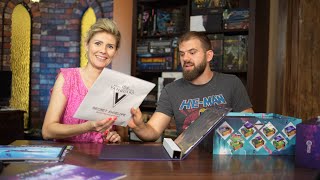
- Massive, content-rich deluxe package with extensive expansion content
- Stellar art direction and overall graphic design
- Strong production quality across inserts, dice, minis, and storage solutions
- Open-world, branching structure that boosts replayability
- Rulebook iterations with improved examples and accessibility
- Thoughtful QoL features (booklets, bookmarks, dividers, and trackers) that aid play
- High complexity may deter new players or casuals
- Extremely large, heavy box raises handling, shipping, and storage considerations
- Premium components come with higher price tag
- Spoiler risk when discussing content without app or digital guides
- Exploration, crew management, and mission-driven storytelling in a sci-fi setting
- Space exploration and planetary discovery across a branching galaxy
- Open-world, branching campaigns with multiple missions and story scripts
- Nemesis
- Tainted Grail
- Prototype
Mechanics (from transcript analysis)
- campaigns and scenarios — Story scripts, journals, and personal files drive progression with branching outcomes.
- deck/card management — Crew members, equipment cards, and feature cards are drafted, stored, and activated throughout play.
- Insert and organization design — Double-layer inserts, card holders, and bookmarks streamline play and reduce downtime.
- Modular Board — Motherships, landers, and other ships use modular bases with configurable setups.
- Modular miniatures and bases — Motherships, landers, and other ships use modular bases with configurable setups.
- Open-world exploration — Roaming galactic map with system maps, planetary encounters, and ship-side actions.
- Personalized storytelling — Personal files and crew backstories add emotional and narrative depth to sessions.
- Resource and energy economy — Energy management, planetary scanners, and planetary exploration impact actions and outcomes.
- Resource Management — Energy management, planetary scanners, and planetary exploration impact actions and outcomes.
- Storytelling — Personal files and crew backstories add emotional and narrative depth to sessions.
Video topics + discussion points
Quotes (from this video)
- this eight kilograms consist of me shall we so okay we're opening up the box
- open world sandbox feel where we change something in the world we actually change it forever
- the biggest element of the game that changed
- the open and play campaign
- the amazing graphics
- we're super happy with how the miniatures turn out
References (from this video)
- strong, place-specific embedding of economic activity
- conveys ideas about globalization and local practice
- feels historically grounded in a real Pacific nation
- mechanics can be clunky and dense
- assumes prior knowledge of Vanuatu, which may alienate some players
- Rising Waters expansion shifts focus away from base-game specificity
- island economy, export dynamics, and local practices within a global system
- Vanuatu, a contemporary Pacific island nation with historical colonial context and modern external linkages
- thematic and place-specific; grounded in local context though presented through a Eurogame lens
- Catan
Mechanics (from transcript analysis)
- contextual knowledge dependence — game relies on some local cultural knowledge; players encounter items and terms that may be unfamiliar
- export/market economy — players earn money by exporting goods (beef, copper, carver) and engaging in local markets
- Worker placement with bidding — players allocate workers to different economic roles; a multi-layer bid/commitment mechanic governs actions each turn
Video topics + discussion points
Quotes (from this video)
- Islands without islanders: there were villages and there were temples but there were no people.
- the game brands itself as a set of destruction game in the sense that it is responding to people coming to the island.
- the spirits can only act through fear.
- board games can also be an interesting like intervention to how we think about the world.
- this is actually what's like impacting life more immediately there and said they've made it the key thing when climate change in Vanuatu.
References (from this video)

- strong storytelling potential
- fits fans of Nemesis and space-survival vibes
- may require a dedicated group and longer sessions
- rule complexity could be high
- storytelling-driven space exploration
- Spacefarer narrative with exploration and conflict
- rich atmosphere with campaign-like progression
- Nemesis
- This War of Mine
Mechanics (from transcript analysis)
- scénario-based exploration — Visiting planets and undertaking missions advances the arc
- story-driven / campaign — Narrative arcs influence mission choices and progression
Video topics + discussion points
Quotes (from this video)
- the most anticipated game of 2022 for two players two one
- please like, subscribe and see you next time on the next video
- it's cute and perfect for a family game to get introduced somebody