/pic2839651.png)
Crafters, builders and carriers — your help is needed to dispel the mists of Nebula! The people of the valley will reward you handsomely if you harvest and exploit our many resources, open paths through the mists, and help our settlers build new structures. Cooperate temporarily with other builders in order to create paths and share goods, but do not forget your own objectives. Will you have a statue erected in your honor on the Nebula City plaza?
A game of Via Nebula starts with a board showing a hexagonal grid, some production sites with a few available resources on them (wood, stone, wheat, and pigs), building sites in various areas scattered over the whole board, and a lot of mist.
Turn after turn, players have two actions at their disposal from these options: They may clear the mist of a hex to create new paths of transportation, open new production sites, open a building site in a city, carry resources from any production site to their own building sites, and, of course, achieve a construction. Resources and paths through the mist may be used by all the players. This initially induces a kind of cooperation, but eventually other players will take advantage of your actions!
To achieve a construction, you fulfill a contract on one of your cards. You start the game with two contracts, and four more contracts are available for all players to see and use on a first come, first served basis — and that's where the cooperation abruptly stops. Additionally, most contracts have special powers that are triggered on completion.
The game ends when a player finishes a fifth building. Opponents each take two final actions, then players score based on the number of cleared hexes and opened production sites and the point value of their contracts, with a bonus for the player who ended the game.


Via Nebula Full Playthrough

- easy to teach
- neat concept of fog-cleared paths remaining usable by others
- quick to play
- two-player limit stated
- players may feel compelled to help opponents
- route-building with fog clearing on a hex board
- competitive with occasional cooperation
- Splendor
- Elisium
Mechanics (from transcript analysis)
- cooperation/competition balance — clearing fog creates shared benefits while remaining competitive.
- resource gathering and building placement — spend actions to clear fog and move resources to building spots; multiple players can be invested in the same spots.
- route-building with fog clearing — resources and buildings are placed on a hex board; fog is cleared to reveal paths which remain open for others.
Video topics + discussion points
Quotes (from this video)
- It's a very exciting time for the channel.
- I've filmed nine videos worth of content last week, actually in three days.
- I'm hoping to increase my output.
References (from this video)

- nice medium-weight style game
- hasn't really taken off
- clouds
Mechanics (from transcript analysis)
- Train game — Described as a train game but about moving around in clouds.
Video topics + discussion points
Quotes (from this video)
- Hey everybody, I'm Tom Vassal. Welcome to Look Back. This is a series that I do where I take a look at reviews that I did 1 year ago, 5 years ago, 10 years ago, and even 20 years ago during this time frame.
- It's It's doing okay. I think it's in the 4000s at BoardGameGeek. I just didn't like it at all. Boring, boring airplane travel game.
- What a fantastic game, a real-time shoot-'em-up strategy style game. Very entertaining. 10 out of 10. Just a great game. Still love this game 10 years later.
- honestly for a game that's themed on Taco Bell is like a 10 out of 10 in a sense cuz you're expecting it to be bad.
- This is the follow-up to the very popular Dominant Species.
- This is a fun party game in which someone's dying and they write a message on the board, but the other person he erases I think half of it.
- So, this is like the lowest seven I can give a game in a sense.
- The artwork is a little uh uh It's all mixed over. It's muddled and they made it for people who love Overpower and they threw in the kitchen sink.
- We're trying to get more people to play these games and they made it super complex.
- Point chips from a bag. That battle system is my favorite part and a lot of interesting decisions.
- The theme of the world is a little mundane for me. I wish there was more. It wasn't as interesting as it could be.
References (from this video)

Mechanics (from transcript analysis)
Video topics + discussion points
Quotes (from this video)
- hey everybody today R runs through the klling on subtitle system and what do I mean by that well you may have heard me or one of the other contributors on the channel at some point when you start watching One our run through saying hey turn on the clling on subtitle so if we make any rules Goose you'll know what they are
- and it has now become kind of a standard practice for a good portion of board game media and it's all my fault I apologize if it drives you nuts
- and now you can sit back and watch the video knowing that if I make a mistake anywhere throughout that little subtitle system will pop up and let you know the mistake that I made
- but more importantly if you want to hey forget about the English switch it over to clling on and now here you are you're getting to read it in the original burmes um if that's how you want to listen to it
- and knowing is half the battle
References (from this video)
- House rules could introduce taxing players for using resources or roads opened by another player, potentially awarding victory points or new currency.
- House rules could fundamentally change the game by altering goals and strategies, such as implementing tolls on opened roads.
Mechanics (from transcript analysis)
- fog of war — Map is covered in fog which players clear to open up spaces.
- Resource Management — Players transport resources across the map to build buildings.
- Route Building — Opening roadways through fog allows for increased movement and resource transport.
Video topics + discussion points
Quotes (from this video)
- If a house rule makes the game more accessible you know provides an interesting variant or adds custom content without breaking the feel and balance of the game then the house rule is all right
- The best house rules streamline play like drawing Tiles at the end of the turn for tiing games
- Games should be fun you know it's your game you should have fun if you need to house rule in order to have more fun do so there is no disrespect to the developer in doing that you can't make the perfect game for everyone
- I think if you house rulle a game too much you eventually get to the point where you're playing a different game
- If it's a general consensus that's going to make the game funner go for it
- You know games are designed to be fun you know and the people playing the game should have final say on what is being being fun for them
References (from this video)

- central design incentivizes helping opponents while you take turns
- rules teach themselves, quick to learn
- short turns and gateway-friendly, easy to teach
- two maps (beginner and expert) add variability
- balanced with four players; enjoyable endgame tension
- end-game rule penalizes leftover resources with negative points
- contracts can be not very interesting; limited variety
- buildings sometimes not interesting; need more flavorful/variable options
- two-player mode reduces shared interaction and pacing
- rebuilding civilization and resource management under foggy constraints
- fog shrouded world where players rebuild civilization
Mechanics (from transcript analysis)
- Action Points — on each turn you choose two actions from six options; one action costs two
- building sites and contracts — build buildings by spending resources and complete contracts
- Contracts — build buildings by spending resources and complete contracts
- exploitation tiles — tiles that provide resources and victory points when claimed
- fog clearing — players clear fog spaces to reveal paths and resources
- hidden contracts — players start with hidden contracts giving special text and costs
- resource transport along cleared paths — move resources along fog-cleared Meadows to building sites
- two actions per turn, six options — on each turn you choose two actions from six options; one action costs two
Video topics + discussion points
Quotes (from this video)
- I've had fun every time I've played Via nebula
- gateway style category where I would have no problem teaching this game to people who are not experienced with board games
- the rules almost teach themselves they're very quick to get through
- it's a light to mediumweight Euro game
- this is a neat little package but not necessarily one that I'm overly excited to continue to play
References (from this video)
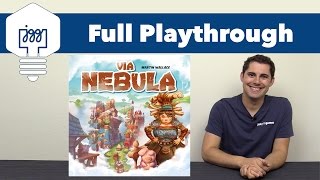
- Close scoring (28–25) makes it feel balanced and exciting.
- Euro-style depth with multiple viable paths to victory.
- Hidden contracts and exploration add tension and strategic depth.
- Exploitation tiles encourage cooperative clearing of resources that benefits everyone.
- Resource scarcity intensifies toward the end, limiting options.
- Some buildings require hard-to-get two-of-a-kind resources late game.
Mechanics (from transcript analysis)
- construction sites — Players place construction site tokens to create locations for buildings; each site can be used by up to two players.
- Contracts — Each player has hidden contracts that guide building choices and provide end-game points.
- craftsmen — Players place craftsmen on exploitation tiles to gather resources and gain points.
- end-of-game scoring — Points come from explorers revealed, contracts completed, exploitation tiles, and remaining resources on your board.
- exploitation tiles and points — Exploitation tiles produce resources and grant end-game points for clearing or owning them.
- fog clearing — Players clear fog from map hexes using green tiles to access resources and connect routes.
- hidden contracts — Each player has hidden contracts that guide building choices and provide end-game points.
- resource exchange and top-deck cards — Building tiles with costs, drawing top cards from building deck and adding to hand (often hidden).
- route-based resource transport — Resources are moved along cleared meadow paths to building sites to construct buildings.
Video topics + discussion points
Quotes (from this video)
- everything you do in this game is going to help out your opponents
- it's a route building game
- I really liked that the player who won did not actually have all four buildings down because it makes it feel like a little bit less of a race to put buildings down and more of a Euro game
- 28 to 25
- pays to help your opponents out by exploiting a bunch of stuff
References (from this video)
- great gateway into a designer's other games
- clear instructional flow
- can feel light after heavier titles
- Darkness
Mechanics (from transcript analysis)
- Engine Building — A teachable entry into Martin Wallace style games with clear mechanisms.
- gateway engine-building — A teachable entry into Martin Wallace style games with clear mechanisms.
Video topics + discussion points
Quotes (from this video)
- it's so tight like if you play this with five players it would be probably horrible so three or four players is the best
- this week we played 22 games and three of those were not for the talents we played and then 19 games for this challenge
- i'm having fun so far
- this is basically the same designer so it has a lot of the same element
- the weirdest thing that has ever happened in a board game
References (from this video)
- Excellent gateway/introductory game
- Lighter than original Steam design
- Actually fewer rules than My Little Scythe
- Beautiful graphic design
- Game for experienced gamers despite simplicity
- Science fiction
- Space exploration
- Resource management
- Steam (original complex version)
- My Little Scythe
Mechanics (from transcript analysis)
Video topics + discussion points
Quotes (from this video)
References (from this video)
- Clear action economy
- Tight pacing with defined choices
- Action pool can feel constraining for some players
Mechanics (from transcript analysis)
- Action Drafting — On a turn, players select from a central pool of actions, providing strategic choice.
- dual-action turns — Each player has a limited number of actions to spend per turn from a fixed set.
Video topics + discussion points
Quotes (from this video)
- actions selection it's a very hard thing to pin down
- there are so many options but some players will find this totally overwhelming
- one of the most ill-defined sort of category of games
- the clever action selection mechanism here relates to the sharing of these dice between the players
- in Dominion a player has their own personal deck of cards