











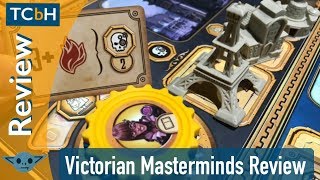
Victorian Masterminds Deep Dive
What the Community Thinks About Victorian Masterminds
Reviewers consistently describe Victorian Masterminds as a game with solid, fast-moving mechanics. Designed by Antoine Bauza and Eric Lang and published by CMON, it casts each player as a villain building a steampunk machine while the Secret Service closes in. Commentators who play it describe a game that is easy to teach, plays quickly, and rewards close attention to what opponents are doing. The Rolling Dice & Taking Names hosts rated it as a light to medium difficulty game and said that it moves briskly once everyone understands the flow. The disagreement centers on theme: the Secret Cabal Gaming Podcast called the game polarizing, praising the gameplay as solid and the action management as unique while finding the theme so thin that it reduced their enthusiasm. Rolling Dice & Taking Names, by contrast, said the Victorian steampunk setting was a major reason they wanted to play it. Reviewers also differ on rules clarity; some found the rulebook and mission cards easy to read, while others said that important details had to be deciphered during play.
Core Mechanics That Define Victorian Masterminds
Stacked Agent Placement and Saboteur Blocking
Each turn, a player draws a face-down agent from a shuffled stack and places it in one of the cities on the board, so opponents cannot see who is acting there. When a city collects three agents, the stack flips and resolves, and reviewers describe the order as starting from the bottom agent. Rolling Dice & Taking Names compared this stacking to the worker resolution in Starcraft and Forbidden Stars, noting that the wait for a stack to fill creates a tension that the game sustains well. The Saboteur is the key interaction piece. It cancels the ability of the agent directly beneath it, though the city spoils are still collected. Because agents go to a discard pile after resolving, experienced players track which agents remain and avoid cities where a Saboteur might be waiting.
Engine Building and Scientist Chaining
Agents collect copper plates, bolts, and sheet metal, which players spend to complete sections of their machine. Each completed section grants a lasting bonus, such as making each Da Vinci Codex book worth two points instead of one or adding firepower for claiming buildings. Reviewers describe the machine as a puzzle that rewards planning, because the order in which sections are built determines which bonuses come online first. Scientists are a second layer of this engine. The Secret Cabal Gaming Podcast noted that players can kidnap scientists and spend them for extra actions, and Rolling Dice & Taking Names described chaining these actions so that one placement unlocks another.
The Victorian Masterminds Experience
A Steampunk Villain Fantasy That Divides the Table
The premise is that players are villains in Victorian England, kidnapping scientists, stealing materials, and destroying landmarks to build a doomsday contraption. For reviewers who connect with the setting, the atmosphere is playful and mischievous, and the gear-shaped agent tokens and city art reinforce that feeling. For others, the theme is undercut by mechanics that do not connect to the story. The Secret Cabal Gaming Podcast argued that mission requirements have little to do with the city where they appear, so completing them can feel like a checklist rather than a heist.
Predicting and Blocking Rivals
The experience is most engaging when players react to one another. Because each stack can flip at any time, reviewers describe constantly reading opponents, blocking a city that a rival is about to activate, or racing to activate a city before someone else does. Rolling Dice & Taking Names said that the timing matters a great deal, and the table often sees players stack their own agents to force a resolution they want. This is the heart of the interaction: a game in which opponents are the real challenge rather than the board.
What Makes Victorian Masterminds Stand Out
Multiple Paths to Victory
Reviewers praise the variety of ways to score. The Secret Cabal Gaming Podcast listed collecting Da Vinci Codex books, completing city missions, destroying buildings, and racing to finish the machine as viable strategies. Rolling Dice & Taking Names similarly highlighted that many scoring routes exist, including mission cards, book tokens, and building control. The variety keeps individual turns meaningful, because a player can pivot between approaches as the board changes.
Fast Pacing Without Rounds
The game has no traditional round structure. Play continues until a player completes their machine or the Secret Service track reaches its top, and reviewers describe the rhythm as snappy. The Secret Cabal Gaming Podcast said turns move so quickly that the table seems to pass the action around in a constant loop until a stack resolves. Rolling Dice & Taking Names also called it a fast game that rewards focus and avoids long downtime.
Potential Drawbacks
A Thin Theme and a Flat Finish
The most frequent criticism is that the theme does not carry through the mechanics. The Secret Cabal Gaming Podcast questioned why a machine's power affects another mechanism and felt the contraptions were thrown together thematically. The ending also received criticism. Reviewers said the game concludes the moment a machine is completed, with the final round simply scoring what is on the board, which feels abrupt after the buildup. Some suggested an extra final challenge would give the finish more weight.
Rules and Card Text That Need Untangling
Several reviewers found that the rulebook does not fully explain the mission card symbols or the special abilities of each contraption. Rolling Dice & Taking Names reported that two players read a symbol requirement differently and had to pick one interpretation for the rest of the game. The reviewers also noted that an early version of the game had a corrected machine power, so players should confirm they have the current wording before relying on the text. These gaps did not stop reviewers from enjoying the game, but they added friction to early sessions.
If You Enjoy Victorian Masterminds
Players who enjoy the stacked worker resolution in Victorian Masterminds will find a familiar tension in Forbidden Stars and StarCraft, both of which Rolling Dice & Taking Names named as points of comparison. In those games, players also commit workers to a location and hope that the order of resolution works in their favor. Players who want the satisfaction of building a machine piece by piece and then using that machine to generate new options should look for games where early investments grow into lasting engines. Players who enjoy predicting and blocking opponents will likely appreciate the same direct, reactive play that reviewers describe here.
What Reviewers Are Saying
"The worst thing is that the game is a little bit of a letdown at the end. You're trying to build this doomsday device, this machine in front of you, put all these components on it, and the minute somebody completes it the game ends."
— The Secret Cabal Gaming Podcast
"Resolving that stack is what I like. The difference is in StarCraft and Forbidden Stars, you resolve from the top down, here is off from the bottom up. It's that nice little mechanic where it's like, well, I got to put a worker here but it's not going to activate until there's three things on that stack, and then I could take advantage of it and you just hope and pray that somebody didn't mess you up."
— Rolling Dice & Taking Names
"What you're gonna do is in each of the different locations that you can go to, you're going to put one of your workers face down in that location. It's a secret. You wait until multiple people get their actions stacked up on top of each other, and when you get a certain number you flip them over and then you resolve from top to bottom, so the timing is really important."
— Chazz Marler, Game Night Picks - Pair Of Dice Paradise