













Video Game Champion Deep Dive
What the Community Thinks About Video Game Champion
Video Game Champion has emerged as a sleeper hit among reviewers who initially dismissed it based on its busy artwork and theme-heavy presentation. The Broken Meeple, Going Analog, and Sir Thecos all found that the game resonates strongly with players who grew up during the Nintendo and early arcade era, triggering genuine nostalgia for magazine cheat codes, blockbuster rentals, and asking parents for allowance money. While its reliance on theme is pronounced, reviewers consistently note that the mechanical foundation beneath that theme is thoughtful enough to sustain engagement across multiple plays, even if components and playtime demands limit its audience.
Core Mechanics That Define Video Game Champion
Grid-Based Tile Selection and Action Activation
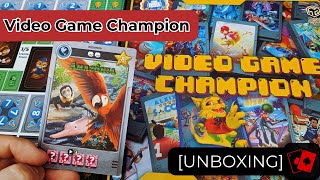
At its heart, Video Game Champion uses a streamlined grid where players claim numbered and colored joystick tiles. Taking a tile activates one of two actions from that tile's row or column: collecting money from your parents, accepting IOUs (promises to do chores later), renting games early, or acquiring more tiles. The elegance lies in a dual constraint, since you must want the tile for its numbers and colors but also want at least one of the actions that comes with it. This tension between tile requirements and action availability creates meaningful decision moments rather than predetermined paths.
Game Completion and Progressive Mastery
To score, you play video games by matching collected tiles to each game's requirements: a set of the same number, a set of the same color, an ascending sequence, or other patterns. Crucially, you can play a game once for practice and then again to finally beat it for points, mechanically representing the real experience of struggling with a game, setting it down, and returning with newfound confidence. Completing games and collecting genres drives the bulk of scoring, while diversifying which games you play and buying rentable games from the market contribute through secondary tracks.
The Video Game Champion Experience
Nostalgia Grounded in Authentic Daily Life
What elevates Video Game Champion beyond a simple tile-collecting puzzle is its commitment to thematic authenticity. Every action carries narrative weight: IOUs represent actual debt to your parents that you must later clear by doing chores, renting a game means other players cannot rent that same copy until you return it, and getting money from grandparents or begging your parents maps directly to 1980s and 1990s childhood. Magazine cards function as strategy guides that help you complete specific genres. Going Analog emphasized how each action has a real-world equivalent the audience grew up with, so the mechanics embody the experience rather than sitting on top of it.
Quick Decision-Making with Cascading Combos
Despite its thematic depth, turns resolve quickly once players understand the grid. Choosing a tile and its action, deciding whether to rent or complete a game on the weekend phase, and evaluating magazine purchases are snappy choices that keep play moving. The real satisfaction emerges when a combo clicks: a specific tile unlocks an action that grabs the exact number you need for a game, which triggers an objective, which earns bonus points. These moments of synchronicity across multiple turns deliver the payoff that keeps players engaged, and because objectives rotate from game to game, strategy cannot calcify into a single optimal path.
What Makes Video Game Champion Stand Out
Theme as Mechanic, Not Window Dressing
Video Game Champion succeeds because it refuses to separate theme from system. The password notebook where you place colored crystals represents how used games lose value, IOUs are real debt that clutters your space, and renting creates table-state consequences when another player is locked out of a game until you return it. Magazines and cheat codes are not cute flavor but tools that change which games you prioritize. Every mechanic answers a simple question: why would a kid in the 1990s do this? The answer is always rooted in economic and logistical realism, which makes the theme stick in ways pasted-on flavor cannot.
Accessibility Without Sacrifice
The game lands between gateway and hobbyist. It is not light enough for casual non-gamers, since the grid, tile combinations, and objective tracking demand attention, but it is not so heavy that it punishes newcomers. The rulebook leans on examples and icons, making the core loop teachable quickly. The weekend phase is slightly ambiguous in the rules, but once clarified the system clicks. Decision trees stay narrow enough to avoid paralysis yet wide enough that two players pursuing similar plans rarely finish with the same score, asking players to commit to a rough direction early while permitting tactical adjustments as the market shifts.
Potential Drawbacks
Playtime and Table Space Demands
The box quotes fifty to ninety minutes, but most playthroughs settle toward the higher end, especially at four or five players where downtime grows as people weigh their tile options. More pressing is the table footprint. The main action grid, the rotating rental display, the magazine market, the player boards, goal cards, and the oversized game cards consume real estate that makes cramped tables or convention play challenging. Reviewers report that even three players can feel tight, and five-player games cross into genuinely awkward territory.
Mandatory Objectives Narrow Strategic Expression
While reviewers praise the mechanical coherence, some note that objectives exert overwhelming pull on strategy. Each is worth a large chunk of points, and completing several all but guarantees victory, which makes chasing them less a viable strategy than the only strategy. The other scoring sources deliver modest points, leaving them mathematically insufficient as primary paths. This creates a sense of railroaded play, where the illusion of choosing between magazines, diversification, or the password bonus masks a narrower reality. Players who prefer wide-open, multi-path strategies may find this constraining.
If You Enjoy Video Game Champion
Video Game Champion shares DNA with The Pursuit of Happiness, which similarly uses theme to make resource constraints feel like life decisions rather than arbitrary scarcity. Both blend nostalgia with meaningful choices, asking you to balance competing priorities in narratively coherent ways. Automania shares the grid-selection action mechanic while layering in deeper production, a natural step up for players wanting more mechanical meat. For those who love the 1980s and 1990s aesthetic, Video Game Champion captures the texture of childhood gaming in ways few designs attempt, delivering an engaging midweight Euro with satisfying combo moments despite its constraints.
What Reviewers Are Saying
"It's a really nice midweight game, lots of comboing, and it was satisfying when you figured it out. Ooh, if I take this particular tile I can do this turn and activate this, as long as nobody takes this other bonus tile, and you had all these plans in your head that you could try to fulfill."
— Going Analog
"Every action you do felt like there's a real world equivalent that we kind of grew up with and that we could relate to, like people grew up playing video games in the 80s and 90s, so I really like that."
— Going Analog
"You cannot ignore these, you must do them or you will lose. Trying to win this game without completing objectives is not physically possible."
— The Broken Meeple