/pic5207472.jpg)






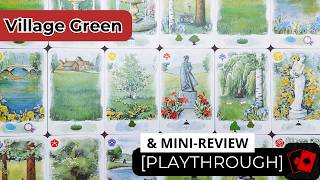
















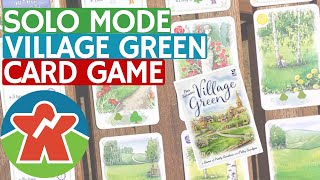

Village Green Deep Dive
What the Community Thinks About Village Green
Village Green has established itself as a beloved gateway game with surprising depth. Channels like Meeple University and Allies or Enemies consistently praise its elegant design that combines accessibility with compelling decision-making. The English village garden theme resonates with players, creating an inviting and relaxing experience that belies the strategic puzzle at its heart. Reviewers describe playing it repeatedly, and it appears frequently in most-played lists among gamers who appreciate tableau-building games with a unique twist.
Core Mechanics That Define Village Green
Card Drafting and Grid Building
Village Green uses a shared pool card draft where players select from displayed cards and market stacks. What makes this distinctive is how drafting serves two purposes at once. Players can either take a green card (the flowers, trees, and features that form their garden) or an award card (the scoring objectives that define how the garden will be evaluated). This dual-action system, from designer Peer Sylvester and Osprey Games, creates interesting tension: spending cards to claim awards and good turn order means fewer garden cards to fill your grid, and vice versa.
Flower Adjacency Constraints
At the heart of Village Green's puzzle lies a deceptively simple rule: each card placed in your garden grid must match an orthogonally adjacent card in either flower type or color. Roses, petunias, and lilies each come in several colors, and matching is the key constraint. As players fill their grids, available placement spots become increasingly restricted. Cards with no flower (lawns) act as wildcards, and reviewers note that planning around these restrictions transforms Village Green from a relaxing garden-building exercise into a genuine puzzle that can frustrate perfectionists who want every placement to score optimally.
The Village Green Experience
Cozy Yet Challenging
Village Green successfully straddles the line between approachable and demanding. The theme of designing a village garden creates an inherently calming atmosphere, reinforced by charming artwork full of whimsical details like ducks, cats, and birds. Yet the mechanical puzzle of adjacency matching and objective fulfillment means players must think several steps ahead. Reviewers describe the game as immediately enjoyable while being genuinely thinky, and they mention that the puzzle element can lead to real analysis paralysis, particularly for players who want to maximize their score.
Quick Play With Surprising Replay Value
Village Green typically plays in around 15 to 20 minutes once players understand the rules. It supports one to five players, though reviewers note it shines at one or two players, where you do not feel rushed by opponents completing their grids first. Solo play is supported through simple scoring. Despite the short play time, the game generates substantial replay value because each draw produces different award objectives and garden-card combinations, meaning no two games follow the same path or reward the same strategies.
What Makes Village Green Stand Out
Novel Objective Drafting System
Most tableau-building games score from preset objectives every player chases. Village Green innovates by letting players draft their own scoring conditions. Reviewers note that this makes for an unusual experience, because players are not all competing for identical goals. One player might focus heavily on lawns while another builds toward flower color sets. This agency in defining what success looks like adds strategic variety beyond merely filling a grid efficiently, and reviewers struggle to name many games that do something quite like it.
Elegant Simplicity in Execution
The core rules are brief: draw a card and play one from hand, or draw a card and play an award. The adjacency rule is straightforward to explain. Yet this simple ruleset generates surprising depth through the interaction of drafting, placement constraints, and scoring variability. Reviewers appreciate that setup is quick and the game does not overstay its welcome, and solo players in particular praise it as a compact, satisfying travel companion.
Potential Drawbacks
Color Visibility Issues
One reviewer reported a genuine component issue: the yellow flower cards can be difficult to see against the light card stock, particularly under dim home lighting. Since yellow represents a significant share of the color palette, this visibility problem compounds throughout play, making it harder to verify legal placements at a glance and adding an unintended layer of difficulty to an already challenging puzzle.
Puzzle Difficulty and Frustration
While most reviewers praise the puzzle element, some note that Village Green can become frustrating for those who chase efficiency. Reviewers described it as causing analysis paralysis and even straining the brain in ways that can discourage casual play. If a player draws cards that do not match their carefully planned layout, they may be forced to abandon prepared strategies, and one reviewer admitted realizing mid-game that they were not enjoying it as much as hoped, suggesting the puzzle can overshadow the relaxing theme for some players.
If You Enjoy Village Green
Players drawn to Village Green often appreciate other tableau-building games with puzzle elements. Cascadia and Calico offer similar grid-filling satisfaction with placement restrictions and nature themes. Arboretum provides card hand management with color and suit adjacency rules. The Lost Expedition, also designed by Peer Sylvester, shares the designer's talent for clever, compact design with hidden information and cooperative elements.
What Reviewers Are Saying
"What works really well here is the objective cards. You don't see that many games like this where you're trying to build up your objective cards as well as the tiles."
— Meeple University
"It's very relaxing, this sort of build-the-garden type of thing. There's someone cycling by a pond, there's a lazy cat underneath the tree. It's so cute."
— Crimsonboardgames
"Village Green is set in the cutthroat world of small-town gardening competitions, and it's really a tableau builder. You've got nine cards that are going to be your garden, and then three on the top and on the side that are awards, so those are the scoring cards."
— Allies or Enemies