/pic6153324.jpg)































Voidfall Deep Dive
What the Community Thinks About Voidfall
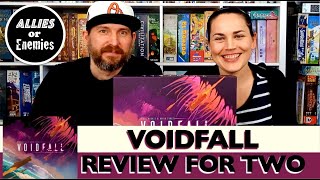
Voidfall has earned passionate responses from the board gaming community since its 2023 release. Reviewers consistently identify this as a landmark experience for solo players and complex-game enthusiasts, though opinions diverge sharply on accessibility. The game succeeds brilliantly within its design vision but remains emphatically not for everyone. Those who embrace it tend to do so intensely, viewing Voidfall as a transformative entry in the space-4X genre.
Core Mechanics That Define Voidfall
Deterministic Resource-Management Combat
Combat in Voidfall operates with complete predictability, eliminating dice-based randomness entirely. Reviewers universally celebrate this system. Battles resolve through two phases , approach and salvo , where damage output depends on upgraded technologies, shipyard positions, and sector defenses rather than chance. Players calculate outcomes before engaging, creating a stark contrast to games like Eclipse or Twilight Imperium. One consequence: combat feels mathematically elegant but can discourage player-versus-player conflict when outcomes are obvious, making the deterministic elegance feel cautious in competitive play. In solo mode, this system shines, forcing players to engineer specific technological progressions to overcome predetermined enemy strength.
Interlocking Resource Cycles and Guild Production
Voidfall's economy operates through five resources , food, energy, materials, credits, and science , linked to five guild types placed on sectors. Production multiplies guild count by sector population, creating cascading dependencies. Building more guilds increases demand for food at cycle end. Overstocking resources yields three bonus victory points but wastes potential storage. Trade tokens can cover upkeep or unlock all actions on a focus card instead of two. This system creates constant tension between expansion, efficiency, and resource scarcity. Reviewers describe the experience as a "crazy puzzle," where each action ripples through multiple systems simultaneously, rewarding deep planning and punishing improvisation.
The Voidfall Experience
Intense Strategic Planning and Puzzle-Solving
Multiple reviewers compare Voidfall to Mage Knight, emphasizing the puzzle-like nature of turn planning. At cycle start, players develop multi-turn strategies knowing only which cards appear in the crisis deck. Random crisis cards can force plan adjustments, but the core loop remains deeply analytical. Reviewers spend 10, 15 minutes per turn even in experienced hands. The game rewards careful sequencing of actions, corruption removal, guild placement, technology upgrades, and crisis resolution. This thinky experience is deliberate and valued by its audience as the heart of the game, not a flaw to overcome.
Epic, Tense Table Presence
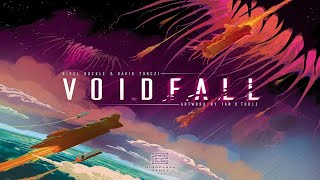
The physical presence matches the mental engagement. Game boards sprawl across large tables with sector tiles, guild markers, population dice, glory tokens, harbinger busts, and corruption pots creating a visually dense, impressive setup. Reviewers praise Ian Odell's artwork for clarity and aesthetic impact, noting that despite visual complexity, icons and components serve functional design rather than pure spectacle. The retail version includes beautiful components like sculpted corruption markers. This table presence creates psychological weight: players feel they are commanding space empires, supported by physical authenticity rather than just mechanical abstraction.
What Makes Voidfall Stand Out
Asymmetrical Faction Design with Genuine Replayability
Voidfall offers 14 factions with different technologies, focus cards, and starting agendas. Four base factions share common mechanics; ten unique factions transform play experience. Reviewers highlight that playing different houses feels genuinely different, not just mathematically adjusted. Coupled with 11+ scenarios per player count and 40+ total maps, players report satisfaction replaying the same scenario with different variables dozens of times. Unlike many games with "content for everyone," Voidfall's variety serves its core solo experience rather than diluting focus across competitive, cooperative, and solo modes equally.
Galactic Events as Direction-Setting Puzzles
Three cycles are punctuated by galactic event cards that specify scoring conditions and often change game state mid-cycle. These elegantly funnel players toward shifting objectives without railroading. An event might reward pure sectors with finance guilds one cycle, then shift emphasis to military advancement the next. Reviewers note this creates "play arcs" within the overarching game, giving narrative structure to what could be abstract optimization. The events prove intentionally balanced for each scenario, reflecting deep designer curation rather than one-size-fits-all randomization.
Potential Drawbacks
Steep Learning Curve and Setup Burden
Learning Voidfall requires 5+ hours of first-play engagement. Setup takes 30 minutes to over an hour even after learning. The rulebook, while praised as comprehensive, demands sustained attention, and three separate documents (rules, glossary, compendium) are essential references. Reviewers consistently identify this as a dealbreaker for groups prioritizing quick, casual gaming. One reviewer sells a competing space game (Eclipse) specifically to commit to Voidfall, accepting the learning cost but acknowledging it as genuine friction. The game respects player time through richness of experience but demands upfront investment that not all groups can justify.
Icon Density and Iconography Overload
Voidfall uses a four-page icon reference sheet containing symbols not fully explained within the glossary. Reviewers describe learning "a second language" to parse cards. While the comprehensive glossary receives praise, the raw number of unique symbols creates cognitive load. New players must frequently cross-reference, slowing turns. Experienced players internalize patterns and speed up, but the initial barrier remains substantial. This contrasts with games balancing complexity through streamlined iconography; Voidfall embraces symbolic density as a necessary consequence of mechanical depth.
If You Enjoy Voidfall
Fans of Voidfall gravitate toward Mage Knight for similar puzzle depth and solo focus, Spirit Island for asymmetrical faction design and emergent complexity, Gaia Project for space exploration with Euro mechanics, and Terraforming Mars for engine-building satisfaction. Those drawn to the solo campaign experience may explore Gloomhaven or Arkham Horror: The Card Game. Players seeking comparable 4X strategy at lighter weight should consider Scythe or Twilight Imperium, though both sacrifice Voidfall's determinism and add substantial randomness or negotiation. For pure Euro optimization, Agricola and Caverna deliver comparable economic puzzles with faster play.
What Reviewers Are Saying
"Void fall is 95% a Euro game with a few other bits added to pass the visual litmus test of 4X. If you're familiar with board games this is more Gaia project than eclipse."
— No Pun Included
"I want to call void fall the next Mage Knight, by that I mean I think this is going to be embraced by the solo community and become one of those perennial top tier games up there with Mage Knight and spirit Island."
— Totally Tabled
"This is a very very heavy game. It is really rewarding. It's an interesting puzzle that you need to solve. The combos you can pull off and how you can stretch out and do more than you think you can is really rewarding."
— Allies or Enemies