/pic6665090.png)















Voyages Deep Dive
What the Community Thinks About Voyages
Voyages has earned devoted fans among board game reviewers and solo players alike. Reviewers consistently praise the game for delivering unexpected depth within its minimalist footprint, combining elegant mechanisms with compelling theme integration. The game generates genuine exploration feelings despite its compact design, and players report discovering wildly different strategies and experiences within the same elegant ruleset. Multiple reviewers highlight their appreciation for how well the game balances accessibility with meaningful decisions, and many have returned to it repeatedly since discovering it.
Core Mechanics That Define Voyages
Dice Allocation and Direction
The fundamental puzzle of Voyages centers on allocating three rolled dice across three distinct purposes. One die determines your sailing direction across the hexagonal map, another determines how far you move, and the third feeds into the side-game track of duties and crew management. This tri-fold allocation creates the tactical tension that defines each turn, balancing navigation against resource development forces meaningful opportunity-cost decisions that ripple across the entire game.
Flexible Resource Management
Sailors represent your primary mitigation tool. By spending sailors, players can adjust dice rolls by ±1, effectively purchasing precision in a game governed by chance. This system creates strategic depth: hoard sailors for critical moments, or spend freely to explore freely? The economy is tight enough that every sailor matters, and multiple paths to acquiring them (island visits, cargo sales, duty completion) ensure no single strategy dominates. Goods collected from islands can be saved and sold at settlements for both immediate points and crew recruitment, adding another layer of resource juggling.
The Voyages Experience
Thematic Exploration on Open Seas
The theme of eighteenth-century sailing permeates every mechanism. Rolling dice feels like contending with wind and weather, sometimes you're pushed where you didn't intend, but that restriction creates the puzzle. Moving sailors up the duties track represents building a trained crew, while gathering cargo mirrors real maritime commerce. Players report genuinely feeling like ship captains navigating uncertain waters, constrained by natural forces yet capable of meaningful strategic influence. The sensation of being "at the whims of the wind" is designed into the core and feels authentic rather than frustrating.
Rewarding Adaptation and Flexibility
The game rewards players who plan flexibly rather than rigidly. Reviewers emphasize that mastery comes from learning to pivot when dice rolls don't align with original intentions, identifying multiple paths to victory, and leaving yourself positioned so that any reasonable roll advances progress. This creates a satisfying puzzle where restrictions become tools, figuring out how to reach your goal despite dice limitations feels clever rather than punishing.
What Makes Voyages Stand Out
Remarkable Value and Variability
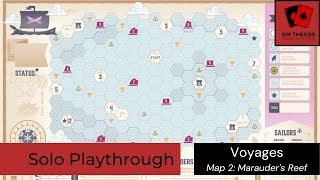
Voyages delivers exceptional content for a $5 investment. The base game ships with six different maps, each with distinct mechanics and difficulty levels. Reviewers emphasize that these aren't simple reskins, different maps introduce marauder combat, reef navigation, different cargo systems, and varied duty tracks, fundamentally altering how each island plays. Solo players specifically praise the included solo campaign with escalating restrictions and unlockable powers, creating a meta-progression that encourages repeated engagement with the base mechanisms.
Simultaneous Play and Scalability
Because players act simultaneously, game length remains consistent at all player counts. One reviewer explicitly noted playing equally engaging games with 1, 3, and 5 players without length bloat. The solo mode transforms the competitive race to three legendary stars into a clock race against 16 turns, fundamentally shifting priority from pure optimization to efficient star acquisition.
Potential Drawbacks
Dice Dependency and Early Frustration
Some players initially react negatively to how heavily the game constrains exploration through dice rolls. When you need to move south but roll north, and the dice mitigation feels expensive, games can feel restrictive early. New players sometimes interpret this as excessive luck-dependence. However, experienced players note that this perception shifts with mastery, the restriction becomes the puzzle, not the problem. The game actively teaches flexibility through play.
Dense Information Management
Each map layer presents multiple symbol systems: terrain types, mission objectives, special abilities from duties, and resource tracking. While the core rules are simple, the visual information density can initially overwhelm, particularly on the more complex maps with multiple interacting systems. Some players need several plays to internalize icon meanings and mission structures rather than referencing the rules continuously.
If You Enjoy Voyages
Players who love Voyages typically gravitate toward Guild of Merchant Explorers, which shares the exploration and map-constraint DNA. The Postmark Games catalog offers similar design philosophies in Waypoints and Aquamarine. For spatial puzzle experiences, Rolling Realms and Cascadia provide comparable decision-making around limited resources, while Can't Stop shares the push-your-luck tension and dice-allocation puzzle. Solo players appreciate Hadrian's Wall and other tight roll-and-writes that reward mastery over luck, and fans of theme-integrated mechanisms enjoy Wayfarer's Tale.
What Reviewers Are Saying
"The solo mode is great. In the solo mode you only have eight cards that you have to use, and once a certain number of cards are out of the game, that's it. You have to use it very strategically. The snappy game does play the same length of time at one or five players because it is simultaneous play."
— Tabletoptiktok
"The puzzle is a spatial one as well as a point-based puzzle. I love these games where you're exploring a map and getting things right. The scoring in the puzzle is tied to that map structure, and I think that really gives me that sense of exploration where it feels like I've really accomplished something when I land on that perfect spot."
— The Board Gaming Doctor
"I haven't seen a lot of people talk about it. I've had it for probably about a year or so and I really enjoy it. I think this is a really great roll-and-write game. It plays really great at all the player counts because it is simultaneous play and nothing gets bogged down."
— Tabletoptiktok