


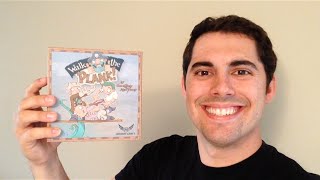
Walk the Plank! Deep Dive
What the Community Thinks About Walk the Plank!
Walk the Plank! is a pirate party game from Mayday Games, the publisher that also released Get Bit. Players are the crew of a mutinous ship, shoving one another's pirates off a plank and into the waiting mouth of the kraken. Reviewers agree that the game produces a lot of noise and laughter at the table, but they split on whether careful play improves the experience or undermines it.
Getting Games is the most enthusiastic of the three. The reviewer describes it as a light, chaotic game about pirates trying to kill each other before they kill themselves, and reports hearing laughter from across the room whenever it is played. That reviewer is also the clearest about the split in opinion: some players love the experience, while others dislike it because strategic decisions work against the fun.
Board to Death TV presents the game from the publisher's side. Ryan Bruns, president of Mayday Games, introduces it at Gen Con as a title with a good reception so far, and frames its appeal around the tension of planning moves that do not always resolve as intended. Because the segment is a booth showcase rather than an independent review, its praise should be read as the publisher's own view.
The Dice Tower offers the most measured assessment. Tom Vasel placed Walk the Plank! in a mid-ranked game survey, rated it six out of ten, and concluded that it does not play out as well as Get Bit. Vasel's verdict is that the game is okay, but it lacks the sharpness of its predecessor.
Core Mechanics That Define Walk the Plank!
Relative Movement Along the Plank
Pirates in Walk the Plank! do not occupy fixed positions. What matters is their order relative to the other pirates on the board. In the Getting Games walkthrough, a Shove Left card only has an effect if one of the player's pirates sits directly beside an opposing pirate on the left. When no legal target exists, the card does nothing. Because shove, pull, drag, and charge all depend on neighbors, every movement changes who is adjacent to whom, which in turn decides whether the cards still to be resolved will work at all. The plank adds a second layer of relative positioning: it can be extended up to three spaces, and retracting it flips the outermost section and sends any pirate on it into the kraken.
Programmed Actions With a Revealed Order
Each player begins with a hand of ten action cards that are identical across the table. Cards include Shove Left, Shove Anyone, Shove Right, Retract the Plank, Extend the Plank, Drag to Sea, Pull to Ship, Run Around, "I Don't Want to Die," and Charge. Each round, players secretly choose three cards and place them face down in an order of their choosing. The cards are then revealed and resolved one at a time around the table, starting with the holder of the starting player token. Charge can never be the first of the three, which forces it into the second or third slot.
This programmed sequence is the source of most of the game's tension. Board to Death TV highlights the difficulty of programming a turn in advance, noting that a player may expect one outcome and end up shoving an unintended pirate. Skull cards add a further layer of planning. Once they resolve, they are set aside and return to the player's hand only on the following round, so a powerful card cannot be relied upon immediately.
The Walk the Plank! Experience
Chaotic Swings Driven by Planning
Reviewers describe the game as deliberately unpredictable. Because every player's three cards resolve in turn order, a carefully planned push can be undone by a pull that happened earlier in the sequence, and a pirate that seemed safe may find itself at the end of the plank after a retraction. Getting Games notes that players often stop trying to optimize and simply select cards at random, and that the resulting board state produces plenty of entertainment. Many of the most memorable moments come from plans that collapse midway through a round, which is exactly the chaos the game is built to deliver.
Comedy Created by the Mechanics
The humor in Walk the Plank! emerges directly from how the cards interact. The Charge card is the reviewer favorite in Getting Games, which calls it the funniest of the ten, because it advances one pirate and then bumps the next one forward, even when that piece belongs to the same player and is knocked into the kraken by accident. Retract the Plank is equally comic, since a pirate who believes it still has a move can be removed in an instant. Reviewers agree that observers enjoy watching these reversals, and that the game rewards players who embrace the spectacle rather than trying to avoid it.
What Makes Walk the Plank! Stand Out
Iconography That Teaches Itself
Getting Games praises the card art as cartoony but very well executed, and singles out the iconography as exceptional. The reviewer argues that players rarely need to read the text, since the symbols make each card's effect clear at a glance. For a game with ten action cards and several interacting rules, that clarity lowers the barrier to entry and keeps the focus on the table rather than the rulebook.
A Table That Stays Loud
The most consistent praise concerns the energy the game generates. Getting Games reports that the game produces laughter whenever it is played, enough that the reviewer hears it from across the room while playing something else. Board to Death TV describes the design as a success for Mayday Games, noting that it has received a strong reception since release. Together, these accounts suggest that the game succeeds most when players treat its outcomes as shared entertainment.
Potential Drawbacks
Strategic Play Slows the Game Down
The most serious criticism comes from Getting Games, which argues that optimal play is largely defensive. Players end up using Run Around and Pull to Ship to retreat from danger, and the reviewer finds these moves dull to watch because the spectacle of pirates going into the drink disappears. With three or four experienced players who want to win, the game can stretch past half an hour as pirates are shoved forward and pulled back repeatedly, and the plank is retracted and then extended again. The reviewer also warns that if every player approaches the game as a filler to be won, it becomes a long and tiresome contest that everyone wants to end.
Results Can Feel Out of Players' Hands
Because cards resolve in a fixed sequence and their targets change as the round unfolds, a single card can have effects that its player did not intend. Getting Games reports that Charge frequently backfires, since a player often ends up knocking their own pirate into the kraken after an earlier card has moved another piece into the path. Strategic players, the reviewer notes, rarely include Charge in their hands at all. Board to Death TV makes a similar point from the designer's side, observing that the programming process itself is tricky and that intended outcomes frequently fail to materialize. Players who enjoy tight control of their turns may find the game frustrating for this reason.
If You Enjoy Walk the Plank!
- Get Bit: This Mayday Games title is the closest relative. In it, players hold numbered cards, the lowest played number acts first, and the player beside the shark loses a limb, so elimination arrives in the same chaotic fashion. The Dice Tower expected Walk the Plank! to be a close copy, and although Tom Vasel found it less satisfying, Get Bit remains the natural next step for anyone who enjoys its elimination tension.
- Jenga: Jenga suits players who enjoy physical tension and the anxiety of pulling a piece that might bring everything down. Board to Death TV describes Mayday's Click Clack Woodman as a Jenga-style game in which the player who knocks off the core piece loses points, which makes it a useful companion for anyone who wants that same risk in a more tactile form.
What Reviewers Are Saying
"Optimal play is unfortunately, it optimal to play, first of all, slows down the game a lot. If I play this game with three or four people who are gamers and they want to win, this game could drag on to well over half an hour."
— Getting Games
"Walk the Plank is about moving and pushing people off a plank. And I thought they'd be like, Hey, this is just like Get Bit. Sort of. It just doesn't play out as well."
— The Dice Tower
"The tricky thing is how you program it. Sometimes you'll play a card and think you're going to be doing something, you'll end up shoving somebody or or messing up somebody else."
— Board to Death TV