/pic6179448.jpg)











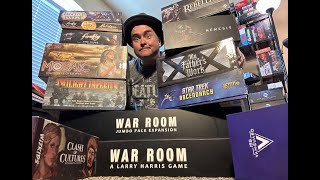


War Room Deep Dive
What the Community Thinks About War Room
War Room stands as a spiritual successor to Larry Harris's legendary Axis and Allies, yet reviewers consistently emphasize that it transcends its predecessor. From the moment players engage with it, the game leaves a lasting impression, with some describing it as a game they contemplate for days afterward. The consensus among experienced wargamers is that War Room achieves something remarkable: it maintains the grand strategic scope of a global World War II conflict while becoming surprisingly accessible compared to its more complex cousins. BoardGameBollocks called the way it juggles linked theaters a mind-boggling feat of ingenuity, while The Discriminating Gamer described it as one of the most beautiful wargames they have seen on a table.
Core Mechanics That Define War Room
Secret Simultaneous Order Programming
One of War Room's defining innovations is how it transforms player agency through simultaneous secret order writing. Instead of the turn-based movement that can bog down Axis and Allies, players assume the role of commanding generals, writing their moves on a sheet so they feel like they are genuinely directing their forces into battle. This creates an authentic command experience where decisions cannot be instantly revised based on opponent reactions. The mechanic eliminates real-time table crowding while maintaining immense strategic tension, since players must anticipate enemy movements without seeing them unfold.
Large-Scale Combat with Battle Stances and Resources
Publisher Nightingale Games and designer Larry Harris engineered an elegant solution to the unit-density problem that plagued Axis and Allies by using a stacking system of tokens rather than individual unit pieces. This approach solves the crowded-board problem while introducing sophisticated combat resolution across distinct theaters of land, sea, and air, each requiring different tactical approaches. Players assign battle stances for each unit type during conflicts, manage oil and iron on dedicated trackers, and guard convoys to control resources. With several phases per round, though many are brief, the strategy required to juggle all the linked theaters is substantial.
The War Room Experience
An Epic Event Game with Global Scope
War Room is unquestionably an event game in the truest sense. Its scope encompasses the entire World War II world on a single grand board, with players split into Allied and Axis teams competing to control enemy capitals. With a long playing time that often extends across an entire gaming day, it demands serious commitment. Yet within that span lies genuine narrative emergence: the simultaneous orders and fog of war ensure that even replays feel fresh as players discover new strategic possibilities. The game transforms a dedicated game day into a historical simulation where players feel the weight of strategic command.
Beautiful Presentation and Board Design
Reviewers consistently praise War Room's aesthetic presentation. The round map, a distinctive design choice, draws players in visually and represents the global theater more effectively than a traditional rectangular board. Component quality is high, with thick trackers, sturdy reference cards, and a magnetic unit storage system that keeps pieces organized. Territory cards with period photographs ground players in historical specificity, adding immersive detail that reinforces the game's narrative dimension without becoming cartoonish.
What Makes War Room Stand Out
Accessibility Within Complexity
Despite its elaborate mechanics and substantial rules weight, War Room stands out as perhaps the most accessible large-scale wargame available. Its biggest achievement lies in presenting massive strategic depth without requiring an encyclopedic rulebook or weeks of preparation. While several phases exist per round, reviewers note that many are very small, allowing the game to flow more naturally than competitors in the genre. Teaching remains manageable because the concepts build logically from one another, a marked improvement over notoriously difficult competitor titles. For those who want to be treated as military strategists rather than rulebook archivists, War Room achieves a rare balance.
Spiritual Kinship to Axis and Allies with Superior Mechanics
As a direct spiritual successor to one of board gaming's most beloved classics, War Room inherits the appeal of global World War II conflict while systematically improving nearly every mechanical element. Where Axis and Allies struggles with board crowding and unwieldy unit stacking, War Room eliminates these frictions entirely. The simultaneous order system replaces sequential movement with greater tactical depth and realism, and the token stacking system provides elegance while maintaining clarity. Players who adore the grand-strategy, world-conquest appeal of Axis and Allies often find War Room to be the natural evolution they have been waiting for.
Potential Drawbacks
Demanding Runtime and Player Requirements
War Room's most significant barrier is its runtime. With sessions routinely extending many hours, finding the right circumstances to play becomes a major obstacle. As one reviewer noted, the practical reality is that you have to gather the right group of people willing to sacrifice a sizable portion of a day to get it to the table. This is not a game that fits a casual Friday night; it requires a dedicated group, planning, and genuine enthusiasm. The two-to-six player range also means you cannot casually add or remove participants, so the experience depends on assembling the right people.
Financial and Logistical Investment
War Room carries both a substantial price and significant logistical demands. The deluxe production represents a meaningful monetary investment that many casual gamers will hesitate to make, especially given the time required to recoup that cost through play. The commitment extends beyond money into storage space and table real estate, since the round board with full components demands considerable setup, takedown, and a dedicated home. For players with space constraints or those who prioritize variety, the practical demands may outweigh the rewards.
If You Enjoy War Room
If War Room captivates you, explore Axis and Allies to experience its thematic predecessor and the design lineage that led here. For comparable scope and runtime in a science-fiction setting, Twilight Imperium offers epic, multi-player conflict with modular boards. Memoir '44 provides a more accessible World War II experience with card-driven tactical combat, and for grand strategic conflict at the card-driven level, Twilight Struggle delivers tension at a much lower complexity and footprint.
What Reviewers Are Saying
"War Room is a spiritual successor to a game called Axis and Allies. There's nine different phases you've got to go through, and a lot of them are very small. But the amount of strategy and tactics that this game involves, juggling all of the different theaters of war that are intrinsically linked in order to gain victory, is a mind-boggling feat of ingenuity."
— BoardGameBollocks
"It is a giant epic game that covers all of World War II. You split into two teams and try to control capitals of different countries. You write down your moves on a sheet so you feel like this general sending your troops into battle. There's logistics, there's so many things, and it's not that complex actually."
— Board Game Hangover
"War Room is a Larry Harris game. For a wargame, this is one of the most beautiful wargames sitting on a table that I've seen. It is absolutely phenomenal. This is one of those games that I just want to devote a Saturday to and say, all right, we're going to spend the entire day and all we're going to do is play War Room."
— The Discriminating Gamer