







Wasteland Express Delivery Service Deep Dive
What the Community Thinks About Wasteland Express Delivery Service
Reactions to Wasteland Express Delivery Service are genuinely divided, and the split tends to follow how much a reviewer tolerates a long, reactive, interaction-heavy game. Some reviewers land on a solid recommendation. They praise the setting, the presentation and the replay value that comes from a map that is rebuilt every session, while still warning that the table time can drag. Others are openly unimpressed. They argue that the design leans on frustrating randomness, that resources slip away before a truck can reach them, and that the ending can feel arbitrary. The strongest opinions come from people who clearly enjoy the Mad Max flavor but struggle with how the rules play out in practice.
Core Mechanics That Define Wasteland Express Delivery Service
Pick-Up and Deliver
The heart of the game is a delivery puzzle. Players drive to a location, collect food, water, weapons or artifacts, then haul that cargo to a settlement whose demand token is waiting for it. Reviewers describe the loop plainly, and several find that the core action has limited depth on its own, since much of each turn is moving to a spot, picking something up and dropping it somewhere else. The appeal, in their telling, lives in the routing and the rivalry. Priority contracts add goals on top of each delivery, and the market prices for each cargo type rise and fall as demand is met, so a route that looked efficient can lose its value by the time a truck arrives. Reviewers who like the genre say it works best when the table is in the mood for that kind of logistics, while those who tire of it find little to hold their interest.
Variable Map
The playing surface is assembled from sixteen tiles arranged in a grid, with the depot in the center and the raider enclaves set toward the edges. Reviewers return to this arrangement often because it changes the character of each game. One channel notes that the locations are entirely random and that the map will look completely different from session to session, with dramatic effects on how the game plays. Another describes how the same job can be a short hop in one setup and a long trek in the next. Because the geography is never the same twice, reviewers who enjoy planning find a fresh puzzle each time, though some also feel that the randomness of the layout adds to the sense that a carefully made plan can be undone by the board.
The Wasteland Express Delivery Service Experience
Post-Apocalyptic Atmosphere
The theme is where the most consistent praise lands. Reviewers compare the game to Mad Max immediately, and one commenter says the board art and the mod shop pop on the table and look like a cross between Mad Max and Fallout. The tone is lighter than grim survival fiction, with a comic-book, sketch-style look that sells the wasteland quickly. Trucks loaded with trailers, weapons and allies give the table the feel of a road war in progress, and players who love the setting often find the table talk and the truck designs are part of the fun. The story is less convincing for some. Reviewers say the book builds a strong world, but the faction jobs can feel generic once the flavor text stops matching what the player is actually doing, so the atmosphere is stronger than the narrative beats.
A Satisfying Engine of Momentum and Upgrades
Reviewers also enjoy the way the truck evolves over a game. Movement builds momentum when a player keeps driving without stopping to act, so each successive move can cover more ground, while stopping to trade, fight or upgrade resets that speed. One channel calls this movement mechanism quite novel and says that bombing through the wasteland at breakneck speed, racing an opponent to a resource, is really exciting. Upgrades such as turbos, armor, machine guns, sleeper cabs and trailers reshape the truck, and reviewers note that the choices can produce wildly different builds, from a rolling warehouse to a heavily armed raider hunter. That loop of buying, tuning and then using the truck is what gives the engine its satisfying feel.
What Makes Wasteland Express Delivery Service Stand Out
Component Quality and Game Trays
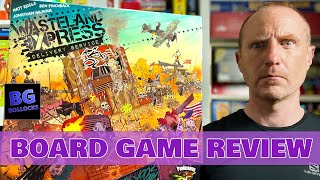
Reviewers who covered the components consistently single out the game trays. One channel describes the inserts as wonderful plastic molded trays that keep everything well stored, and another calls the box an insert example worth studying because the trays make setup and teardown far more manageable. Even reviewers who notice minor issues, such as tiles that sit slightly wonky, treat them as small niggles against a well-made package. The truck miniatures, the painted standees and the card art all get praise, and the mod shop tray is singled out as a clever way to keep a sprawling set of upgrades organized. For a game with this many pieces, reviewers feel the presentation is a real selling point.
Varied Priority Contracts and Replay Value
Replay value is a second area of praise, and reviewers tie it to the priority contracts rather than the faction jobs. One channel finds the priority contracts much better than the rest of the job pool, noting that they range from hunting a boss character to pulling off a heist, delivering a nuke or completing a Vision Quest. That variety, combined with the changing map and the different player powers, gives reviewers a reason to keep returning. The same reviewers note that campaign mode adds a series of linked games with minor rule tweaks, though it is not a true legacy experience and requires the same group to commit to several long sessions.
Potential Drawbacks
Downtime, Length and an Anticlimactic Finish
Length is the complaint that comes up most often. Reviewers expect two hours or more for a typical game, and they find that three or four players can stretch a session well past that point. The downtime is attributed to analysis paralysis, since each player has five action markers and many paths to weigh, and to the constant need to check a rulebook that is text heavy and not laid out in a logical order. One reviewer says the game ends with a finish that can be called early, because the leader is often visibly ahead well before the final contract is completed. Another notes that the game has no set number of rounds, so a session can keep going as trucks trade blows and the finish keeps slipping away. Reviewers who have not played with five players are openly skeptical that it would be enjoyable at that count.
Random Combat, Shifting Markets and Rogue Trucks
The harshest criticism is aimed at how unpredictable the table can feel. One channel describes combat as rolling dice, adding bonuses and hoping to beat a number that is hidden until the raider card is drawn, which makes attacking a high-variance gamble that can make or break a game. The same reviewer argues that resource placement is frustrating because demand is fulfilled and prices change constantly. A player can be on the way to a delivery only to find the goods gone, and a planned route can be impossible to lock down. Raider trucks can also be pushed onto an opponent's path, and reviewers describe a disruptive player who is more interested in wrecking everyone else's plans than completing their own contracts. Once that happens, a player with no cargo and no money can be pushed back to the depot again and again, and the reviewer who experienced it argues that this push and pull can go on for hours.
If You Enjoy Wasteland Express Delivery Service
Reviewers most naturally reach for Star Wars: Outer Rim when they describe Wasteland Express Delivery Service, usually to say that Outer Rim is the more streamlined and intuitive pick-up game of the two, with shorter downtime, a solo mode and a stronger sense of story. Merchants & Marauders and its Firefly edition come up as the other benchmark, since reviewers describe them as the same kind of vehicle game where players race for points or jobs and efficiency decides the winner. One reviewer prefers the sandbox freedom of Merchants & Marauders to the tighter structure here, while still considering Wasteland a great pick for anyone who loves post-apocalyptic themes and delivery games. Dominant Species is mentioned only as a harsh point of comparison, appearing in the same breath as the worst games one channel has played, which places the frustrations of this game in a very different league from the ones that reviewers find truly bad.
What Reviewers Are Saying
Making a game with universal components very easy to set up and very user friendly. There's the mod shop in it that is easy super easy to pass around.
— The Cardboard Herald
The resources are constantly in a state of flux they're constantly moving around as soon as somebody goes to a location and fulfills a demand it's going to change. So you might be on your way there and by the time you get there it's gone.
— BoardGameBollocks
The rule book is not terrible but it's quite text heavy and I found that it's not laid out in the particularly logical fashion. It goes into a few concepts of the game like combat that before it even mentions what the turn sequence is and even then before what the various actions do.
— The Broken Meeple