/pic4110410.jpg)
"Wendake" is the name that the Wyandot people use for their traditional territory. This population, also known as the Huron Nation, lived in the Great Lakes region, together with the tribes who formed the Iroquois Confederacy, and many others. In this game, you will explore the traditions and everyday life of these tribes during the 1756–1763 period, when the Seven Years’ War between the French and the English took place in these territories.
But this white man’s war is only a marginal aspect of the game; the focus is on life in the native villages, fields, and forests. In this game, you won’t find the traditional tipis, which were used by southwestern tribes who moved their camps to follow the bison herds. The natives of the Great Lakes were more sedentary, living in longhouses. The women farmed beans, corn, and pumpkins, while the men hunted beavers in the forests, mainly to sell their pelts as leather.
In Wendake, you step into the shoes of the chief of a Native American tribe. You will have to manage the most important aspects of your tribe’s daily existence, thereby earning points on the Economic, Military, Ritual, and Mask tracks. The core of the game is the action selection mechanism: you will have the opportunity to choose better and better actions over 7 years (i.e., rounds), and the winner will be the chief who finds the best combinations of actions and uses them to lead their tribe to prosperity!

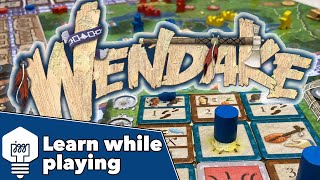
- offers strong replayability through symmetric vs asymmetric village variants, providing different strengths and weaknesses from the start
- upgrade tiles and the mask/turtle systems add depth and variety to choices each round
- the game provides meaningful decisions in tile placement, resource management, and combat
- ritual actions can accumulate points that may not translate into final scoring if not balanced with other tracks
- overall complexity may be high for new players due to many interacting systems (tiles, masks, turtles, progress tiles, combat)
- native village life with farming, fishing, trading; territorial expansion
- mid 1700s in the Great Lakes region of the United States
- instructional/tutorial
Mechanics (from transcript analysis)
- Action tile activation — placing an action token on a tile triggers all effects on that tile from top to bottom
- beaver-to-leather conversion — specific actions convert beaver tokens into leather resources
- campfire and ritual actions — campfire upgrades unlock more powerful actions; ritual actions provide scoring and ongoing effects
- combat and guarding — fighting occurs when moving into an opponent's territory; guards must be defeated first and injured pieces return to longhouses
- Compound Scoring — final scoring uses the lower value of paired tracks (e.g., ritual vs economy, mask vs military) to determine points
- final scoring via paired tracks — final scoring uses the lower value of paired tracks (e.g., ritual vs economy, mask vs military) to determine points
- mask system — players draw and place mask cards on the grid; matching sets grant mask points and influence scoring
- Movement and territory control — warriors move between territories; guards, outposts, and productive spots determine control and scoring opportunities
- production and productive spots — placing pieces on productive spots yields resources or can transform tokens into other forms (e.g., hunters, women, canoes)
- progress tiles — progress tiles grant ongoing benefits and can be purchased with resources; different rows have different costs and effects
- trading and smallpox check — trading resources may trigger a smallpox check by drawing a mask card; skull indicates a native becomes ill and is removed
- turn order and activation constraints — the first action defines the turn order for the next round; the other three actions activate tiles in the round under specific placement rules
- turtle tiles — military actions can yield turtle tiles which have their own eligibility requirements and victory point types
- year track and purple upgrades — after certain years, purple upgrades enter the market to be used for the last rounds of the game
Video topics + discussion points
Quotes (from this video)
- the game takes place over seven rounds
- you only score the lower of the paired track
- the map is specific to the player count
- the symmetric start so we're not going to see any of these asymmetries
- when you place one of these action tokens down onto a tile you perform everything on that tile starting from the top
References (from this video)

- Innovative action selection mechanic
- Interesting theme and balance
- Complex tracking of upgraded tiles
- Daily village life of the Wendat people; not the war focus
- Great Lakes region during the 7 Years War
- Seasoned action selection with grid placement
Mechanics (from transcript analysis)
- action tile grid — 3x3 grid; select three actions in a straight line; no fixed order.
- grid cycling — Tiles flip and refill; potential upgrades.
Video topics + discussion points
Quotes (from this video)
- deliciously confrontational game with everything out in the open, no hidden information.
- you only have 16 actions for the entire game
- There are two ways you can go in the game. You can stay a merchant for the entire game, and there are definitely some advantages for that, like there's a lot of income, but you can also decide to become a monk
- the action selection progress
- this is the most player interactive game I have in my list, and it is mean, but so much fun
- I love the aliens; at the beginning of the game, there are random aliens placed on the board face down
- you don't roll your dice. You set them to whatever numbers you want