





















Wilmot's Warehouse Deep Dive
What the Community Thinks About Wilmot's Warehouse
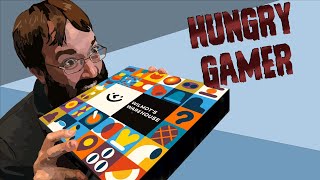
Reviewers agree on the core premise. Wilmot's Warehouse is a cooperative memory game in which the whole table places face-down tiles on a shared grid, then has to reconstruct where everything went during a timed final rush. Where opinions diverge is on how well the experience survives repeated play and how much the group's temperament matters. The Hungry Gamer describes the game with real enthusiasm, calling the result a kind of magic once the group settles into its shared story. The Brothers Murph place it firmly in the fun-but-fragile camp, noting that it is a delight with the right table and a source of frustration without it. Board Stupid recommends it specifically as a dinner party game, arguing that its loose rules encourage conversation among guests who do not normally play board games. BoardGameBollocks argues that the novelty fades after a few sessions. That skeptical voice is the outlier, but it matches a concern that appears in several of the more enthusiastic reviews as well.
Core Mechanics That Define Wilmot's Warehouse
Two mechanics account for most of what reviewers describe.
Memory Placement
Each turn, the group draws a tile from a stack, discusses what the abstract shape might represent, and places it face down adjacent to an existing tile, always orthogonally. Once a tile is down, nobody may look at it again. The Hungry Gamer explains that the rules overview alone cannot convey the experience, because the real work happens when the table has to remember dozens of face-down tiles. Liz Davidson of Beyond Solitaire describes the design as memory on steroids, noting that the timing pressure and the time penalties for each mistake make the final reconstruction feel like a genuine test. The tiles are deliberately ambiguous, so each group's memory depends on the associations it chooses to build during placement.
Collaborative Storytelling
The second mechanic is the story the group invents to anchor each placement. Reviewers consistently treat the storytelling as the actual memory aid. Board Stupid notes that the stories are unique to each table and change from session to session, which is why the game rarely plays the same way twice. The Brothers Murph describe a session in which a rocket, a donut factory, and an underwater deity became the scaffolding for remembering the layout. Reviewers also point out that the design asks players to agree on a shared interpretation, which means the story is not an optional flourish but the mechanism that makes the final recall possible.
The Wilmot's Warehouse Experience
Giddy Absurdity
Most reviewers describe the early sessions as ridiculous in the best way. Tables invent elaborate narratives about devils, urchins, and warehouse managers, and the laughter is constant. The Hungry Gamer recounts an entire backstory built from the placed tiles, complete with a villainous CEO who has to stand on an apple box and a party disrupted by a guitar-smashing interruption. Board Stupid frames the experience as a source of energy around the table, where the strange justifications players come up with become shared inside jokes. This absurdity is the main reason reviewers return to the game, even when they remember few of the details afterward.
Frantic Rush
The closing phase changes the mood. After all tiles are placed, the group matches a deck of customer cards to the face-down tiles within a five-minute window, and reviewers describe the pressure as a sharp contrast to the playful placement phase. BoardGameBollocks says the rush produces a real elevated heart rate and a moment of panic when a card cannot be found. The shift from silliness to scramble is one of the features that keeps the ending from feeling anticlimactic.
What Makes Wilmot's Warehouse Stand Out
Stories That Become Shared Memory
The strongest praise in the transcripts centers on how the group's story functions as a memory tool. The Hungry Gamer says the story stayed vivid for more than a week, long after the session ended. Liz Davidson notes that the game reveals how each friend makes mental associations, which builds familiarity between players. Reviewers repeatedly contrast this with a standard memory game, where recall is a solitary exercise. Here, the recall is social, and the shared story is what makes it succeed.
Rules That Bend Without Breaking
The Hungry Gamer highlights the way the game handles its daily emails, which change the rules each day. Some emails ask the team to work in silence or to speak only in words beginning with particular letters. The official guidance allows the group to decide not to follow an email, and The Hungry Gamer found that this flexibility made the difficulty adjustable without making the game feel arbitrary. Board Stupid also praises the simplicity of the core rules, which can be taught quickly enough for a dinner party audience.
Potential Drawbacks
Dependence on the Group
Nearly every positive review includes a caveat about the table. The Hungry Gamer argues that the game needs players willing to say yes to each other's ideas and to lead the storytelling. Without that, the game can stall, because the rules offer little guidance on how to build a narrative. The Brothers Murph make the same point, describing the game as very group dependent, with a sharp divide between tables that love it and tables that dislike it. Prospective buyers should consider whether their regular group will embrace improvisation before committing.
Thinning Replay Value
BoardGameBollocks argues that the game becomes repetitive after a few sessions. Once the group has seen every tile, the associations start to repeat, and the sense of discovery fades. The same channel also finds the final matching step too easy after the first game, because the stories made earlier help players locate tiles quickly. BoardGameBollocks notes that the rulebook includes harder options, but felt they were not enough to sustain interest after about three games, and adds that the game works best in small doses, better treated as an occasional party game than a regular game night staple.
If You Enjoy Wilmot's Warehouse
Players who enjoy Wilmot's Warehouse's collaborative storytelling will find a related satisfaction in Tale of Arabian Nights. BoardGameBollocks names it directly as the better choice for groups who want a game built around narrative, which makes it a natural next step for players who enjoyed inventing stories but want more structure around them. Players who enjoy the way Wilmot's Warehouse asks a group to read a picture and agree on its meaning will find a similar experience in Vantage, where the art itself drives the decisions. The Brothers Murph describe Vantage as a combined story told by players who each see only their own location, a first-person structure that Stonemaier Games also highlights when discussing its art. Finally, players who like the shared discovery of memory placement may enjoy Time Stories, which Stonemaier Games describes as a game where players gather information from cards and then talk through what they learned as a group.
What Reviewers Are Saying
"And I'll be damn if this game isn't some kind of magic because we nailed it. And the really cool thing is because we made this collective story, I still remember the story."
— The Hungry Gamer
"Super silly, super fun, very group dependent, but if you get a group that's down to just create a weird story for like justification for what's going on, it is such a fun game to play."
— The Brothers Murph
"And the stories that you come up with are absolutely incredible and so unique to the people that play it. It's different every single time."
— Board Stupid