/pic7947338.png)
/pic4458123.jpg)
/pic7947338.png)
/pic8634453.jpg)
/pic4982682.jpg)






































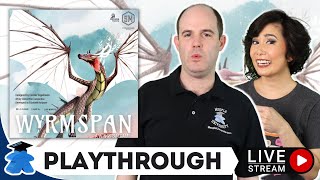

Wyrmspan Deep Dive
What the Community Thinks About Wyrmspan
Wyrmspan lands with a clear sense of identity: the fantasy-flavored, slightly crunchier sibling of Wingspan, and reviewers largely celebrate it on those terms. The consensus is genuine enthusiasm, with players pleasantly surprised that Stonemaier Games delivered something distinct enough to earn its place alongside the bird-collecting classic rather than merely replacing it.
Meeple University's Taran and Stella describe the game as "60 to 70 percent" inspired by Wingspan, but playing with a noticeably different feel. Kovray's Tyler admits he "was a little bit skeptical of is this going to be like Wingspan 2.0 with just dragons," only to conclude "I can say the answer is no." For players who already love Wingspan, the transition is smooth. For newer players, the game offers a welcoming on-ramp that quickly reveals its own strategic depth.
The word that surfaces repeatedly is "satisfying." Engines come together at a pace that rewards patience, scores remain tight until the final round, and the theme of building a dragon sanctuary feels genuinely realized. Meeple University's Stella ranks Wyrmspan as her favorite of the span family, citing combo building that feels more approachable than Wingspan without sacrificing strategic texture.
Core Mechanics That Define Wyrmspan
The Coin Economy and Action Sequencing
Perhaps the single mechanic that distinguishes Wyrmspan most clearly from its predecessor is how turns are structured. In Wingspan, each player has a fixed, shrinking number of actions per round. In Wyrmspan, coins serve as action points, and players begin each round with six, but that number is neither fixed nor guaranteed. Dragons cost coins to play, caves cost coins to excavate, and exploration costs coins to initiate, yet certain cave cards and guild bonuses return coins to your supply. The result, as Kovray's Tyler explains, is that "I might have eight turns in one round and Ilia might have six," creating meaningful asymmetry without any single player running away with the game.
Taran from Meeple University frames this as simultaneously an easier rule set to absorb and a harder game to master. Because you decide how to allocate coins, there is a constant micro-puzzle of whether to spend now for a strong turn or conserve resources to unlock a longer chain of actions later. Reviewers consistently note this feels "smooth" and "bright" throughout play.
Excavate, Entice, Explore: Building the Tableau
Wyrmspan's three core actions form an elegant loop. You excavate caves by placing cave cards, which unlocks spaces for dragons and provides immediate resource rewards. You entice dragons into those spaces at a cost in coins plus the resources printed on each card. You then explore a cave of your choice, moving your adventurer figure left to right past each dragon and triggering every activated ability along the way. Each dragon added to a cave extends the chain of effects your next exploration will activate, which is the engine building in practice: early turns feel sparse, but by the final round a single exploration can cascade through half a dozen abilities.
Meeple University's Taran notes that "things start slow and tight" because there is no bird feeder equivalent for mass resource collection, forcing careful management through cave cards. The payoff comes later, with reviewers describing the final round as capable of generating huge point swings if your engine is properly assembled. Hatchling dragons, which use eggs and milk rather than the standard resource suite of meat, crystals, and gold, add a parallel development track, rewarding players who balance the two populations across their three caves.
The Wyrmspan Experience
A Cozy, Personal Puzzle
Reviewers describe Wyrmspan with a warmth that goes beyond mechanical appreciation. Kovray's Ilia captures this with the image of her little adventurer discovering crystals and feeding baby dragons, noting that "the whole aspect of moving through it made more sense to me" compared to Wingspan's more abstract bird placement. The game feels inhabited. You are not simply placing cards on a mat. You are walking through tunnels, coaxing creatures into chambers, and watching a sanctuary come to life over four rounds.
The tone sits squarely in cozy-fantasy territory. Meeple University's Taran describes dragon abilities as "fitting halfway between Earth and Wingspan," more transactional and icon-driven than Wingspan's text-heavy cards but still layered enough to produce satisfying combos. Decisions feel meaningful without becoming agonizing. Players who prefer a contemplative, solitaire-style puzzle will find the game deeply engrossing, while the Dragon Guild board adds just enough shared competition to keep everyone watching opponents.
Scores Stay Close, Strategies Diverge
Kovray's reviewers note how consistently tight scoring remains across sessions. Their games were routinely decided by three to five points despite pursuing entirely different strategies: guild track advancement, end-game dragon abilities, tucking cards, caching resources. The multiplicity of scoring paths, from eggs and cached resources to guild markers and end-of-round objectives, means no single approach dominates.
Meeple University's Stella frames the satisfaction around the coin system: managing your economy to earn extra actions "feels very satisfying," distinct from the frustration she sometimes has assembling combos in Wingspan. Taran, while slightly preferring Wingspan's broader combo variance, agrees Wyrmspan "is a better game for gamers" overall.
What Makes Wyrmspan Stand Out
The Dragon Guild Board
Replacing Wingspan's private end-round objectives, the Dragon Guild board is a shared racing track where players advance by collecting shield icons during exploration. Each time your marker completes a half-circuit, you place one of your colored cubes on the guild tile, claiming either an immediate powerful ability or an end-game scoring bonus. The tile is available in four variants, each keyed to a specific strategic theme such as eggs, and this provides meaningful session-to-session variety.
Kovray's Ilia singles out the Dragon Guild as her favorite element, describing the tension of deciding whether to grab a spot immediately or wait for a better one while an opponent closes in. Meeple University's Taran notes it functions as the primary form of player interaction: a "racing" element that gives everyone something to watch beyond their own board without introducing take-that aggression.
Art, Theme, and the Dragon Facts Book
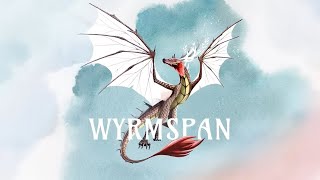
The watercolor illustrations by Clementine Campardou drew immediate attention during The Mill's unboxing, with the reviewer expressing genuine wonder at the variety and imagination on display, noting "I don't think I have enough imagination in my entire head to make all of these unique dragons." The art ranges from adorably round hatchlings to imposing adult creatures to strange hybrids that resemble real-world animals given fantastical treatment. Each card is distinct.
Stonemaier also includes a Dragon Facts booklet with lore for every dragon in the game. Kovray's reviewers note this is a nod to the bird fact text in Wingspan, providing context for players who want a richer world around their sanctuary. The game also ships with a solo automaton mode and a how-to-play section specifically for Wingspan veterans noting key differences.
Potential Drawbacks
Cave Card Color Confusion
Several reviewers flag a common stumbling block: cave cards are printed in different colors (red, yellow, purple), which players naturally assume restricts placement. In fact, cave card color is purely aesthetic and any card can go in any cave column. Kovray's Tyler mentions needing to mentally "overcome" this expectation, Meeple University's Taran notes the visual implication runs counter to player intuition, and The Mill's reviewer calls it out during the unboxing. It clears up after a first game, but it is a notable friction point.
Tighter and More Transactional Than Wingspan
Meeple University's Taran, while positive on Wyrmspan overall, acknowledges that dragon abilities are "more transactional" than the wide variety of text-based abilities in Wingspan. The effects are conveyed almost entirely through icons, which is cleaner to learn but produces a somewhat lower ceiling for surprising or creative combo building. Players who love discovering wild, unexpected card interactions in Wingspan may find Wyrmspan's design vocabulary slightly more constrained.
The early game is also deliberately resource-lean. Without a bird feeder equivalent, players rely heavily on cave card rewards and exploration chains to accumulate the meat, crystals, gold, and milk needed to entice dragons. Meeple University's Taran notes he "wrecked himself" in one round by running out of resources, underscoring that the tighter economy punishes inefficient turns more noticeably than Wingspan does. For some players this is a feature; for others it may feel constraining.
If You Enjoy Wyrmspan
If Wyrmspan clicks for you, the most natural next step is Wingspan if you have not already played it, or the reverse for Wingspan veterans. Both share tableau and engine construction DNA while offering genuinely different experiences: Wingspan is broader and more theme-accessible, Wyrmspan is tighter and more Euro in feel.
Players drawn to resource conversion loops will enjoy Flamecraft, a cozy dragon-themed engine builder with a similarly light tone. Tapestry from Stonemaier offers a satisfying civilization arc with landmark moments of progress at greater complexity. Castles of Burgundy rewards careful planning across multiple development tracks for fans of efficient resource routing. And if the card-driven engine building resonates most, Dominion remains the foundational exploration of cascading turns.
What Reviewers Are Saying
"I was pleasantly surprised by this game. I think in the beginning I was a little bit skeptical of is this going to be like Wingspan 2.0 with just dragons, and I can say the answer is no to that. I feel like these games are so different but they can exist kind of cohesively. There's definitely inspiration, you can see the similarities, but they feel very different when playing the game."
— Tyler, kovray
"It's definitely an easier rule set but a harder game. You would definitely say it's a step up from Wingspan if you enjoy Wingspan. Half a step up. And I think this one is ultimately better for gamers, but not for beginners."
— Taran, Meeple University
"This art I love watercolor art to begin with, but this stuff is just so nice looking, and I would just love to see an original. I don't think I have enough imagination in my entire head to make all of these unique dragons."
— The Mill