/pic7436387.jpg)



FABLED: THE SPIRIT LANDS Deep Dive
What the Community Thinks About FABLED: THE SPIRIT LANDS
FABLED: THE SPIRIT LANDS has captured the attention of board game reviewers with its elegant design and surprising depth. Released by Crowd Games, this 2025 fantasy strategy game plays 1 to 5 players and combines resource management with spatial puzzle-solving in a way that feels both accessible and intellectually satisfying. Reviewers consistently praise its clever mechanics and beautiful artwork, though they note that first impressions may not capture the full appeal. The game rewards multiple plays as layers of strategy reveal themselves and players discover new tactical approaches through different ally combinations and scenario variations.
Core Mechanics That Define FABLED: THE SPIRIT LANDS
Tile Placement and Path Building
At its heart, FABLED: THE SPIRIT LANDS is about constructing a landscape of interconnected paths. Players purchase location cards (prairie, mountain, and forest) and arrange them into a continuous row, choosing where to insert each new card to maximize their sages' movement opportunities. When a location is placed with no sages on it at the end of a turn, it disappears from the board, forcing players to balance long-term planning with immediate tactical concerns. This creates meaningful decisions around placement: inserting a card early in the row might block opponents but also limits your own options, while placing it late offers less control. The paths on each location must connect physically, and sages advance along these paths based on movement phases triggered by player actions.
Resource Conversion and Knowledge Collection
The game features a four-tier resource system where players collect books of increasing value: prairie (yellow), mountains (blue), forests (green), and the ultimate victory point, the book of sun (red). Every action on a player's turn falls into one of four categories: gain two books of prairie, perform conversions at a two-to-one ratio up the tiers, purchase a location, or move a sage one step. What makes this satisfying is that conversion rates are fixed and predictable, so players can calculate precisely what they need without randomness interfering. The elegant constraint is that players must spend these precious resources to place new locations while simultaneously hoarding them to convert toward final victory. This creates the tension of resource allocation where every decision trades off immediate placement power against future point generation.
The FABLED: THE SPIRIT LANDS Experience
Cerebral and Thinky
FABLED: THE SPIRIT LANDS rewards deep thinking and careful planning. Each round feels like solving a personal optimization puzzle, where you must consider not only your own path to victory but also how your actions affect opponents' access to movement and fabled place bonuses. The game creates a constant dance of priorities: do you block an opponent's path to a valuable fabled location, or do you extend your own network? After each player action, every player moves their sages along the chosen terrain type, ensuring that decisions have immediate cascading consequences. This means seemingly minor placement choices ripple through the turn order and force players to adapt their strategies dynamically.
Elegant and Puzzle-Like
Reviewers describe the game as having an elegant simplicity that belies its strategic depth. The core turn structure is straightforward enough for new players to grasp in fifteen minutes, yet the interaction patterns between placement, movement, and fabled place bonuses create a genuine puzzle to solve each turn. The experience feels satisfying because optimization matters without becoming overwhelming. Victory depends almost entirely on the player who makes the best placement and movement decisions, not on who draws the luckiest cards or rolls the best dice. This clarity of cause and effect means players can improve through repeated play, and learned strategies genuinely translate into better performance.
What Makes FABLED: THE SPIRIT LANDS Stand Out
Stunning Visual Design and Presentation
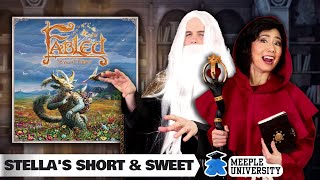
The artwork has made a strong impression on every reviewer who has engaged with the game. The game features striking, colorful illustrations that evoke a fantasy fairy-tale aesthetic. Each location card and ally card has unique art, creating a sense of discovery as players explore their spirit lands. The production quality, from the color palette to the card design, elevates the experience beyond functional game components. The visual presentation does genuine thematic work, transporting players into a world of magic and exploration rather than feeling like abstract symbols on cardboard.
Scalable Complexity and Replayability
FABLED: THE SPIRIT LANDS ships with a scenario book that provides different difficulty levels and flavor variations through variable event decks and special rules. This design choice ensures the game can serve both newcomers seeking a more forgiving introduction and experienced players looking for additional strategic challenges. Ally cards introduce asymmetric player powers that fundamentally alter how you approach each game, and the decision to draft additional allies during play means every game develops differently. Even the same scenario played multiple times can yield entirely different tactical puzzles based on which allies enter play and how the location deck shuffles. This combination of scenarios, ally selection, and card randomness means players discover new strategic dimensions across many plays without feeling like they have solved the game.
Potential Drawbacks
Icon Readability and Learning Curve
Some reviewers note that the icons on location cards are quite small and can be difficult to read from a distance, particularly during crowded game sessions. More significantly, the game has a noticeable learning curve: the turn structure and basic mechanics are simple, but the optimal play patterns and how to evaluate placement opportunities take time to develop. New players may not immediately appreciate the game's elegance because they lack the experience to see the puzzle. The rules are clearly written and teachable in about 15 minutes, but genuine competence requires multiple plays. Players unfamiliar with spatial puzzles or resource management engines may find the first play somewhat abstract and unrewarding.
Medium Complexity and Serious Tone
FABLED: THE SPIRIT LANDS occupies a middle ground in terms of weight: it is lighter than heavy euro games but noticeably heavier than light party games. The game's serious, thinky nature means it works best with players who enjoy optimization puzzles over social interaction or narrative experiences. While the game includes solo and cooperative modes through scenario variations, the default competitive experience is primarily a personal puzzle where your main interaction with opponents comes through blocking their paths and moving their sages when you declare a terrain type. This makes it feel less directly confrontational than games emphasizing player conflict, which may disappoint those seeking more interactive direct competition.
If You Enjoy FABLED: THE SPIRIT LANDS
Players who love the elegant resource conversion in the Century series will immediately recognize the DNA of FABLED: THE SPIRIT LANDS, though the addition of spatial placement and path-following creates a distinct experience. If you enjoyed the path optimization and asymmetric powers of games like Spirit Island, you will find similar satisfaction here, though at a lighter weight. Fans of Great Western Trail and other map-building games should explore the tile placement mechanics that form the backbone of the spirit lands construction. Those drawn to puzzle-like engines will appreciate how Splendor inspired much of the resource layering and how Terraforming Mars' approach to engine building translates into the ally powers here. For solo players and cooperative enthusiasts, the scenario book delivers varied challenges comparable to what dedicated solo systems like those in Talisman provide, without requiring a legacy component or permanent board changes.
What Reviewers Are Saying
"It's got a little bit of a Century kind of vibe to it if you told me this was a fourth episode in the Century series I wouldn't have, it's gonna, it's got enough differences to be its own game but I wouldn't have been fully surprised."
— Meeple University
"When you stop on one of these fabled places you can decide either to stay on the path or for free move to the fabled place and activate it. Now on this one we actually have a choice between two different fabled places we can either go to this one here which will just get us a book of mountains or we can move to this one here which has a special ability that lets us take any of these places where one of our sages is located and move it to anywhere else on this track."
— Totally Tabled
"This is a fantasy fairy tale like game where the gods have determined that it is time for all things to be cast into Oblivion for a new world to start but they want that new world to be led by whoever is the most worthy of containing knowledge so they have issued a competition where these brotherhoods are going out to collect different books of knowledge."
— Board Games for One