







Grand Central Skyport Deep Dive
What the Community Thinks About Grand Central Skyport
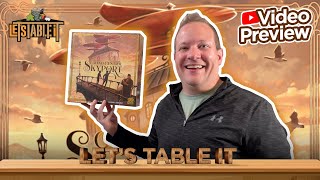
Reviewers across the board are drawn to Grand Central Skyport's elegant design and gorgeous production, though they diverge on the depth of its appeal. Board Game Brody, Jamie Tabletoptiktok, Hungry Gamer, Grant Lyon, and TheGameBoyGeek at Origins Game Fair all speak positively about the game's puzzle-like gameplay and Andrew Bosley's striking artwork. The general sentiment is one of enthusiasm for a game that delivers genuine strategic depth in a compact playtime. However, The Dice Tower's Tom Bassel strikes a more measured tone, calling the game competent but not particularly memorable, and TheGameBoyGeek's main channel review raises concerns about the game's unintuitive flow and scaling issues across player counts. Most reviewers agree: the game is clever and visually stunning, but its appeal hinges on whether you embrace its puzzle-first design philosophy.
Core Mechanics That Define Grand Central Skyport
Tableau Building
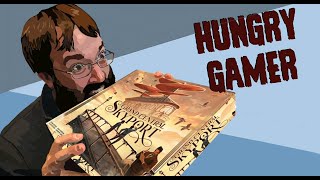
At its heart, Grand Central Skyport is a game about constructing and manipulating a personal skyport: a tableau of colored airship cards arranged in front of each player. Players draw cards from their hand and place them at either the leftmost or rightmost end of their skyport, triggering movement abilities that shift cards across the tableau. The real depth emerges when same-colored cards sit adjacent to each other; they consolidate into stacks that multiply in scoring power. Reviewers consistently highlight this mechanic as the engine driving every decision: you must think carefully about card placement, movement directions, and how each action ripples across your growing tableau. As the Hungry Gamer puts it, the clever fusion of this tableau mechanic with the rondel creates a game where every turn presents a mini-puzzle, and successful players are those who can visualize two or three moves ahead and orchestrate their airships into high-value arrangements.
Rondel
A circular track with fixed action spaces forms the game's second pillar. After resolving your tableau action, you move your marker around the rondel a number of spaces dictated by the card you just played, then take the action at your landing spot. You might acquire new airship cards, draft a station to add scoring opportunities, or recruit a tycoon, a specialist card with unique abilities that unlock new ways to manipulate the tableau or score points. The rondel forces forward planning because the card you play today determines where you land, which gates what options you'll have next turn and beyond. TheGameBoyGeek notes that this creates a notably different rhythm from most rondel games: you're not selecting an action and then acquiring resources to use it next turn; instead, you're playing a card that disrupts your tableau first, then racing around the rondel to grab the pieces you need for the next disruption. This reversal can feel unintuitive initially, but it's what generates much of the game's tension and depth.
The Grand Central Skyport Experience
A Quick, Brain-Burning Puzzle
Grand Central Skyport delivers surprise cognitive engagement in a deceptively compact package. Jamie Tabletoptiktok describes it as "surprisingly puzzly" and notes that the game plays in roughly 40 minutes once players know what they're doing, making it easy to squeeze multiple plays into an evening. Yet those 40 minutes contain real teeth: reviewers consistently mention the "brain-burning" quality of deciding which cards to play, how to arrange stacks, and which tycoons will best amplify your strategy. The puzzle isn't punishing; none of the cards are bad, and multiple viable scoring paths exist. But the decisions matter enough that analysis paralysis can set in. The Hungry Gamer acknowledges this risk, noting that despite the game's intended pace, AP-prone players might find themselves stalling out the clock.
Elegant Chaos with Surprising Interaction
Reviewers praise the game's light-hearted theme and the web of semi-shared interaction that emerges from the wild card mechanic. When you play a wild airship, all other players gain an action tied to that card, letting them move a lane or swap stacks on their own tableaus. The Hungry Gamer calls this "crushing" in the best sense: it means your choice to play a wild card isn't purely selfish; you're giving everyone a tool that might help them too. This shared-resource tension, highlighted by TheGameBoyGeek at Origins, creates moments of genuine fun. The airship theme feels whimsical rather than heavy, and the constant rearrangement of the skyport gives the game a kinetic, almost playful energy. The aesthetic pull of Andrew Bosley's artwork compounds this: reviewers consistently mention that the game simply looks beautiful, and that visual elegance reinforces the sense of orchestrating something grand and efficient.
What Makes Grand Central Skyport Stand Out
Andrew Bosley's Artistic Vision
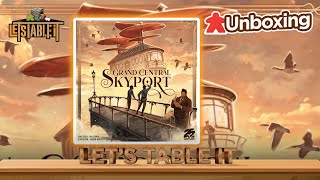
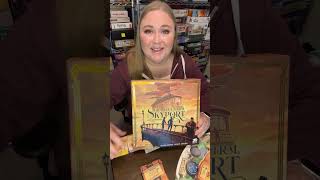
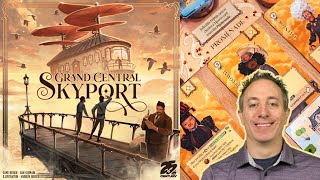
Every reviewer who discusses the visual presentation praises Bosley's work without reservation. His art for Everdell, Tapestry, and flow has earned him recognition across the hobby, and Grand Central Skyport showcases that same distinctive style. Board Game Brody, TheGameBoyGeek, The Dice Tower's Tom Bassel, and Grant Lyon all emphasize the beauty of the components and cards. The airship theme is brought to life through warm, appealing character designs and a cohesive visual palette that makes the game immediately inviting. This isn't just polish; reviewers suggest the artwork reinforces the game's whimsical, approachable tone and makes the puzzle-solving feel less abstract and more thematic.
Strategic Depth Wrapped in Accessibility
One of the most consistent threads in reviewer feedback is the surprise of finding genuine strategic meat under a light exterior. TheGameBoyGeek explains that "there's a lot of strategies in the game that aren't obvious the first couple times you play them, but as you play the game, you'll find the right times to do the right things," including the importance of acquiring the right station at the right moment or landing on specific rondel spaces to unlock key abilities. Jamie notes that the game is "approachable for newer people as well as experienced gamers," suggesting that the learning curve doesn't punish newcomers while rewarding mastery. Multiple viable scoring paths (color stacking, icon collection, tycoon bonuses, station matching) mean that no single dominant strategy emerges, keeping replayability high. This balance between accessibility and depth is what makes the game special for players who want their puzzles without the intimidation factor of a heavy Euro.
Potential Drawbacks
A Sprawling Table Footprint
The most consistent complaint across reviews is the game's physical footprint. Both the Hungry Gamer and The Dice Tower emphasize that while the ruleset is streamlined, the actual tableau of airships, stations, and tycoons sprawls across the table in a way that demands significant real estate. The Hungry Gamer notes that the game requires "a relatively large table footprint due to sprawling tableau and components," and The Dice Tower's Tom Bassel describes it as "a massive table hog" despite the fact that it doesn't feel like it needs to be. This mismatch, a small game mechanically with a large physical presence, is a legitimate friction point for players without generous table space, and it's worth factoring into a purchasing decision.
Unintuitive Flow and Planning Demand
TheGameBoyGeek raises a more subtle but meaningful concern: the rondel's reversed logic compared to tradition. In most rondel games, you choose an action space, take its rewards, and then use those resources on future turns. In Grand Central Skyport, you play a card that immediately alters your tableau, then you're racing around the rondel to grab the reinforcements that capitalize on what you just did. This forward-and-then-grab sequence isn't wrong, but it can feel unintuitive to players accustomed to other rondel games. TheGameBoyGeek notes that "it doesn't feel unintuitive" but "it's what makes this game incredibly crunchy," requiring mental visualization of future board states that some players will embrace and others will find off-putting. Coupled with the fact that card draw randomness can occasionally leave you without optimal plays, the game can frustrate players who prize smooth decision-making over puzzle-solving friction.
If You Enjoy Grand Central Skyport
If the puzzle-like rhythm and multi-use card system appeal to you, consider Everdell, which shares Andrew Bosley's visual magic and also rewards clever tableau construction. For rondel fans seeking deeper engagement, Brass Birmingham or Great Western Trail offer more substantial economic systems with similar rotational action selection. If you value the semi-shared resource tension and want something equally light-hearted, Splendor or Ticket to Ride provide similar decision depth in a more approachable package. For players who love the brain-burning puzzle aspect without the rondel, Cascadia or Azul deliver satisfying spatial reasoning in tighter playtime windows.
What Reviewers Are Saying
"This game is surprisingly puzzly, but plays really quickly. I really like it. It's for two to four players. I do, of course, wish it had a solo mode. But this game plays pretty, especially at the lower player counts once you know what you're doing."
— Jamie, Tabletoptiktok
"First thing is I think the aesthetic and kind of the theming behind the game is great. I love the way it looks. I love this idea of the airships that you're moving around. I really enjoy it. It's just all around clever. I love the way it looks. I love the inclusion they've put into it. It's just beautiful."
— Hungry Gamer
"Gorgeous art to look at. Andrew Bosley art. He does amazing work. And it looks great here. I like the rondel with multiple levels of depth. So there's a lot to think about here with how simple the game is."
— TheGameBoyGeek - Hi Quality Hi Energy Board Game Reviews