










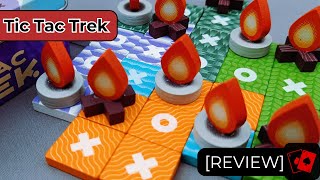

Tic Tac Trek Deep Dive
What the Community Thinks About Tic Tac Trek
Tic Tac Trek has emerged as a delightful surprise in the two-player abstract strategy space. Reviewers consistently praise it as a clever reinvention of a familiar concept. The game takes the simple, solved nature of traditional tic-tac-toe and transforms it into a rich tactical puzzle where every decision feels meaningful. Community responses highlight genuine delight at discovering a game that makes players actually want to get three in a row, overturning decades of understanding that the classic game is largely determined from the opening move.
Core Mechanics That Define Tic Tac Trek
Tile Drawing and Terrain-Based Placement
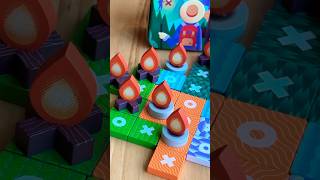
At its heart, Tic Tac Trek combines hand management with tile placement in a thoughtful way. Each turn, a player draws a tile from a cloth bag and must flip it to their side (X or O). The terrain type on that tile dictates where it can be placed: tiles may only be placed adjacent to other tiles of the same terrain type. The one exception comes from wild tiles, which may be placed anywhere on the board. This constraint transforms tile placement into a genuine puzzle. Players cannot simply place tiles wherever they wish; instead, they must work within the evolving landscape they and their opponent are building. The terrain types include forest, mountain, clearing, lake, and others, each represented by distinct colors. This mechanic rewards forward thinking and punishes careless placement.
Campfire Tokens and Scoring
The true genius of Tic Tac Trek lies in how it uses three-in-a-row moments. When a player completes a line of three tiles bearing their symbol (horizontally, vertically, or diagonally), they place one of their campfire tokens on the tile that completed the line. These campfires are the sole source of victory points. Critically, scoring happens only at game's end based on empty spaces surrounding each campfire, including diagonals. Each empty adjacent space is worth one point. This creates a secondary layer of strategy: once your campfire is placed, your opponent naturally wants to fill in the spaces around it to minimize your final score. Conversely, a player might intentionally leave gaps around their own campfires if they believe they can score enough elsewhere. The game ends when the bag runs empty, at which point final scoring determines the winner.
The Tic Tac Trek Experience
Speed and Accessibility
Tic Tac Trek plays in about 15 minutes once players understand the rules. Setup is trivial: place two tiles in the center and distribute the campfires. The ruleset is minimal, making teach time quick and painless. Yet despite the brevity and accessibility, the game rewards tactical play and careful observation. Players spend their turns balancing offense (setting up their next campfire opportunity) against defense (disrupting their opponent's emerging patterns). The compact nature, combined with its portable tin packaging, makes Tic Tac Trek ideal for play anywhere: cafes, airports, beaches, or at home between heavier games. Reviewers repeatedly mention surprise at how much game emerges from such a small package.
The Feel: Charming Yet Cerebral
What makes Tic Tac Trek memorable is the emotional arc it creates. The game opens with a sense of openness and possibility. Placement constraints are loose early; with many tiles unseen, players often have multiple legal moves. As the game progresses, the board fills and the constraint tightens. By midgame, some terrain types may be exhausted or locked behind closed areas, forcing tricky decisions. The presentation throughout is charming: the campfire tokens are beautifully rendered, the tiles are sturdy wood, and the board grows organically as play unfolds. Colors are clear and distinct. The small tin format feels satisfying to pull out, and the components have a pleasant tactile quality. Reviewers noted that the overall charm and presentation significantly enhance engagement, even as the puzzle underneath deepens.
What Makes Tic Tac Trek Stand Out
Solving Tic-Tac-Toe Without a New Ruleset
Traditional tic-tac-toe is solved: both players know the optimal strategy, and expert play leads to a draw. This makes the game dull for anyone above the rank of novice. Tic Tac Trek keeps the tic-tac-toe loop intact (three in a row is still the goal) but breaks the solution by introducing constraints and incomplete information. Players cannot place tiles anywhere; they must follow terrain adjacency rules. They cannot see the next tile drawn until it emerges from the bag. These two elements alone shatter the solved nature of the classic game. Reviewers emphasized genuine surprise that a game inspired by tic-tac-toe is actually exciting to play repeatedly, defying expectations that anything derived from the classic game could escape its solved reputation.
Area Control Depth in a Minimal Package
Many abstract strategy games feel cerebral but cold. Tic Tac Trek combines area control elements (filling spaces around campfires to reduce opponent scores) with a familiar three-in-a-row theme, creating a game that feels both tactical and thematic. The area control is never spiteful or random; it flows naturally from the game's core loop. A player isn't forced to block an opponent; rather, filling empty spaces is often a sensible part of pursuing one's own campfires. This makes the blocking feel organic rather than obstructive, creating a lighter, more social feel compared to mean-spirited abstracts. Reviewers consistently described the experience as fun and engaging without feeling hostile.
Potential Drawbacks
Limited to Two Players
Tic Tac Trek is strictly a two-player game with no official higher player count or cooperative variant. For groups preferring multiplayer abstracts or those who primarily play in teams, this is a limitation. Some reviewers who enjoy competitive play found this constraining, though others appreciated the focused head-to-head design. The asymmetry of a two-player game also means it may not serve as a centerpiece for game nights with larger groups, though it pairs well with other games as an opener or closer.
Early-Game Randomness and Luck
Tile draws are random, and in early turns, players often have many legal placement options regardless of what emerges from the bag. This means the opening 2-3 turns can feel less tense than midgame play. Conversely, some players see this as a feature: it allows casual play while still rewarding skill as the game tightens. Luck does play a small but real role in which tiles arrive and when, which may trouble players seeking pure optimization. However, reviewers noted the luck element is not so punishing as to overshadow player agency, and skilled play can often compensate for unlucky draws.
If You Enjoy Tic Tac Trek
If Tic Tac Trek resonates with you, consider exploring related two-player abstracts. Hive shares the head-to-head puzzle dynamic and minimal ruleset but uses a different tile-movement model and a hexagonal board. For players who love simple yet deep systems, Patchwork offers a two-player quilting game with pure strategy and no luck, though the theme and tile-interaction model differ significantly. Lost Cities provides accessible two-player card play with hand management and a push-your-luck element. Boop is another compact abstract duel with magnetic pieces and a quick playtime. Those seeking charm and portability in the abstract space might also appreciate Gift, a minimalist two-player tile-laying game with a striking visual design. If you love tile-placement mechanics more broadly, Azul, while primarily multiplayer, offers the satisfying puzzle of tile drafting and set collection at a similar weight.
What Reviewers Are Saying
"Tic Tac Trek takes that familiar idea and turns it into a clever and engaging tile placement game. You're always limited by where you can actually place your tile, which makes every move meaningful. There's a surprising amount of strategy here given how minimal the rules are."
— Sir Thecos
"It's a clever game because everyone knows tic-tac-toe, but tic-tac-toe is a little basic and gets a little boring. So this is a fun way to kind of take what everybody knows and just ramp it up a little bit, and the terrain tiles give you some limited movement but also brings in some strategy."
— Jamie, Tabletoptiktok
"It's a wonderful charming little game. It's simple, it's fast. It's the kind of thing you play, okay, let's shuffle, put them back in the bag, let's go again because it's just fun in a tiny little package. The presentation is absolutely lovely."
— Rahdo Runs Through