













All In Predictions Deep Dive
What the Community Thinks About All In Predictions
All In Predictions has generated spirited discussion among reviewers, with general agreement that it captures something fresh within the poker game space. Designer Phil Walker-Harding and publisher Next Move Games (under the ASMNMG imprint) have created a game that appeals to both newcomers intimidated by traditional poker and experienced card players seeking a quicker, more accessible variant. The consensus tilts positive, though with clear recognition that the game's unusual blend of mechanics creates both strengths and friction points depending on your play group and gaming priorities.
Core Mechanics That Define All In Predictions
Hand Crafting Through Multi-Use Cards
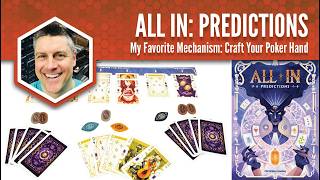
At its heart, All In Predictions is about the constant decision of what to do with each card in your hand. Every card in the deck serves double duty: it grants a powerful action you can activate, but playing it for that action means sacrificing it from your poker hand. This creates a satisfying tension between two competing goals. Each turn, you're evaluating whether a card's special ability (drawing more cards, examining the display, manipulating the river) is worth giving up that card's contribution to your final poker hand. Cards might let you draw additional cards to improve your hand, swap cards from the central display, or gain currency tokens, yet using any of these powers means playing the card face-up and rotating it into the shared play area where others can no longer be affected by its abilities.
Prediction and Information Asymmetry
The game's title reflects its second pillar: the prediction phase at the end of each round. After the river fills with a certain number of cards (determined by player count), all players reveal and score their poker hands, then place a prediction token on the player they believe holds the strongest hand. Correct predictions earn bonus currency, and the pot grows each round, incentivizing sharp observation throughout play. This mechanic forces players to balance their own hand development with careful attention to what other players are collecting, discarding, and requesting information about. It's a clever inversion of traditional poker bluffing, where information is both valuable and deliberately shared through the game's interrogation abilities.
The All In Predictions Experience
Light, Breezy Filler Energy
All In Predictions lands in that sweet spot of being complex enough to reward attention but quick enough to serve as a palate cleanser between weightier games. Rounds play fast, usually wrapping in 20 to 30 minutes depending on player familiarity and group speed. The game moves briskly because most turns involve straightforward card play and decision-making without analysis paralysis. It's the kind of game that works equally well at game night as an opener or a closer, slipping into the evening's rhythm without demanding intense cerebral commitment. The theme of poker is approachable rather than intimidating, and the artwork on the cards, particularly the face cards with their varied illustrations, brings visual personality to each play session.
Tension From Timing and Risk
The round-ending mechanic creates a constant low hum of tension. Because no player knows exactly when the river will fill (cards go down gradually as players take turns), there's perpetual uncertainty about whether you have one more turn to improve your hand or if this is your last chance to commit to your current strategy. The "go all in" option amplifies this by forcing an immediate decision: lock in your hand now and accelerate the round ending, or stay flexible and risk the round ending on someone else's turn. This push-your-luck element means even relatively simple poker hands can feel exciting when they come down to split-second timing decisions or close prediction calls.
What Makes All In Predictions Stand Out
The Satisfying Craft of Building a Poker Hand
Reviewers consistently praised the tangible satisfaction of building a poker hand in this game. Unlike traditional poker, where you're often at the mercy of the draw and bet sequencing, All In Predictions gives you agency. You see cards in a central display, you can request them through card abilities, you can pick up cards you or others have discarded. This abundance of choice means players often finish rounds with strong hands, which feels good. The opportunity cost puzzle, created by multi-use cards, means every decision feels consequential without feeling punishing.
Beautiful Component Design and Thematic Integration
The game's physical presence at the table enhances play without overcomplicating it. Wooden prediction tokens, thick coins, and a carefully illustrated deck all serve the game's poker identity while remaining unmistakably its own thing. The mystical theming (scarab suits instead of traditional diamonds, the ability called "hypnosis") adds flavor without creating a rules burden. Players appreciate that the designers maintained poker's visual language and hand hierarchy while wrapping it in a fresh wrapper, making the game instantly familiar to poker veterans while welcoming those who find traditional poker's betting and bluffing mechanics off-putting.
Potential Drawbacks
Information Revelation and Prediction Tension
The game's most controversial element is how freely information circulates. Certain card abilities let players ask opponents directly about their hand strength, and other abilities force players to reveal multiple cards from their hand. While this feels thematic and supports the prediction elements, it can undermine the guessing game late in a round. Once several players have been asked about their hands, or if one player's strong hand is already widely visible, the final prediction phase loses its mystery. Some groups find this information abundance leads to a game that plays slower than its 25-minute target, as players debate and deduce rather than simply deciding quickly.
Luck and Hand Mitigation Imbalance
The tension between luck and player control occasionally feels unresolved. While hand crafting abilities abound, the cards you draw from the deck remain somewhat random, and the river composition depends on turn order. Some groups report that the ability to manipulate your hand sometimes feels so strong that outcomes feel predetermined, while other groups experience runs of bad draws that create frustration. The balance point between "too much luck" and "too much control" appears sensitive to both player count and group play style, making the game's difficulty and pacing variable in ways that aren't always obvious before sitting down to play.
If You Enjoy All In Predictions
Players who enjoy All In Predictions will find natural bridges to related games. Fans of the poker hand-building without the betting pressure will gravitate toward Ace of Spades, a solo card game that leans even harder into strategic hand development in a western setting. Those drawn to the prediction and deduction aspects should explore The Gang or Ra, both of which hinge on reading your opponents' intentions and the hidden information they hold. Players who love the quick play and light social deduction might also enjoy The Game for its cooperative variant on push-your-luck mechanics. For those seeking poker-adjacent games with strong hand management puzzles, Fortunes of Scoundrel Bay offers a heavier, longer experience with similar multi-use card decision-making.
What Reviewers Are Saying
"This is kind of a breezy fun game that you'd play in between longer, more complicated games. I think if you're familiar with poker hands, it certainly makes it easy to learn."
— Brains on Games
"I really like this idea that this little bit of sacrifice. You're giving up a card from your hand that maybe doesn't fit well in the hand you're trying to craft and you're getting a powerful ability in exchange that will hopefully make your hand better. I thought that was really really clever in all in predictions."
— Stonemaier Games
"What I love about this game, this game plays in 20 25 minutes. Plays two to five players. If you're into simple games based on existing games like we've done with trick-taking games and poker, check out all-in predictions from Next Move Games."
— Rolling Dice & Taking Names