



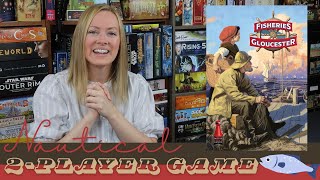

Fisheries of Gloucester Deep Dive
What the Community Thinks About Fisheries of Gloucester
Fisheries of Gloucester is a tightly designed two-player racing game that has earned consistent praise from reviewers for delivering surprising strategic depth within a small box. Designers recognize Steve Finn as a master of the compact two-player game, and Fisheries of Gloucester exemplifies this mastery. The game succeeds precisely because it constrains its scope: two players, six rounds, and a shared ocean board create a system where nearly every turn involves meaningful tension and tactical decisions. Reviewers consistently highlight how the game avoids the "push and pull" dynamic common in adversarial two-player games, instead creating a system where both players feel engaged and competitive throughout all six rounds.
Core Mechanics That Define Fisheries of Gloucester
Tile Placement (Charting a Course)
Players navigate the ocean by placing polyomino tiles onto the shared board. Each placement is free in terms of time cost, but constrained by strict adjacency rules: tiles must be orthogonally adjacent to a ship already on the board and can only be placed on calm water spaces. This creates a puzzle where players must balance setting up their own movement paths with the knowledge that their opponent can also use the tiles they place. The free cost of charting a course makes it an efficient way to extend your fleet's range, but it also means careful positioning is essential, because a well-placed tile by one player becomes an opportunity for the opponent to leapfrog into prime fishing waters.
Time Track (Hour Management)
The heart of Fisheries of Gloucester is the time mechanic. Each round, players receive a set pool of hours: the first player gets six, the second gets seven. Every action costs time: moving a ship costs one hour per space (with modifiers for rough waters or opponent ships), fishing costs one hour per catch, but charting a course is free. The player whose time marker is furthest behind always acts next, meaning cheaper actions yield more total turns while expensive ones cede initiative. Players can also bank unused time between rounds, up to a maximum of twelve hours, adding a resource-management layer. This creates the mind games reviewers emphasize: should you spend your time now and risk running dry, or conserve it and give your opponent more control?
The Fisheries of Gloucester Experience
A Game of Chicken
Reviewers describe Fisheries of Gloucester as tactical and tense, often using the phrase "game of chicken" to capture the moment-to-moment tension. Players constantly weigh whether to commit resources (time, ships, tiles) to seize an advantage or hold back to see what the opponent does. The decision to end your round early and claim the initiative card for the next round is a high-stakes choice: you might need that extra time for a big play, or your opponent might have been waiting for you to pass so they can execute their plan. This back-and-forth creates a game that feels like a series of calculated gambles where perfect information and foresight matter less than reading your opponent and responding dynamically.
Meaningful Decisions at Every Turn
Despite the game's simplicity on paper, reviewers emphasize that nearly every decision moves the needle. Players must continuously balance three parallel paths to victory: gathering fish to trade for preservation cards (which score points), positioning ships on islands for docking points, or manipulating the board state to control which positions become available. The fleet management rule, which prevents any ship from moving more than three columns ahead of the leftmost ship, forces players to advance their entire fleet in lockstep. This prevents runaway leaders and ensures that both players must constantly tend to their lagging ships, adding another layer of tactical constraint that generates meaningful choices throughout the game.
What Makes Fisheries of Gloucester Stand Out
Dr. Finn's Mastery of Small-Box Design
Reviewers note that Fisheries of Gloucester exemplifies Steve Finn's design philosophy: delivering mechanical sophistication and thematic coherence without bloat. The game ships with multiple variants, including a 20-minute card-based express version, a blank-board mode for custom map creation, and optional combative cards called the Fisherman's Feud for added player interaction. Despite all these options, the core game plays in 30-45 minutes and teaches cleanly. Nothing in the box feels wasted; the design is economical in the best sense, with each component serving the game's central tension between exploring the ocean and competing for resources.
Fleet Management Creates Elegant Tension
The three-column constraint on ship movement is a simple rule that generates enormous strategic ramifications. It prevents aggressive players from sending a single ship on a scouting mission while leaving the rest behind, and it forces players to make hard trade-offs: advancing your fleet takes time and resources but unlocks new fishing grounds and island routes. Reviewers praise this mechanic for balancing the game such that both players stay competitive regardless of early luck, because no one can run away with the game through a single dominant strategy. The rule is also elegant because it directly flows from the theme: a scattered fleet has limited range as a cohesive unit.
Potential Drawbacks
Theme May Not Click for Everyone
Reviewers acknowledge that the 19th-century fishing industry is a niche theme. While the mechanics integrate the theme well, the setting doesn't carry the immediate appeal of more popular themes. Players who feel disconnected from the flavor of being ship captains racing to fishing grounds may struggle to engage with the narrative layer, though the game's mechanical elegance should carry them through if they're drawn to two-player optimization puzzles.
Commitment and Follow-Through
One reviewer noted that despite owning Fisheries of Gloucester for years, they never found the time to play it and ultimately culled it from their collection. This reflects a broader challenge: the game requires both players to be present and engaged, and scheduling two-player game sessions can be difficult in modern life. While not a fault of the game itself, the two-player-only restriction means it won't serve as a flexible choice for game nights where group size varies or solo play is desired. Players must commit to finding a regular partner to extract full value.
If You Enjoy Fisheries of Gloucester
Reviewers who love Fisheries of Gloucester also praise other Dr. Steve Finn designs, particularly Finn's compact two-player line. Games like Cosmic Run and Biblios share Finn's philosophy of squeezing meaningful strategy into small packages with tight two-player balance and quick play times. Beyond Finn's catalogue, players drawn to Fisheries of Gloucester's time-track mechanism and resource management might explore other economical Euro-games with strong two-player modes, particularly those where both players must manage shared spaces and adjacency constraints. The game's emphasis on read-your-opponent decisions over luck-driven outcomes appeals to players who enjoy psychological depth in their competitive games.
What Reviewers Are Saying
"This game has so many more interesting complex nuanced mechanics and opportunities for players to really envisage this race in the Fisheries of Gloucester to get your crew together to map out a path to reach these deep waters, these rough waters, to fish for these variety of fish — there's four different fishes — and then to hopefully find these islands, all of which are beneficial to the player. So that's really what players are doing here, and I think it's just done masterfully."
— Tabletop Tolson
"The game is really made by these two mechanics, the the fleet mechanic as well as your time. Yep, because that is what limits you, and that's what makes the game really sort of tough when you — it turns it into a mind game of sorts, right? It's a game of chicken."
— Monique and Navine, Before You Play
"And that's the thing that's neat — it's, it's a... all the decisions are meaningful for such a small game, right?"
— Monique and Navine, Before You Play