









The Four Doors Deep Dive
What the Community Thinks About The Four Doors
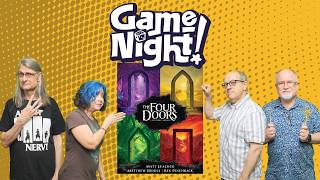
Reviewers across the board celebrate The Four Doors as an exceptional cooperative game that packs heavyweight design into a remarkably compact package. The consensus is remarkably consistent: this is a masterclass in distillation. One Stop Co-op Shop's Jason describes it as "basically Pandemic the card game," while Roto (Rahdo Runs Through) calls it "two-dimensional pandemic" because the tower of four doors replaces the world map. Jon Purkis of Actualol praises it for delivering "big game energy crammed into such small pants that people will stare." The game is especially noteworthy because it represents the first time legendary cooperative designers Matt Lecock, Ben Pinchback, and Matt Riddle have collaborated on a single title. Where reviewers diverge slightly is on replayability: Jason from One Stop Co-op Shop expresses some concern about long-term replay value after multiple plays, noting that the tactical puzzle, while satisfying, lacks the navigational variety found in Pandemic or Forbidden Island. That said, even he concludes with a firm "Recommended," acknowledging veteran-level craftsmanship throughout.
Core Mechanics That Define The Four Doors
Cooperative Game
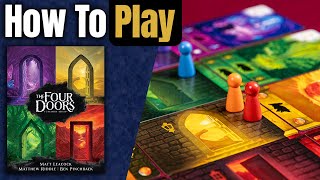
The Four Doors places all players on the same side against escalating shadow threats. Your adventurers move along a row of four doors, each player starting at a different position. The joy, as Actualol notes, "is in making a plan: Who can go where and deal with what?" Every action is public knowledge, so teams must constantly discuss strategy, coordinate their limited card plays, and anticipate the emerging danger. The game creates what One Stop Co-op Shop identifies as "crisis management" moments, where shadow attacks force the group to react in real time. Unlike many lighter co-ops that offer no real threat, The Four Doors demands genuine tactical discussion and carries meaningful win-or-loss stakes.
Set Collection
Victory depends on collecting all four relics before the shadow veil seals the doors forever. To claim each relic, a player must discard four matching cards of the corresponding color and move their pawn to that door. This creates sustained tension: you must balance your immediate need to clear shadow threats against your longer-term obligation to gather and hold the specific cards you need for relic collection. The set collection is not passive; it drives moment-to-moment decisions about which cards to play for defense versus which to hoard for acquisition.
The Four Doors Experience
Escalating Pressure
The defining emotional arc comes from the game's brilliant dual-use deck. Jon Purkis of Actualol explains it best: the deck holds only one pool of cards, and those same cards serve double duty as both the players' hand and the shadow threat. Draw cards from the deck to replenish your hand, and shadows simultaneously accumulate against the doors. This creates a vicious cycle: the more cards you draw to fight back shadows, the fewer resources remain in the deck, which forces a reshuffle that advances the shadow level. Actualol captures this perfectly: "As your dirty laundry is piling up, that means you've got less clean clothes to wear." The pressure mounts deliberately, forcing choices between immediate relief and long-term survival.
Tense Puzzle-Solving
Reviewers consistently use the word "puzzly" to describe the moment-to-moment play. Each turn unfolds like a puzzle: which door needs attention most, which cards can you afford to spend without sabotaging future relic claims, which player should move where. The Unknown Channel reviewer captures this clarity: "You will have to talk and strategize together to beat this game." The game rarely offers a single obvious solution; instead, it presents trade-offs that demand group discussion and compromise. As Roto notes with admiration, it plays in 30 minutes despite offering this level of strategic depth, making it a genuinely satisfying cooperative puzzle that never outstays its welcome.
What Makes The Four Doors Stand Out
The Ingenious Dual-Purpose Deck
Reviewers on multiple channels single out the same design innovation: one deck serving dual roles. Jon Purkis of Actualol frames it directly as the "genius design choice" of the entire game, and other reviewers circle back to this same mechanic when explaining what sets The Four Doors apart. Because player cards (which you need for your hand and for fighting shadows) come from the same pool as the shadow cards themselves, every draw has a cost hidden within its benefit. This is not new territory for cooperative games, but here it is weaponized with exceptional clarity. The result is what Actualol describes as a game that "packs a tense, puzzly co-op experience into a face value of 45" (referring to shelf space efficiency, but capturing the design density as well).
Masterful Design Distillation
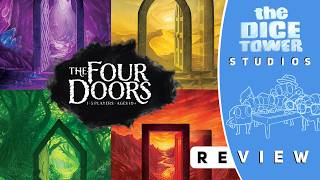
From HCM, a publisher committed to value, The Four Doors achieves what the Unknown Channel reviewer praises as a "small box cooperative game that feels bigger than its box size." This is not minimalism for its own sake; every rule exists to strengthen the core puzzle. Movement is confined to a row, which simplifies navigation but focuses conflict onto specific doors. The 5-card hand limit is strict, which forces desperate choices about card management. Special abilities on adventurer cards and relic cards layer asymmetrical power without overwhelming players. Roto's enthusiasm stems partly from this restraint: designers like Lecock, Pinchback, and Riddle know how to cut away the extraneous and leave only what matters.
Potential Drawbacks
Limited Tactical Variation Across Sessions
Jason from One Stop Co-op Shop articulates a measured concern: the game can begin to feel solved after repeated plays. He contrasts The Four Doors with Pandemic and Forbidden Island, noting that those games feature dynamic tactical decisions because of their spatial variety. Forbidden Island's disappearing tiles reshape the board each game; Pandemic's 48-space world forces constantly shifting strategies. The Four Doors, by contrast, always has four doors in a row. The variability comes primarily from card draw and from which adventurers enter play, not from the board itself. Jason stops short of calling this a fatal flaw, noting he is happy to play if it comes out on the table, but he acknowledges it may not be a game he seeks out repeatedly once he has gotten the idea after several plays.
Steep Difficulty Floor Requires Player Buy-In
The Unknown Channel reviewer notes pointedly: "I think I've lost this game more than I've won it." This is framed positively (winning feels good when it happens), but it signals that The Four Doors is genuinely difficult. It is not a game for groups seeking a relaxed, low-stakes cooperative experience. The escalating threat and the tight hand limit mean players must coordinate precisely. Groups that prefer cooperative games as social experiences rather than puzzles to solve may find the puzzle overshadows the fun. However, for groups that thrive on challenge and team communication, this difficulty is a feature.
If You Enjoy The Four Doors
Reviewers consistently draw parallels to Pandemic, calling The Four Doors a spiritual successor. If you love Pandemic's crisis management and cooperative resource juggling but want a tighter, faster experience, The Four Doors delivers exactly that. Similarly, if Forbidden Island's blend of escalating threats and set collection appeals to you, The Four Doors explores comparable ground with more mechanical depth. The game sits comfortably between those two franchises, making it an ideal next step for groups ready to graduate from Pandemic-adjacent experiences.
What Reviewers Are Saying
"As much fun as I have with this game, and I'm happy to play if it comes out on the table, I don't know if it's going to be something that I'm going to seek out, especially as I've already played four or five games of this, and I think I got the idea. Still, it's very solid."
— One Stop Co-op Shop
"The genius design choice of this game is there's only one deck of cards. They are player cards for killing spirits, and on the other end, they're spirit cards for killing doors. Whether you're drawing new cards for your hand or new spirits for the lighthouse, you're drawing from the same deck. And that means it runs out fast. Whenever you have to reshuffle the discard pile to draw more, the game escalates."
— Actualol
"I think I've lost this game more than I've won it, which makes it feel pretty good when you win. You will have to talk and strategize together to beat this game, and it's only $20."
— Watch Review