








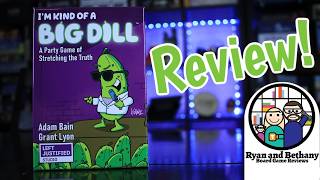

I'm Kind of a Big Dill Deep Dive
What the Community Thinks About I'm Kind of a Big Dill
Reviewers agree that I'm Kind of a Big Dill is a verbal party game built around storytelling and social reading. Designed by Adam Bane and Grant Lyon and published by Left Justified Studio, it asks each turn-taker to draw a category card, such as their thirst for revenge or their bedside manner, and then secretly adjust their honest answer by a token ranging from negative three to positive three. The storyteller then talks through the adjusted version of themselves while everyone else tries to work out the token.
Ryan and Bethany Board Game Reviews called it "super silly fun" and a great pick for holiday gatherings. The same channel was clear that the game works best among people who already know each other. Grant's Game Rex placed it outside its top ten party games but described it as a game the designer believes in, and the channel noted that the design is built to be fun even when the storyteller is slightly off. Watch It Played presented it as a fresh take on the genre, and Tabletoptiktok praised it as a party game that moves past the standard formats players have seen many times. Among the reviewers, the shared view is that the game is a warm, low-prep social game for groups who enjoy talking, with the caveat that it rewards familiarity more than strangers.
Core Mechanics That Define I'm Kind of a Big Dill
Storytelling With a Secret Exaggeration Token
The storytelling mechanic is the heart of the game. The storyteller picks one of the category cards, thinks honestly about the topic, and then draws a token that tells them how far to bend the truth. Ryan and Bethany explained that a player who draws a negative token might make themselves sound less capable than they are, while a positive token pushes the story in the opposite direction. Tabletoptiktok described the appeal as letting players "use some storytelling skills" without having to invent something from nothing: "you're taking some truth and then you're kind of finessing it one way or the other." Because the storyteller starts from something real, the stories stay grounded enough for listeners to read them. Ryan and Bethany noted that a zero token means telling the plain truth, which gives the table a useful baseline when they guess.
Compound Scoring Split Between Clue Giver and Guessers
Scoring divides the table into two roles with separate tallies. Each guesser who names the exact token earns two points, and a guess that lands one step away earns one point. The storyteller scores only when some, but not all, of the other players guess correctly. Ryan and Bethany described the consequence clearly: if everyone guesses right, the storyteller scores nothing, and if nobody does, they score nothing either. Watch It Played noted that the scoreboards are shaped like pickles and use pickle tokens, so the points are tracked on the box itself. Tabletoptiktok appreciated that there are no extra score sheets to manage. Because the two sides are tallied independently, a player can do well as a guesser even on a turn when the storyteller's clue falls flat, which keeps everyone engaged across the whole round.
The I'm Kind of a Big Dill Experience
Playful Tension in Being Subtle
Reviewers describe the moment before a story as a balancing act. Ryan and Bethany said they liked that the game does not allow an over-the-top performance: "if you draw the negative three or the positive three you could just go so grandiose about it and it's going to be very obvious." Instead, the storyteller has to shade the account just enough that some players catch on and others do not. Watch It Played summed up the same tension when discussing how a listener who does not know the speaker might read the same story very differently. That gap between what the storyteller knows and what the table can infer creates a steady, comedic pressure that reviewers found enjoyable rather than stressful.
Warm, Familiar Table Talk
The second feeling reviewers mention is the warmth of hearing people you know reveal something about themselves. Ryan and Bethany described a round in which their question-asking felt like knowing a friend well enough to predict the answer, and they said the game is "just a great silly fun party game" for family and friends. Their seven-year-old child asked to play even when the adults were only setting up, which the channel took as a good sign. The Christmas and holiday cards in particular gave the table a shared joke to build stories around. The atmosphere is closer to a conversation with a playful rule set than to a competitive contest, and reviewers said the best rounds end with players going back to explain why they answered the way they did.
What Makes I'm Kind of a Big Dill Stand Out
Almost Entirely Verbal Play
Ryan and Bethany's list of games to play while caring for a newborn put this title near the top, largely because it is "almost 100% verbal." The channel explained that the storyteller speaks while everyone else listens, and guessers only need to write or circle a number. Nothing has to be moved, shuffled, or handled, which made it one of the few options that worked when one parent had a baby in one arm. The same qualities appear in Tabletoptiktok's review, which described the game as easy to pick up and light on components. For a party game meant to be played across a room, that low handling requirement is a practical advantage.
Flexible Length and Expansions That Fit the Base Box
Reviewers also praise how easily the game adapts to the time available. Tabletoptiktok pointed out that players can choose the number of rounds, from a quick game to an extended session, and that the expansions tuck neatly into the base box so everything stays in one place. The Big Dill Gets Nerdy expansion was the one Tabletoptiktok tried, and Ryan and Bethany played the holiday expansion with cards themed around the season. Both channels noted that content can be separated when needed, which makes the game easier to tailor to different groups.
Potential Drawbacks
It Rewards Players Who Already Know Each Other
The most consistent criticism comes from reviewers who tested the game with people they barely knew. Ryan and Bethany said it is "not a game that I would use as an icebreaker," because guessing a token depends on understanding how each person normally talks about themselves. Their advice was that, without that background, the scores become almost random and the stories land in unexpected places. Watch It Played raised a similar point about introverted players, who may find it hard to perform a story in front of a group they do not know well. Reviewers generally see this as a design boundary rather than a flaw, but it does limit where the game fits.
Age Rating and Card Content Need Some Care
Ryan and Bethany noted that the base box lists an age of 12 and up, while their seven-year-old enjoyed the game. Some cards, such as those about specific fandoms or niche hobbies, were not understood by a young child, and the channel suggested explaining those cards or removing them. Their discussion also flagged that a separate After Dark expansion exists for more mature content, and that it is not included in the base box. Families who want an all-ages game should plan to prune or explain cards before play.
If You Enjoy I'm Kind of a Big Dill
Players who enjoy I'm Kind of a Big Dill's storytelling mechanic will find similar satisfaction in That Escalated Quickly. Grant's Game Rex described it as the storytelling counterpart to Wavelength, where players give funny or descriptive clues to get others to guess a number from one to ten based on a scenario. Players who like the scoring tension of guessing hidden values will feel at home with Wavelength, which Grant's Game Rex praised for its clue-driven guessing and its physical spectrum. For larger groups that want a social game where everyone's answers matter, Green Team Wins offers the same blend of group reading and laughter, and the same appeal to players who enjoy watching others reveal their choices.
What Reviewers Are Saying
"The box does say 12 plus, but we did play this with our seven-year-old and she totally got it. There's cards in there that she doesn't understand, like your love for goth night at your local bar. She just doesn't get that, but they're not like necessarily inappropriate."
— Ryan and Bethany Board Game Reviews
"If they are spot on to the number that I had they will get two points, and I love it because you just tally them on here no extra pieces of paper or score sheets needed. If they were one away they'll get one point."
— Tabletoptiktok
"It's a fun game of exaggeration. So, I designed a party game that's out there. I didn't want to put it in my top 10 cuz that's a weird thing to do, but it is a fun game and I do believe in it and that one is available as well."
— Grant's Game Rex