







Tricky Kids Deep Dive
What the Community Thinks About Tricky Kids
Tricky Kids has generated significant enthusiasm among board game reviewers, who consistently praise its cleverness and fresh approach to trick-taking. The game stands out for solving a problem that many trick-taking enthusiasts find frustrating: being stuck with a poor hand. Reviewers from Ryan and Bethany Board Game Reviews to The Cardboard Herald highlight how the game manages to be simultaneously chaotic and strategic, creating memorable moments at the table. A notable point of discussion centers on the game's marketing and naming. While the title and cute aesthetic suggest a children's game, reviewers unanimously agree this is actually a thinky, engaging experience better suited for players aged 12 and up. Despite this mismatch between branding and gameplay depth, the community's overall reception is positive, with most reviewers appreciating both the mechanical innovation and the social dynamics the game creates.
Core Mechanics That Define Tricky Kids
Hand Crafting Through Dry Erase Values
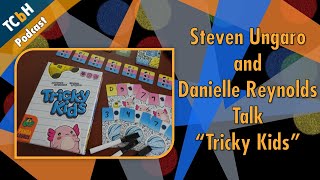
The heart of Tricky Kids lies in its innovative value-assignment system. Players receive nine cards representing three different suits (axolottle plushies, video game controllers, and soccer balls), then discard two to form a hand of seven. Rather than playing predetermined numbers, each player uses a dry erase marker to write values on their cards, with one constraint: all values in a hand must sum exactly to 21 points. Players can distribute these 21 points however they wish, assigning anything from zero to 21 on any individual card. This design eliminates the classic trick-taking frustration of receiving an unplayable hand. Instead of being dealt bad luck, players have complete agency over how their hand aligns with the scoring tokens available each round. The scoring tokens themselves display different point values for each suit, creating a puzzle where players must balance building a hand strong enough to win the tricks they want while remaining flexible enough to avoid getting stuck with cards they don't need.
Dynamic Scoring and Trick-Taking Resolution
Once hands are crafted, play follows familiar trick-taking conventions: players must follow the led suit if they can, and the highest card of the led suit wins the trick. However, Tricky Kids adds several wrinkles that keep the genre feeling fresh. There is no trump suit in the base game, keeping the ruleset streamlined. If two players write the same number on the same suit, those cards knock each other out, creating moments of chaos and humor. Players score points based on the scoring tiles available when they win a trick, and these tiles change each round to encourage varied strategies. The game plays three rounds, and players track their cumulative scores across all hands. An important safeguard: if a player's written values exceed 21 when checked at round's end, that player scores zero points for the entire round, adding a tension between ambitious hand-crafting and careful arithmetic.
The Tricky Kids Experience
Clever Decision-Making Within Tight Constraints
Tricky Kids creates a satisfying puzzle at the table. Before tricks are even played, players face a genuine problem to solve: how to distribute 21 points across seven cards in a way that positions them to score points when they want them and avoid losing when they don't. Reviewers highlight how this phase, often just a few minutes of silent marker work, is where the game's real strategic depth emerges. Players must look at the scoring tiles available that round and make educated guesses about what their opponents will do. Will everyone go for the high-value suits, or will clever players sabotage obvious strategies by assigning low values to powerful cards? Each decision branches into cascading consequences, making every hand feel like a fresh puzzle to solve.
Chaotic Table Moments and Social Play
Despite its strategic underpinnings, Tricky Kids cultivates a remarkably social atmosphere. When two players accidentally write the same value, triggering the knockout rule, the resulting laughter and groans create the kind of memorable table moments that make games memorable. The game's designers deliberately included this rule partly for the emergent humor. Reviewers describe how the game's social nature transcends typical trick-taking experiences, moving closer to party-game or deduction-game territory because players spend so much effort trying to read what their opponents will do. The handwriting phase also adds personality to the game, as legibility becomes a live concern at the table. These social elements combine with solid mechanics to make each play session feel different, keeping the experience fresh across multiple plays with the same group.
What Makes Tricky Kids Stand Out
Player Agency and the Elimination of Bad Luck
Unlike most trick-taking games where players are slaves to the cards they draw, Tricky Kids gives players meaningful control. If you draw a weak hand in a traditional trick-taking game, you are stuck. Here, you get to decide your hand's strength. This shift is profound. You cannot have a genuinely bad hand because you define what your hand means. This design choice attracted the interest of Danielle Reynolds, the lead designer, who famously dislikes trick-taking games precisely because of situations where players feel powerless. By creating a game where hand quality is determined by the player rather than the deck, Tricky Kids solves that core frustration while staying true to the trick-taking genre's essence.
Elegant Mechanical Simplicity Hiding Depth
The base game rules fit on a single page. You write numbers adding to 21, you follow suit, highest card wins. Yet this simplicity enables surprising depth. The game includes optional "Tricky Rules" cards that can modify individual rounds, introducing mechanics like allowing offsuit zeros to win tricks or requiring players to write to 42 instead of 21. These cards add variability without bloating the ruleset. Reviewers appreciate how Pandasaurus and the designers crafted a game that plays quickly (under 30 minutes) while offering enough meaningful decisions to keep experienced gamers engaged. The publisher also made the strong choice to include these variant rules in the box, allowing groups to escalate complexity as they become comfortable with the base game.
Potential Drawbacks
Marketing Mismatch and Audience Confusion
The most consistent concern reviewers raise is the disconnect between the game's name, artwork, and actual complexity. The title "Tricky Kids" combined with the cute axolottle plushies and colorful aesthetic creates an expectation that this is a family game suitable for young children. In reality, the game requires comfort with arithmetic (adding to 21) and strategic thinking better suited to ages 12 and up. This mismatch may cause casual buyers to purchase the game expecting something simpler, or conversely, potential adult players might overlook it thinking it is too simple. Parents looking for a genuine children's trick-taking game may find Tricky Kids too demanding, while adults seeking accessible trick-taking options might worry the theme will bore experienced gamers. The designers have acknowledged this tension, but it remains a barrier to optimal matching between the game and its audience.
Component Readability and Physical Handling Challenges
The dry erase card system, while innovative, presents practical challenges. Writing numbers on cards with markers sometimes results in illegible handwriting, especially during rushed play or with younger hands. Reviewers note that smudging can occur as cards are played and handled, and the readability of hastily scribbled numbers occasionally requires clarification mid-trick. Additionally, some players report that dry erase ink does not adhere perfectly to all cards in all boxes, potentially requiring rewriting values during a game. While these are minor concerns that do not fundamentally break the experience, they represent friction that more established components would not introduce. The physical nature of writing on cards also means the game does not appeal to players who find the administrative overhead burdensome, even if that overhead takes only a few minutes per round.
If You Enjoy Tricky Kids
Players who appreciate Tricky Kids's core appeal should explore related games that emphasize player agency and social interaction within trick-taking frameworks. Cat in the Box offers even more creative freedom in card play, allowing players to declare suits retroactively, which delivers the kind of decision space and emergent storytelling moments that Tricky Kids players often enjoy. Skull King combines trick-taking with bidding mechanics and a push-your-luck element, offering a different flavor of strategic trick-taking that similarly rewards clever hand evaluation. Exploding Kittens</strong appeals to the social, chaotic energy of Tricky Kids, though it trades trick-taking mechanics for a faster, more luck-driven experience.
For those who want more scalable complexity after mastering the base game, exploring the Tricky Rules variants included in the box is the natural first step. The designers and publisher have signaled that expansions are already in development, which may introduce new wrinkles without losing the game's essential elegance.
What Reviewers Are Saying
"So, it's both chaotic and strategic. Two things that don't normally, you know, get paired together are happening at the same time in this game, which is really weird and fun."
— Ryan and Bethany Board Game Reviews
"The writing at the values is my favorite part of the game. I think it's an amazing thing. It's so interesting."
— The Dice Tower
"When I first played this, I was like, 'All right, so designed by somebody who doesn't like trick-taking games. Okay, let's give this a try.' And I was like, 'Oh, this is actually really, really clever.'"
— Heavy Cardboard