







Xenology Deep Dive
What the Community Thinks About Xenology
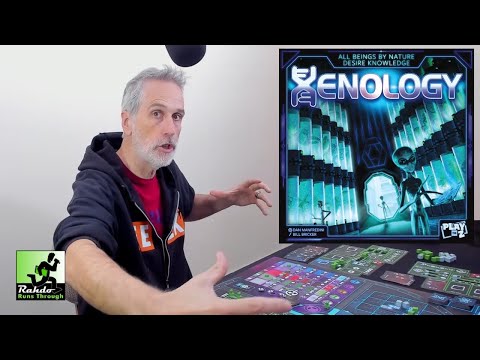
Reviewers consistently praise Xenology as a tightly designed, thematically integrated euro that challenges players to manage a deceptively complex economy. The game's core identity revolves around resource scarcity and forward planning, drawing enthusiasts who enjoy puzzles of efficiency. Graham from the featured review put it plainly: the game "revolves around your cubes" and understanding "when to use them and when to save them is kind of critical to how well you do." That tension defines the experience across the board.
One consistent note emerges from multiple reviewers: the game does not shine at two players. Graham explicitly observed that at two players the game "felt like it was missing something" compared to three and four player counts. The Rolling Dice & Taking Names hosts found the two-player experience felt overly procedural, with predictable turns that lacked competitive friction. With more opponents at the table, that same predictability transforms into genuine tension, as each action decision carries weight against multiple competing plans.
The game's visual presentation draws mixed reactions. Reviewers note the components are "functional" and the alien meeples are charming, though the overall aesthetic doesn't command the table presence of recent AAA productions. For a euro that wears its theme so deliberately, the visual design holds its own.
Core Mechanics That Define Xenology
Worker Placement
Xenology employs a directional worker placement system unlike traditional fixed-action boards. Players move one alien at a time across the mothership, always traveling to an adjacent action space. This creates a puzzle where position matters: you cannot jump across the board, forcing players to think several moves ahead about where their workers will be stationed. The system allows multiple workers at the same space, so blocking is not the core tension: scarcity of actions and their sequencing is.
Knowledge Management Through Research Cards and Archives
The second pillar is the research and knowledge system. Players propose studies to the council of elders, complete research by extracting samples from the planet, and then archive that knowledge in a communal database. Each card represents a study with two requirements; fulfilling both costs management cubes but advances players toward rank and unlocks more powerful storage capacity. The archive layer adds a sophisticated puzzle: you must plan extractions that match your terrain, store specimens in specialized lockers (each with unique sample types), and eventually convert completed research into points. This isn't simply acquiring resources, it's transforming specialized knowledge into tangible advantage.
The Xenology Experience
The Tension of Cube Scarcity
Reviewers unanimously identified cubes as the emotional core of play. You begin with three and spend them constantly: one for proposing research, one for moving up a track, one for claiming storage, one for leaving evidence when extracting samples. The economy is so tight that players can hit dead turns where they lack the cubes needed to act. Rather than skip the turn, they're forced to move a worker into neutral position, hoping next turn will unlock what they need. That constraint creates genuine anxiety about every decision. Graham summed it up: "Getting cubes is not easy. So when you see a chance to get them, you should take it."
The Puzzle of Optimal Sequencing
A secondary vibe runs through the reviews: the satisfying crunch of planning the ideal sequence. Do you prioritize launching landing craft now to collect samples, or grind up the elders track to unlock higher rank and more storage? Does this research card synergize with the terrain you explored, or should you hunt for a better match? The game rewards players who trace consequences three or four moves forward. Reviewers who loved that planning challenge found themselves absorbed; those who found it restrictive felt railroaded by their own earlier choices.
What Makes Xenology Stand Out
Theme as Mechanic, Not Flavor
Graham made the key observation: "For a Eurogame, I found the theme well done and actually kind of well integrated into the mechanisms." The alien narrative isn't window dressing. Leaving evidence on the planet justifies why extractions cost cubes. The research proposal system explains why completing studies unlocks bonuses and advances rank: the elders grant favor for directed study. The themes of exploration and knowledge-gathering drive every action. Players aren't moving abstract tokens; they're directing a coordinated alien mission under mounting pressure.
Ranking and Final-Round Leverage
The endgame mechanic rewards players who balanced focus and diversification during the game. Rising to rank three grants three bonus turns once the game ends (triggered when someone claims their last cube). This can swing the outcome dramatically and makes mid-game rank advancement a strategic pivot point. Players chasing rank play very differently from those chasing pure cube accumulation, and both strategies can win.
Potential Drawbacks
Two-Player Dynamics Fall Flat
Multiple reviewers noted that the two-player experience suffers from predictability. With fewer opponents, it becomes obvious what your opponent wants to build, and you have little incentive to compete for the same resources. Instead, you split the board: "You're making your movie, I'm making mine. May the best studio win," as one reviewer observed. The spacious action economy at two players eliminates much of the desperation that makes three-plus-player games sing. If Xenology is in your collection, it should be played at the higher player counts to unfold properly.
Luck and Card Cascade in Early Rounds
Reviewers noted that the first several rounds of every game feel similar because players need lockers and specimen containers before they can execute more exotic strategies. The database really only becomes a major scoring engine later, so most games follow a predictable progression: secure storage, go to elders, land on planet, extract samples. Card luck also matters: if you need a specific study card and the wrong terrain appears on your planet, you're efficiency-blocked. Players at higher skill can absorb these setbacks, but less experienced players can feel trapped by earlier choices or unlucky draws.
If You Enjoy Xenology
Reviewers compared Xenology to a handful of kindred spirits. If you're drawn to its tight economy and thematic worker placement, consider Trail Stories America and Far Space Foundry, both of which layer sophisticated resource management with strong thematic narratives. Games like Agricola also share that "don't waste a single action" energy, though Xenology's knowledge-focused theme gives it a distinct flavor. The game works best with players who savor efficiency puzzles and don't mind multi-step sequences that demand forward planning.
What Reviewers Are Saying
"I absolutely love the theme in this one. The fact that you play as aliens exploring a new planet, they don't explicitly say it's Earth, but I've always thought of it as Earth, and you're abducting people and animals while leaving some evidence behind. So for a Eurogame, I found the theme well done and actually kind of well integrated into the mechanisms."
— Watch Review
"The game really doesn't shine at two. It works and is enjoyable, but it doesn't feel as satisfying as the three and four."
— Watch Review
"You want to get these cubes desperately. In fact, it's such an important thing is that each of us has a bunch of cubes off to the side. The game end is triggered once one player collects all of their cubes."
— Rahdo Runs Through