




Transformers Deck-Building Game Deep Dive
What the Community Thinks About Transformers Deck-Building Game
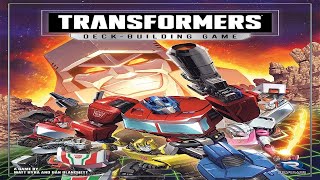
Transformers Deck-Building Game from Renegade Game Studios has earned respect from the board gaming community as a mechanically sophisticated take on deck building that brings genuine thematic weight to a licensed property. Reviewers across multiple channels agree: this is not a light game, and it demands engagement from players who want to master it. But those who invest the time find a system where the Transformers license isn't just window dressing. The way you move around a grid, shift between vehicle and robot modes, and coordinate with teammates to face down boss Decepticons feels intrinsically tied to what it means to be an Autobot. The game offers both cooperative and competitive experiences, and the community recognizes both as equally valid ways to play. Board Game Coffee, which has produced multiple tutorials and breakdowns, approaches the game as a serious rules challenge worth learning. Meanwhile, reviewers from Stonemire Games and Board Games UnLocked spotlight specific mechanics as genuinely innovative, particularly in how the game integrates spatial movement into deck building.
Core Mechanics That Define Transformers Deck-Building Game
Deck Building with Spatial Movement
At its heart, Transformers Deck-Building Game is a deck-building game: players start with a small identical deck, draw five cards each turn, play as many as possible, and cycle through a growing personal deck as they acquire new cards. But Renegade Game Studios adds what reviewers describe as a genuinely unusual twist. Unlike traditional deck builders where cards sit in an abstract market row, Transformers forces you to move your token around a grid in the center of the table. You must physically navigate to the card you want to acquire or battle. This spatial requirement means that movement points become as valuable as power points. You spend your movement resource to explore face-down cards in the Matrix, or to position yourself on a card you want to buy or fight. The grid itself serves double duty: it is both your play area and an implicit timer. As you refill empty spaces from the main deck, the game clock ticks down, pushing you toward confrontation with increasingly powerful boss Decepticons. This fusion of deck building and exploration creates a rhythm that feels distinct from games like Dominion or Ascension.
Boss Battles with Assisted Confrontation
Fighting Decepticon bosses is not a solo affair. When you declare a confrontation, you generate as much power as you can by playing cards, and then other players within range have the option to assist you by contributing a face-down card to the battle. When you accept assistance, you pool power. If the combined total defeats the boss, not only do you gain the victory points, but so does every player who assisted you. This creates an interesting social dynamic: calling for help means sharing the reward, but going it alone risks failure. Reviewers note that boss battles are where the game's rules complexity peaks; you must manage encounter card draws that can increase the boss cost mid-battle, decide which assist cards to accept, and handle the possibility that you simply don't have enough power to win. Damage cards you accumulate during the game also force you to accept assistance even when you do not want to, further complicating your strategic calculus.
The Transformers Deck-Building Game Experience
Brain-Burner Puzzle Solving
This game demands mental effort. Every turn presents a web of interconnected decisions: which cards to play, whether to move or search, which face-down card to flip, whether to attempt a boss confrontation, and how to sequence your actions to maximize impact. Reviewers consistently acknowledge that Transformers is not a casual game. The rulebook is dense. Special keywords like confront, assist, block, and range apply in specific contexts. Energon (a resource spent to transform your character) creates a tension between immediate power and long-term position. Relic cards must be decided at end of turn whether to vault for points or keep in your deck for ongoing value. Scheme cards in cooperative mode require multi-turn coordination to thwart. This is a game for players who enjoy solving optimization puzzles and are willing to spend mental energy managing interconnected systems. Once learned, the rules flow, but the entry barrier is real.
Thematic Immersion Through Transformation
The core transformation mechanic binds the Transformers theme to actual gameplay. Your character card has two sides: bot mode and alt (vehicle) mode. In alt mode, your character generates extra movement points, making it easier to navigate the grid and race toward cards you want. But in alt mode, you lose power when battling adversaries. This creates a meaningful trade-off. If you see a Decepticon robot on a distant square, you might shift to vehicle mode to zoom across the Matrix, then burn an energon cube to transform back to bot mode in time to fight. The flavor justifies the mechanic. Locations like military bases stay on the board permanently, offering ongoing benefits if you position yourself on them. Even the assist mechanic has thematic roots: teammates can bolster your attack on a boss, and stronger Autobots emerge as the game progresses. The card art blends influences from the 1980s animation, modern live-action films, and newer animated properties, creating a visual mashup that reflects the license's layered history. Reviewers comment that nothing feels out of place; the Transformers aesthetic surrounds you.
What Makes Transformers Deck-Building Game Stand Out
A Unique Spatial Approach to Deck Building
Reviewers single out the spatial grid system as genuinely innovative. One reviewer who has designed deck-building games notes that they have not encountered another deck builder that forces players to move a token to interact with cards. Games like Dominion and Ascension present an abstract card row; you simply spend resources and claim cards. Transformers inverts this. The grid is your primary play area, and building your deck is a byproduct of navigating that space. This means that how you move across the board becomes tactical. Blocking your opponent's path, claiming a location that generates extra power, or racing toward a powerful card before someone else reaches it all matter. The grid-as-timer mechanic also stands apart: every time you refill an empty space at end of turn, you are counting down toward the discovery of the three boss cards you must defeat to win. This creates a natural pacing mechanism that feels both thematic and mechanically elegant. No external timer is needed; the game's own card flow creates urgency.
Collaborative Boss Battles with Meaningful Choice
The assist mechanic in boss confrontations creates moments of genuine tension and negotiation. When you confront a boss, other players can help, but both the helper and the helped player gain victory points. This means that assisting is not just charity; it is a calculated decision. If a player is building toward a big point swing and you assist, you dilute their lead but still gain points yourself. Reviewers watching cooperative games unfold note that scheme cards and damage mechanics can turn a straightforward task into a gauntlet. Orbital laser schemes that require multiple players to contribute cards of specific costs over several turns add cooperative puzzle-solving. Damage cards force you to accept unwanted assistance, which creates memorable moments of desperation and table talk. The confrontation system does not reduce players to spectators; everyone is potentially involved on every boss fight.
Potential Drawbacks
Rules Complexity and Steep Learning Curve
Transformers Deck-Building Game is not a pick-up-and-play game. The rulebook is substantial. Keywords like confront, assist, block, range, and energon each have specific applications. The interaction between transformation mode and movement points, between damage cards and forced assistance, between site effects and power generation creates a dense ruleset. Reviewers across all channels acknowledge this. Board Game Coffee dedicates three separate videos to teaching the game, covering setup, how-to-play, and rules breakdown. This investment is not wasted; the rules do create interesting decisions once learned. But for groups accustomed to lighter games, the barrier to entry is significant. You will want to watch a tutorial or play with someone who has learned the game, rather than diving straight into the rulebook solo.
Decepticon Schemes as Punishment Vectors
In both competitive and especially cooperative modes, Decepticon schemes can feel brutal. These cards cannot be bought or destroyed in normal play; they persist in the grid and impose ongoing effects. Magnetized Core reduces alt mode movement to zero, crippling your mobility. Orbital Laser demands multiple players contribute specific cards to thaw it, and while thawed, it damages you each turn. Reviewers playing cooperatively encounter schemes that create genuine feels-bad moments. The good news is that schemes are thwartable if you position yourself on them and meet specific conditions. The tension is that while you are working to thwart one scheme, other cards are being revealed and other threats are building. In cooperative play, this creates a climate of triage and difficult prioritization. Some groups may find this engaging; others may find it frustratingly punitive.
If You Enjoy Transformers Deck-Building Game
If Transformers Deck-Building Game resonates with you, consider Expeditions, a hand-management game with spatial movement and card flow similar to deck building, designed by Jamie Stegmaier. Expeditions shares the idea that you move to interact with the world around you rather than selecting from an abstract pool, though its specific mechanics differ. You should also explore the DC Deck Building Game, particularly for fans of Superman mechanics. Board Games UnLocked makes a direct comparison between Optimus Prime's bot mode ability and Superman's core card in DC: both reward you for controlling other Autobots or Heroes you have played. If you want another licensed deck builder with boss battles and cooperation, DC Deck Building offers a different flavor of the same strategic space.
What Reviewers Are Saying
This is a deck building game. You're drawing five cards, you're playing as many of those cards as you can, you're discarding them, and then you're drawing five more cards. That is standard, but it adds a really neat twist that I don't think I've seen in another deck building game.
— Jamie, Stonemire Games
In Transformers, you start out with this big grid of cards. All the cards are face down. So there's a sense of exploration. You don't know what cards are out there. And the primary way that you gain and interact with cards in Transformers is that you must move your token around using a resource, a move resource. You must move it around to a card to reveal that card and then decide how you want to interact with it.
— Jamie, Stonemire Games
When you're in vehicle form, it's easier for you to race around this board and get to a specific card. But in transformer form, you have a better chance of interacting with the cards. This relates to the Transformers theme well, and it ties to one of the things that you can do in the game, which is that you can transform from a car or a vehicle to a transformer.
— Jamie, Stonemire Games