



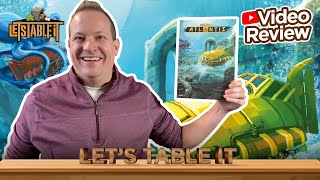
Finding Atlantis Deep Dive
What the Community Thinks About Finding Atlantis
Reviewers agree that Finding Atlantis is defined by its app, and they differ mainly on how well the hidden-information design holds up across a full game. Brody of Let's Table It is the most enthusiastic voice in the coverage. Brody describes the game as the closest title to date that uses an app well, and credits the app with making the rules easier to learn. Brody also finds the components basic overall but appreciates the shaped submarine tokens.
The hosts of Rolling Dice & Taking Names, Marty and Tony, are more mixed. They call Finding Atlantis one of the cleverer app-driven games because of how it uses the phone camera, and they enjoyed the card play and the deduction. Their reservations come from the experience of tracking information on paper and from how the game ends. Tom Vasel of The Dice Tower mentions the game only in passing, noting that its designer had reached out about it, so the coverage is essentially two detailed perspectives.
Core Mechanics That Define Finding Atlantis
App-Driven Deduction and Exploration
The app generates a new ocean map every game on either a 6x6 or an 8x8 grid, and it randomly places the submarines. Each player tracks what they learn on a paper grid hidden behind a player screen, while the app keeps the true state of the game, including every submarine's location. Brody explains that the app shows players the real information from all the players, which is what makes the game function as a deduction contest.
Exploration is handled through scanned cards. Sonar reports whether the eight surrounding spaces contain seamounts or deep ocean, and because the spaces holding Atlantis and artifacts both have seamounts, sonar results point toward them. The jelly rod checks the two spaces on opposite sides of a submarine for traces of civilization, and the periscope reports danger in the eight surrounding spaces. Rolling Dice notes that the phone must keep the same orientation throughout the game, because the app uses that orientation as the shared compass for every player seated around the table.
Because other players can see what you did, sonar and movement results become clues. Brody encourages players to use the information other players reveal, since it lets them gain insight without spending one of their own actions.
Card-Play Action System
Each player starts with a hand of action cards in their color, and on a turn they take up to two actions by playing cards. Movement can be secret, where the player scans a movement card and records the direction in the app, or visible, where the player uses the burn button to discard a card and move openly. Playing a card removes it from the hand until the player surfaces. Surfacing returns the played cards to the hand, but it also reveals the player's current location to everyone, so Brody and Rolling Dice both describe resurfacing as a strategic cost that must be timed carefully.
Artifacts found through exploration add powerful one-time actions to the hand, and each player's Captain card gives an ongoing ability. Brody notes that players who manage their cards efficiently tend to do well, because a hand limits what can be done on a given turn.
The Finding Atlantis Experience
Cat-and-Mouse Inference
Much of the feel comes from trying to hide your position while reading everyone else's. Brody describes moving so that other players cannot tell where the submarine is, while still watching where opponents have been. Rolling Dice describes the same tension from the other side, saying that a clever bluff, such as heading toward one area while privately aiming for another, can work until the app's verdict reveals the truth.
A Late-Game Scramble
The second feeling is a race that tightens near the end. Rolling Dice describes the final stretch as players circling one another and moving in small steps, with the outcome depending on who finds Atlantis first. Brody also notes that a clever read on other players' clues can turn a quiet board into a sprint toward the same region.
What Makes Finding Atlantis Stand Out
An App That Runs the Game and Teaches It
Reviewers consistently praise the app. Brody reports that scanning worked reliably with no glitches and that the app made the game more fun. The app also explains the rules as play proceeds, which Brody credits as a major help for new players. Rolling Dice highlights the camera-based card scanning as one of the more inventive uses of an app in tabletop design.
Asymmetric Captains and a Solo Option
Captain cards give each player a different ongoing ability, and Brody describes them as fun additions that bring asymmetry to the game. The solo option is also a draw. Brody notes that the app can supply three AI opponents, and Rolling Dice suggests the game works as a solo challenge for seeing how quickly you can find Atlantis.
Potential Drawbacks
Dependence on the App and Your Own Bookkeeping
The app carries much of the game, and that makes accurate tracking essential. Rolling Dice admits to getting lost about where their submarine was and says players must be very clear with their marks on the paper grid. Rolling Dice also notes that a wrong guess at Atlantis can be frustrating, and recalls being annoyed with the app when their own reading of the map was overruled. Brody is candid about not knowing exactly how the app reads each card, and warns that the way a card is held when scanned affects the direction of movement.
A Late-Game Race That Can Feel Like a Crapshoot
Rolling Dice felt the late game lost some of the strategy that carried the early turns. As players converged, the hosts found the endgame more like guessing who would reach the city first than making a planned series of decisions. Brody's observations about limited hands and the need to resurface point to the same pressure, since a player who runs low on cards may have to spend a turn recovering rather than acting on information.
If You Enjoy Finding Atlantis
Towers of Yomo is the one related title the coverage connects to Finding Atlantis. Tom Vasel of The Dice Tower reports that the same designer created both games and says Towers of Yomo was being offered on Kickstarter at the time of the review. The review does not compare how the two games play, so the connection rests on the shared designer rather than on matching mechanics. Readers who enjoy the app-supported deduction and hidden-movement design of Finding Atlantis may find that a useful next look at the designer's work.
What Reviewers Are Saying
"The scanning of the app works very well, had no problems with any glitches or anything. I felt like the app added more fun to the game as well, and really helped explaining how to play when you're new to the game, because it just spells it all right out."
— Brody, Let's Table It
"At the very end of the game, Tony, we were just kind of all around each other, just ping, move, ping, move, ping, move. It kind of was kind of a crapshoot. We kind of knew where it was, but then at that point it was just like, who's just going to find it first sort of deal."
— Rolling Dice & Taking Names
"Captain cards are all different and each player has a different one, but it will give you some type of additional information. These cards are fun and add in some asymmetry into the game."
— Brody, Let's Table It