



























Frosted Blooms Deep Dive
What the Community Thinks About Frosted Blooms
Frosted Blooms is widely celebrated by board game reviewers as an elegant tile-laying experience that manages to feel fresh and engaging despite working within a familiar genre. The game consistently earns praise for its balance between accessible mechanics and surprising strategic depth. Reviewers appreciate that Bruno Cathala and Ludovic Maublanc have designed a game that rewards thoughtful play without demanding complex rules, and that respects both solo and multiplayer audiences equally. What stands out is the consensus that this is not just another polyomino game, but rather a deliberate design that subverts expectations in satisfying ways.
Core Mechanics That Define Frosted Blooms
Polyomino Tile Placement
At its heart, Frosted Blooms asks players to build gardens by placing double-sided polyomino tiles, a core mechanic familiar to fans of Patchwork or Bärenpark. Each tile features six flowers in varying distributions across three colors (purple, white, orange) plus two connected water spaces. Tiles can be rotated and flipped freely, but must share at least one complete side with previously placed tiles. The scoring system rewards building connected groups of matching colors and water, creating an immediate incentive to think about layout and adjacency. Each turn, players play a card to score immediately, which reinforces decisions and keeps the game feeling dynamic across its ten-round structure.
Gap Creation and Improvements
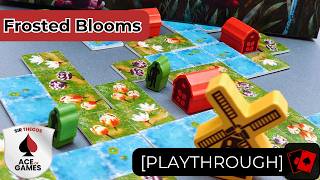
The twist that distinguishes Frosted Blooms from typical polyomino games is its approach to empty spaces. Rather than penalizing gaps, the game actively rewards creating them. When players enclose spaces of specific sizes, they place wooden improvements: a single space nets a worker (worth a coin and three end-game points), two spaces get a barn (ten end-game points), three spaces net a barn and a worker, and a 2x2 square earns the prize windmill (twenty-five end-game points). This inverts conventional polyomino logic, forcing players to balance scoring points from flower and water cards against the long-term value of strategic gaps. The designer's twist turns the fundamental tension of the genre into the game's defining strategic lever.
The Frosted Blooms Experience
Relaxing Yet Thoughtful
Players consistently describe Frosted Blooms as a peaceful game that belies its decision-making weight. There is a meditative quality to tile placement and spatial puzzle-solving, especially in the solo mode where competition fades and only the satisfaction of fitting pieces together remains. The game never feels rushed or punishing. The combination of beautiful production, soothing mechanics, and clear feedback creates an atmosphere where players can think without stress. Even the act of drafting tiles using the coin-skip mechanism feels deliberate rather than frenetic.
Satisfying Reward Loop
Every turn delivers immediate feedback through card scoring, which keeps engagement high and the experience gratifying. Placing a tile, playing a card to score points, and watching the board grow creates a tight positive reinforcement cycle. When a gap finally closes and a windmill lands, or when a row of flowers suddenly aligns for a big score, the payoff feels earned rather than lucky. The game's pacing ensures that even moments of apparent stagnation often set up future scoring opportunities, maintaining player investment throughout.
What Makes Frosted Blooms Stand Out
Beautiful and Functional Components
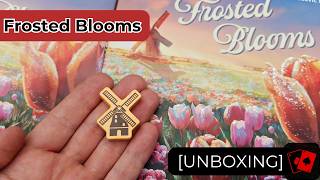
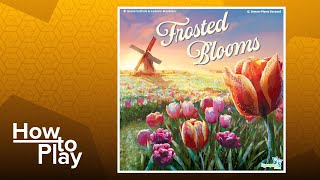
The production quality elevates the entire experience. The tiles feature a holographic frosted foil embellishment on the tulips that catches light and shimmers, making the board visually striking. Chunky wooden improvements, particularly the windmills, have excellent presence on the table and feel substantial to handle. Even the cardboard coins and wooden scoring markers reinforce the game's overall elegance. The aesthetic is not merely decorative; it supports the game's theme and makes every action feel intentional.
Subversion of Polyomino Expectations
Most polyomino games teach players to avoid gaps and fill space efficiently. Frosted Blooms boldly asks them to do the opposite, creating holes on purpose to unlock high-value improvements. This shift immediately distinguishes the game and opens new strategic paths. Players familiar with the genre find themselves in unfamiliar territory, re-learning their instincts. For newcomers, it sidesteps the usual polyomino teaching challenges by making spatial inefficiency rewarding and interesting from the start.
Potential Drawbacks
Spatial Puzzle Difficulty Without a Grid
The flexible placement system, while liberating, comes with a trade-off: without a grid, some players struggle to visualize how pieces fit and whether planned gaps will materialize. The lack of constraints can paradoxically make placement harder to envision, especially for players less comfortable with spatial reasoning. Reviewers note that physical testing of tile placement during a turn can help, but this adds deliberation time. The learning curve is real, and the first few plays may feel less smooth as players adjust their spatial instincts.
Limited Production Variance in Minor Components
While the tiles and improvements are beautiful, reviewers note a minor aesthetic inconsistency: the red scoring tokens do not match the pink-backed scoring cards, which creates a small visual discord in an otherwise cohesive design. Some players also note that cardboard coins, while functional, would benefit from wooden equivalents to match the wooden improvements. These are minor quibbles in an otherwise polished package, but they represent small missed opportunities in an otherwise meticulous design.
If You Enjoy Frosted Blooms
Players drawn to Frosted Blooms will find kindred spirits in other elegant tile-laying games. Those who appreciate the patchwork drafting mechanic should explore Patchwork, the two-player classic that helped popularize polyomino games. Fans of the rondelle-style drafting (the coin-skip mechanism) will recognize echoes in Rise of Augustus, which uses similar player interaction through shared resources. Bärenpark offers a similar spatial satisfaction with a simpler, more accessible ruleset. For players seeking another Cathala design with similar elegance and depth, Kanagawa combines worker placement with polyomino collection and features the same balance of strategy and accessibility. Finally, World Wonders provides another polyomino experience with spatial puzzles and end-game scoring that rewards long-term planning.
What Reviewers Are Saying
"First of all, beautiful production, beautiful foil embellishments on the box and on the tiles. Each of the tiles, they have those sort of frosted blooms on them and when you see them in the light they sort of shimmer a little bit. It looks beautiful."
— TheGameBoyGeek
"I love wooden components. I would always take wooden components over plastic components in games. That also means that I like wooden meeples a lot more than plastic miniatures. And I think this will never change."
— Sir Thecos
"I do like polyomino tile-laying games. I thought I didn't need another one, but this one looked very, very elegant and still loads of ways of scoring and going against everything you know with your polyomino tile laying, right? Because you actually need to have these holes here, right?"
— Sir Thecos