






My Lil' Everdell Deep Dive
What the Community Thinks About My Lil' Everdell
My Lil' Everdell occupies a unique place in the board game landscape as a thoughtfully streamlined entry point into the Everdell universe. Reviewers consistently recognize it as a game designed with families in mind, one that successfully captures the essence of its parent game while dramatically reducing the time commitment and complexity. The game works best for children around 9 to 10 years old, though the "Lil'" branding can be misleading for younger audiences who might find the rules still surprisingly intricate. This is a genuine simplification of a beloved classic, not a game stripped down to its barest bones. Reviewers appreciate it as a winning compromise: a game that delivers meaningful strategic choices and the satisfying Everdell experience without demanding two hours of table time.
Core Mechanics That Define My Lil' Everdell
Streamlined Worker Placement
The heart of My Lil' Everdell's design lies in how it reimagines the original's worker placement system. Instead of opening new action spaces and gaining more workers as the game progresses, this version gives each player exactly three workers per season across four fixed seasons, meaning a maximum of 12 total actions and 12 purchased cards for the entire game. On your turn, you place one friend meeple on a location to gather resources, then optionally spend those resources to buy a single card. This creates a tightly bounded decision space that forces every choice to matter. One reviewer noted that this fix prevents the original Everdell's problem of seasons dragging on as engines grow larger; here, the game stays snappy and purposeful throughout.
Set Collection for Parade Tiles
Players accumulate cards and locations to complete parade conditions: five critters, five places, one card of each color, or three cards of the same color. Each completed set earns a parade tile worth significant victory points, with the highest-scoring tile going to the first player to qualify. Unlike the original, My Lil' Everdell removes the free card chaining mechanic, meaning every card addition requires an action. This keeps the game moving and prevents the kind of explosive engine turns that can feel overwhelming in the full game. Reviewers highlight that the simplified scoring still delivers the strategic satisfaction of building toward meaningful sets without the cognitive overhead.
The My Lil' Everdell Experience
Charming Whimsy With Substance
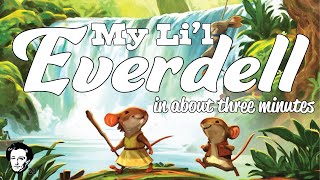
The game radiates an approachable, whimsical charm. Players take on the roles of woodland creature teams gathering resources and building a settlement. The components are notably delightful: colorful cards featuring anthropomorphic animals, resource tokens (berries described as "squishy" by one reviewer), and a thematic moon token tracking the four seasons. This aesthetic accessibility invites younger players while the game's mechanical depth keeps experienced players engaged. The theme remains faithful to Everdell's woodland-settlement worldbuilding without requiring the complexity of managing overlapping card engines.
Satisfying Compressed Play Without Sacrifice
Reviewers repeatedly praise the game's ability to deliver the Everdell feeling in 30 minutes instead of two hours. Multiple reviewers who expressed skepticism about the original Everdell found My Lil' Everdell genuinely satisfying precisely because it preserves the mechanics they enjoy while removing the parts that drag. One reviewer famous for disliking the original called the streamlined version "very satisfying to play," crediting the compressed action sequence with making every decision feel impactful. Kids who played it picked up the rules immediately and remained engaged, suggesting the game maintains momentum without sacrificing strategic depth or replayability.
What Makes My Lil' Everdell Stand Out
A True Distillation, Not a Gutting
What separates this game from a generic family version is its fidelity to the original's core appeal. Reviewers noted that My Lil' Everdell retains "most of the essence of Everdell," which is described as an impressive achievement. The game doesn't simplify by removing mechanics; it simplifies by constraining them. The worker placement, set collection, and card selection remain intact. The goal is still to build a beautiful settlement and score the highest. The difference is that the game accomplishes this in a focused, brisk arc that doesn't outstay its welcome. This makes it ideal for players who love the Everdell concept but rebel against its pacing, or for families wanting to introduce the theme and mechanics to younger players before graduating to the full game.
Smart Scaling for Younger Players
The game includes built-in accessibility features that allow adults to customize the difficulty. Younger players can receive a starting resource bonus (one twig, one resin, one berry), the Fort card (providing an extra resource during gathering phases), or the Captain card (generating one victory point each gathering phase). These optional advantages kickstart early game development without feeling arbitrary or unfair. The rules clearly distinguish these scaffolding tools, making it easy for parents and experienced players to calibrate the game to their table's needs. Reviewers appreciated that the game doesn't condescend to its younger audience; it simply provides knobs to adjust entry difficulty.
Potential Drawbacks
The Name Creates Unrealistic Expectations
Multiple reviewers flagged that "My Lil'" in the title invites assumptions the game doesn't support. The name suggests a game for very young children (five or six years old), but reviewers found it works much better for nine or ten year olds and up. Below that threshold, the rules, particularly the resource management and scoring conditions, become genuinely complex. Parents shopping based on the name alone might buy expecting a preschool-friendly game and find their young kids confused. A more honest subtitle like "Family Edition" or "Gateway Edition" might set clearer expectations about the actual audience.
Reduced Strategic Depth and Softer Mechanics
The streamlining comes with a trade-off. Because every player gets exactly 12 actions and card-chaining is impossible, the game lacks the engine-building depth of the original. Players cannot cascade cards together for free resources, limiting the satisfying feedback loop of watching a carefully constructed engine fire. The rules are explicitly designed to lower confrontation and reduce player interaction, creating a gentler competitive experience. Reviewers acknowledged this as a deliberate choice ("soft rules designed to lower confrontation"), not a flaw, but noted that players who love the original's depth and length may find My Lil' Everdell feels shallow by comparison. If your table thrives on complex combos and explosive card synergies, this version strips away the mechanical nuance that makes those moments possible.
If You Enjoy My Lil' Everdell
If My Lil' Everdell captured your interest, consider exploring related games that occupy similar design spaces or offer natural progression paths. My Little Scythe shares the family-friendly adaptation philosophy, offering a simplified version of another heavier economic engine game but with its own unique mechanics and themes. Like My Lil' Everdell, it proves that stripping complexity doesn't mean stripping the game of its soul. For players ready to graduate to deeper strategic play, the original Everdell awaits with a richer card-chaining system, more worker placement options, and the longer seasons that create emergent engine-building opportunities. Reviewers who found the original exhausting actually appreciated the shorter runtime of My Lil' Everdell, suggesting this version might satisfy players who want Everdell's theme and mechanics without its commitment. Consider your table's appetite for length and complexity before choosing your next step in the Everdell universe.
What Reviewers Are Saying
"Most of the essence of everdell is left in which is a pretty impressive achievement. All up a wonderful family-friendly game."
— Three Minute Board Game
"This is a great introduction into the world of Everdell. But the name My Lil makes it sound like it works for really young kids, and I don't think that's true. I think this is great for like maybe nine or 10 year olds, but doesn't really work for like five or six year olds."
— Everdell Ranking
"You can play it you can get that taste of everdell and then you don't have to play for two hours you can play for 30 minutes and be done with it. All right so I that was that was actually very satisfying to play."
— Board Game Dad