






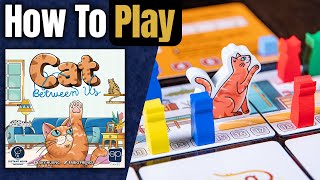


Cat Between Us Deep Dive
What the Community Thinks About Cat Between Us
Cat Between Us is a 2 to 6 player card game designed by Sky Huang and published by The OP, in which players lure a hiding cat with toys. Cat Between Us has found consistent approval among reviewers as a well-crafted filler game that surprises players with depth beneath its accessible surface. The community consensus centers on praise for the game's elegant catch-up mechanic and strategic hand management, balanced against occasional concerns about pacing and randomness scaling with player count. Tom Vasel and Chris Yee of The Dice Tower each rated it a seven out of ten, positioning it as a worthy addition to a game collection that prioritizes both teachability and meaningful decisions. The theme resonates across audiences, with the cat-luring concept providing memorable flavor that makes the numerical gameplay feel connected to a real scenario rather than abstract arithmetic.
Core Mechanics That Define Cat Between Us
Hand Management
At the heart of Cat Between Us lies a hand management puzzle that appears deceptively simple but demands careful planning. Players hold a variable number of cards from round to round, determined by how many rounds they have won. The asymmetry between players is intentional: winners accumulate larger hands, making their remaining unplayed cards count for more at the end of each round. This creates a pressing strategic question on every turn: which card should you play now, knowing that holding stronger cards might help later, but holding them might hurt you when hand size determines your final score. The mechanic forces constant reevaluation of card values in context, transforming what could be a luck-driven experience into one where sequencing and prediction matter significantly.
Simultaneous Reveal and Number Building
Players place cards face-up beneath toy cards, building up attraction values that no other player can see in advance. Each toy accepts exactly two cards, creating a limited resource and forcing players to commit to value modifications without observing other players' intentions. When all toys are populated, players reveal their remaining hand and score based on which toys' values align with the cards they hold. This simultaneous reveal structure generates genuine suspense: if you hold green cards and need green to be valuable, you're betting that enough green cards landed on the green toy to make your hand count. If an opponent flooded the toy with a zero card earlier, your green cards become worthless. The game never explicitly punishes anyone for playing a high card that ruins your own strategy, but the emotional impact feels like take-that gameplay because the math suddenly works against you.
The Cat Between Us Experience
Gateway and Accessible Feel
Cat Between Us teaches itself after a single round. The rules overhead is minimal: deal cards, play one card per turn under any toy, reveal and score. Reviewers consistently highlight that players intuitively understand the game once they see the mechanic in practice, meaning teaching time is short and the barrier to entry is low. This accessibility makes the game ideal for mixed groups where some players prefer light, approachable games. The charming cat theme supports this welcoming tone, transforming abstract number placement into a relatable scenario: everyone has felt a cat ignore their attempts at affection, so the game's premise feels genuine rather than pasted-on.
Strategic Tension Through Escalation
As the game progresses, the tension climbs in a subtle but consistent way. Winners of previous rounds now hold additional cards, raising the stakes of each card they must hold in reserve. The numbers grow larger; more options compound the decision space. A player who won the first round confidently might find themselves holding four leftover cards in round two instead of three, suddenly vulnerable to a cat token placed at an unexpectedly low number. Reviewers appreciate that this escalation doesn't feel artificial or punitive; it flows naturally from the winning condition. The game creates mounting pressure not through aggressive mechanics but through the inherent difficulty of predicting outcomes when more cards and more variables are in play.
What Makes Cat Between Us Stand Out
A Catch-Up Mechanism That Feels Organic
The game's primary innovation is its scaling hand size. Rather than explicitly penalizing leaders, the design hands winners more cards to play and manage. This simple pivot transforms the catch-up dynamic: the leader is not weakened; instead, the leader faces a harder puzzle. A player with eight cards in hand in round three must make six agonizing decisions about which cards to play and which to hold, each decision potentially sabotaging themselves. Reviewers specifically highlighted this mechanic as excellent because it avoids the transparent, artificial feel of many catch-up systems, instead embedding the catch-up in the core gameplay loop. The leader's extra cards are a burden disguised as a reward.
Elegant Design That Rewards Repeated Play
Cat Between Us works at face value on the first play and reveals strategic depth on repeat exposure. The toy values are hidden information that players must infer; optimal play requires reading the table, tracking which colors have been flooded with zeroes, and calculating whether holding a particular card is worth the risk. Despite its short playtime, the game respects player agency: reviewers noted that decisions matter and that the game never feels like you are decisionless. The design does not require a heavy rulebook or fiddly tracking, yet it consistently delivers moments where a single card placement has rippling consequences across other players' scoring potential. This is the mark of elegant design: maximum strategic texture from minimum mechanical complexity.
Potential Drawbacks
Randomness Scaling With Player Count
The hidden toy values and the shuffled card deck introduce a randomness element that grows more pronounced as player count increases. With two players, you have better information about your opponent's likely holdings and can make more confident predictions. With five or six players, the variables multiply; a card you expected to land on a toy never shows up because another player played a different suit entirely. Reviewers acknowledged that the game can feel random, especially at higher player counts, because no amount of hand management fully controls the chaotic interaction of simultaneous reveals. Some players may find this delightful chaos; others seeking pure strategy might prefer tighter player counts or accept Cat Between Us as a party game rather than a competitive strategy showdown.
Pacing Risk With Extended Play
If the catch-up mechanism is too effective, players will trade victories back and forth, and the game may cycle through all seven rounds without anyone claiming the third decisive win. This scenario stretches the game's ideal playtime. While the box promises 25 to 40 minutes, seven full rounds with setup and teach could exceed that window, particularly with larger groups or tables inclined toward lengthy deliberation. Reviewers noted that if you want a quick filler, Cat Between Us performs best in games where the catch-up never fully levels the field and someone reaches three wins by round five or six. The game itself has no built-in mechanism to accelerate the endgame, so pacing depends partly on how the randomness and player skill interact on a given table.
If You Enjoy Cat Between Us
Players who enjoy Cat Between Us's hand management puzzle will find similar satisfaction in Soda Jerk, which shares the mechanic of speculating on hidden values while playing cards that shape those values for your opponents. Both games reward careful card timing and reading the table, though Soda Jerk's values are visible from the start, giving players more information. If you appreciate the filler-style accessibility and the sense that decisions matter despite a short teaching window, other gateway games like Love Letter or Ticket to Ride offer that same balance of ease and engagement, though with different mechanical hooks. For those drawn to catch-up mechanics specifically, Azul and Splendor both embed scaling challenges that keep trailing players in contention without feeling arbitrary.
What Reviewers Are Saying
"Hello my friends. It's the game boy geek here and today our beloved pet is hiding somewhere in the house and you need to coax them out. You'll be dangling a fishing rod, rolling a ball of yarn, or tempting them with a running mouse to draw them out into your arms."
— TheGameBoyGeek
"I'm giving this a seven. It's a nice filler style game if it doesn't go on too long. You can't take it too seriously. You make decisions."
— Tom Vasel, The Dice Tower
"Very simple little card game where you're kind of doing commodity speculation type stuff. Cute, nice theme, nice little built-in, not catch-up mechanism, but more or less something like that. I think it's well done."
— Chris Yee, The Dice Tower