



















Hummingbirds Deep Dive
What the Community Thinks About Hummingbirds
Hummingbirds has struck a chord across the board game community, earning consistent praise from reviewers across different channels. The consensus centers on a simple but compelling premise: a game that captures the elegance of timing and the thrill of risk-taking in a compact, visually appealing package. From casual players to dedicated hobbyists, reviewers describe genuine enthusiasm. Craig and Rebecca from Get into Games went as far as to say "everyone must own" this game, while players across multiple platforms report the same phenomenon—once they try it, they want to play again immediately. Where opinions diverge is mainly in the finer details: some celebrate the push-your-luck tension, others praise the thematic coherence, and a few have noted minor concerns about component durability. But the overwhelming sentiment is positive, making Hummingbirds one of those rare games that pleases both the casual game night crowd and those seeking strategic depth.
Core Mechanics That Define Hummingbirds
Real-Time Timing and Internal Clocks
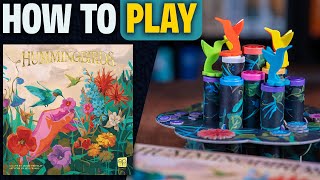
The heartbeat of Hummingbirds is its invisible timer system. At the start of play, all sand timers are flipped simultaneously and hidden inside colored tubes positioned across the garden board. Players then move their magnetic hummingbird tokens from tube to tube, trying to estimate when each sand timer has run out. The longer a timer runs, the higher the point value of the nectar token it yields, but there's a penalty for checking too early: you lose one of your lowest-valued tokens. This mechanic forces players to develop an internal sense of elapsed time without external cues—a skill that becomes increasingly challenging as the game progresses and timers fall out of synchronization. Designer Jason Tremblay and The OP have created a game where the primary antagonist is not another player but the players' own sense of time.
Push-Your-Luck Decisions
Every turn presents the same agonizing choice: stay safe, or push for higher rewards? Because the game ends when any single color of nectar tokens runs out, and because the red 10-minute timer is worth a game-ending 25 points, players constantly balance greed against caution. Do you check a flower you believe is ready, risking a penalty to try for more points? Do you claim a lower-value timer just to play it safe? The emotional arc of the game rises and falls with these decisions. Reviewers consistently highlight the memorable moments when a timer is pulled up and either validates your patience or punishes your overconfidence—moments that stick with players long after the game ends.
The Hummingbirds Experience
Frantic, Dance-Like Energy
Despite its quick playtime, Hummingbirds generates surprising kinetic energy. Reviewers describe the experience as "frantic" and "dance-like," with players flitting between flowers as they navigate the crowded garden. The physical act of moving magnetic hummingbirds feels responsive and satisfying—the magnets click into place, making each placement tactile and deliberate. This physicality elevates what could be a purely mental exercise (timing) into a full-table experience. The game naturally draws spectators in, and players report that watching others makes the game feel more competitive and engaging than the rules alone would suggest.
Emotional Intensity and Memorable Moments
What separates Hummingbirds from other timing games is its capacity to generate genuine emotional reactions. Players describe big moments—pulling up a timer that's still running when they were certain it had finished, or miraculously guessing correctly after agonizing deliberation. One reviewer called these "big emotional moments" the core of the game's appeal, where the line between brilliant play and heartbreaking miscalculation is measured in seconds of sand. The 10-minute red timer adds another layer: it becomes both a countdown to the end of the game and a symbol of the ultimate risk-reward calculation, making whoever finally checks it a pivotal moment in the game's narrative.
What Makes Hummingbirds Stand Out
Beautiful Table Presence and Thoughtful Component Design
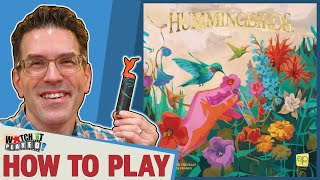
Reviewers unanimously praise the game's visual appeal. The garden board commands the table, with its array of colorful tubes and the magnetic hummingbirds creating an immediately inviting aesthetic. The design choice to hide the sand timers inside the tubes is both thematically perfect and mechanically essential—it prevents players from seeing the sand fall, preserving the uncertainty that makes timing matter. The magnetized components are not just functional but feel premium and satisfying in hand. Art by Jess Franks brings the natural theme to life, and the overall production value gives the game a presence that belies its 10-15 minute playtime. Players naturally want to reach for it and set it up again.
Accessibility Meets Engagement
Hummingbirds works for both experienced gamers and newcomers. The rules are straightforward—move a hummingbird, or check a timer. But the challenge of timing, the emotional decisions, and the replayability appeal to players across skill levels. It plays in 10-15 minutes, making it an ideal filler that can be pulled out on a work break, at a game night, or with families. At the same time, it engages serious players with its push-your-luck decision space and the need to read the table and opponents' behavior. Reviewers note it scales well from two to four players, with each player count offering a subtly different experience—from more predictable plays at lower counts to chaotic abundance at higher counts.
Potential Drawbacks
Box Storage and Component Durability Concerns
One practical concern emerged from detailed play sessions: the garden board structure is made of cardboard and must be disassembled each time the game is packed away. Some reviewers expressed worry that this could lead to wear over time, particularly if the game sees regular play. The box is also relatively thin for the table footprint the game commands during play. While this hasn't been confirmed as a widespread issue, it suggests that frequent players may want to consider storage solutions or be mindful of how the board is handled during packing and unpacking.
Timing Consistency Challenges at Higher Player Counts
With four players, the table becomes noticeably more chaotic. Multiple players checking timers simultaneously can throw off the careful synchronization established early in the game, making it harder for any one player to track elapsed time effectively. While this adds to the fun and unpredictability for some groups, others may find it frustrating when well-reasoned timing estimates become impossible due to the pace of play. Reviewers who played at four players described the experience as "hectic" and "a little chaotic," which is enjoyable for social play but may undermine the game's elegant timing system for players seeking deeper control.
If You Enjoy Hummingbirds
Players who enjoy Hummingbirds's push-your-luck timing mechanics will find similar satisfaction in Kites, another real-time game where players push their luck against an invisible clock. Those drawn to Hummingbirds's set-collection reward system and the satisfaction of building toward specific color combinations will appreciate Sea Salt and Paper, a card game with elegant set mechanics and variable scoring. For players who love the meditative, nature-themed aesthetic combined with strategic tile placement, Flow offers a cooperative alternative that also creates satisfying, interconnected decisions. All three games share Hummingbirds's ability to deliver meaningful play in a compact footprint.
What Reviewers Are Saying
"It's that real frantic hummingbirds flying around all these flowers gaining nectar and it gives you that really thematic experience. You're working time and there's the center, the red sand timer is a 10-minute sand timer. So, that really is the game end. It's a very cool idea."
— Get into Games
"It's a game of testing your internal clock. And I love the big emotional moments in it where you like, you're like, 'It's got to be five minutes. It's been five minutes, right?' And then you pull up that sand timer AND YOU'RE LIKE, 'NO, COME ON. THERE WAS LIKE 3 SECONDS LEFT.'"
— Watch Review
"Hummingbirds is your basically placing you you on a turn you can either place a hummingbird, move the hummingbird or lift the hummingbird. And the coolest thing I think personally about this game is that the hummingbirds are magnetic and so it's easy to grab onto them and pull them up to check them."
— Get into Games