


























Crafting the Cosmos Deep Dive
What the Community Thinks About Crafting the Cosmos
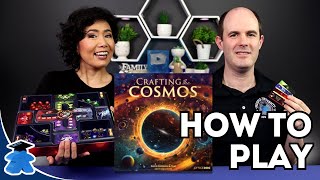
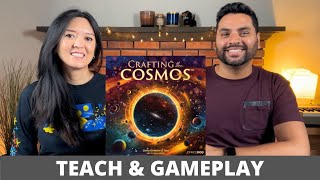
Crafting the Cosmos has made a strong impression on board game reviewers across the community. The Dice Tower's Tom Vassel ranked it as the number one production game of 2025, praising its visual design and overall aesthetic. Board Game Garden's Jenna featured it as her number one game of April 2025, playing it multiple times both physically and on Board Game Arena. Hunger Gamer offered an in-depth analysis, emphasizing the game's satisfying production and clever mechanics, though noting some reservations about interactivity. Maple University provided a comprehensive tutorial, walking players through the game's dual-phase turn structure and intricate resource management system.
Core Mechanics That Define Crafting the Cosmos
The Energy Phase and Rondel-Based Resource Drafting
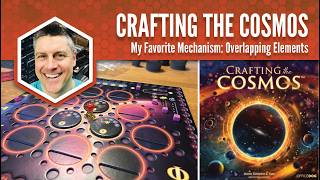
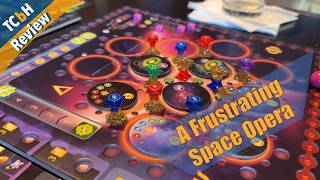
Published by Office Dog, Crafting the Cosmos centers on a rondel mechanism where players manipulate energy around a shared central console. Each turn, players move energy markers up to three times clockwise around the board, collecting stars, nebulas, life tokens, and other resources based on their final positions. As Maple University explains, players gain powerful primary resources from the left side of their energy column and secondary resources from the right. Hunger Gamer emphasizes how this marble-moving system ensures you are constantly acquiring something each turn, creating an engine-building experience where the more you interact with the rondel, the more resources flow into your cosmos.
The Craft Phase and Tableau Puzzle
Once resources are collected, the craft phase becomes a puzzle of placement and tableau-building. Players use their gathered stars, life tokens, DNA, and cards to score nebulas, stabilize life, and unlock advanced life tokens worth hidden points. Hunger Gamer highlights how satisfying it feels to complete a nebula by surrounding it with the required star colors, then discarding one star to trigger scoring. The game also features power cards drawn from color-coded decks, each granting a one-time ability and providing a permanent passive bonus. Board Game Garden's Jenna noted that the constant stream of resources combined with the flexible placement rules creates a fun little puzzle where every turn feels productive, with the ability to move stars and life around the board using graviton resources adding another layer of spatial strategy.
The Crafting the Cosmos Experience
Beautiful Production and Easy Iconography
The Dice Tower's Tom Vassel placed Crafting the Cosmos at number one on his 2025 coolest productions list, captivated by how everything about the game is just really cool. He praised the hydrogen and carbon star tokens, the colorful aesthetic that makes the universe look like a breathing, colorful thing, and the overall packaging that feels like a box of toys, satisfying to open and play. Hunger Gamer agrees wholeheartedly, calling the production beautiful with good double-layered components and clean iconography that is really easy to figure out. The visual clarity means you can quickly scan the table to see what other players have accomplished, enabling smart tactical decisions about which objectives to pursue.
Fast Play and Near-Simultaneous Action
Despite its mechanical depth, Crafting the Cosmos plays faster than many might expect. Hunger Gamer emphasizes that while not strictly simultaneous, the game has a fair amount of simultaneous play, because once you have done your rondel action and collected your resources, you can do your thing while everybody else keeps going around the table. This keeps the game moving quickly, a quality Hunger Gamer prizes in lighter euro games. Board Game Garden's Jenna, who played Crafting the Cosmos multiple times in April including on Board Game Arena's digital implementation, appreciated how the clear objectives displayed three rounds in advance let her quickly assess her position and plan strategy without excessive analysis paralysis.
What Makes Crafting the Cosmos Stand Out
Satisfying Scoring and Constant Point Bumps
Hunger Gamer singles out the scoring system as a highlight, noting that the way scoring works is very satisfying as you go through, because you are constantly getting big bumps of points and that little dopamine hit. This comes from multiple scoring vectors: completing nebulas, stabilizing life, advancing the time track, and fulfilling the rotating objective cards that players can see coming three rounds away. Board Game Garden's Jenna expressed similar enthusiasm, citing the combination of resource collection, spatial puzzle-solving, and the ability to move stars and life around to set up future plays as something that makes her brain incredibly happy.
Variable Powers and Meaningful Decisions
Every game plays differently thanks to the randomized power cards. Hunger Gamer highlights how every time you play you get different powers and the galaxy is your oyster. When you spend colored energy cards at the console, you unlock unique abilities tied to that color's quadrant, and these stack on your player board, providing growing bonuses each turn. Board Game Garden's Jenna particularly enjoyed the puzzle of whether to take the advanced life now and lose the protolife, or wait until you have the DNA side so you can keep it and keep moving it around. This creates genuinely hard decisions without overwhelming players.
Potential Drawbacks
Physical Handling and Fiddly Components
Hunger Gamer voices the most significant concern: the life tokens are a pain to handle when you start moving them around. Even with smaller hands, manipulation becomes cumbersome, and players with larger fingers struggle more. Board Game Garden's Jenna acknowledged the fiddliness as well, noting that a lot of people say it is fiddly, though she quite enjoys that aspect. Still, this remains a valid complaint for those seeking lower-friction gameplay.
Low Player Interaction and Repetitive Arc
Hunger Gamer observes that Crafting the Cosmos is a pretty low interaction game, very heads down, close to multiplayer solitaire but not quite. While the shared rondel offers some blocking through dark energy marble placement, rational play rarely involves using your turn to deny opponents; you are better off securing your own resources. Additionally, Hunger Gamer notes that as a lighter euro, the gameplay arc is going to be the same each play: you are chasing objectives, scoring nebulas, and building your engine through the same mechanisms, with variety coming primarily from different power cards.
If You Enjoy Crafting the Cosmos
Hunger Gamer explicitly compares Crafting the Cosmos to River of Gold, another Office Dog publication, calling the new game really enjoyable though not quite as good as River of Gold in their view. Both are medium-light rondel-based games with strong production and satisfying scoring. If you appreciate tableau-building euros with puzzle-like spatial mechanics, the game's closest relatives include Ark Nova for its layered scoring and engine growth, and Cascadia for its approachable spatial puzzle. For fans of abstract strategy with beautiful aesthetics who do not mind a heads-down experience, Crafting the Cosmos delivers on both mechanical depth and visual charm.
What Reviewers Are Saying
"Crafting the Cosmos is a game that I definitely did a double take when I was walking by at a convention and saw it for the first time. This is a game in which everything about it is just really cool. I like the whole production. I like the insert of the box. I like the way that you draft these things and it opens up and it feels like a box of toys."
— The Dice Tower
"There's just something about this game that makes my brain so incredibly happy. And like I said at the start of me talking about Crafting the Cosmos, it just makes my brain really happy. And that is exactly what I'm looking for in a game."
— Board Game Garden
"The way that scoring works is very satisfying as you're going through. You're constantly getting big bumps of points, and so you're constantly getting that little dopamine hit. It's very easy to see what you need to do to score because of the production, and that makes the scoring very satisfying."
— Hunger Gamer