



















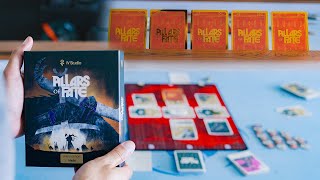





Pillars of Fate Deep Dive
What the Community Thinks About Pillars of Fate
Pillars of Fate has emerged as a standout title among board game reviewers, particularly those who specialize in two-player games and intimate card experiences. Ryan and Bethany Board Game Reviews praised it for its clarity and elegant design, noting how quickly the game moves from unboxing to first cards played. The broader gaming community sees it as a stripped-down, more accessible cousin to IV Studio's larger Fate-universe games. Reviewers consistently highlight how the game manages to deliver surprising strategic depth and interpersonal mind-games within a compact footprint. The game appears especially resonant with those seeking a quick but meaty two-player battle without excessive complexity.
Core Mechanics That Define Pillars of Fate
Lane Battler Architecture with Deceptive Card Play
At its heart, Pillars of Fate is a three-lane battler where players place cards across three simultaneous conflicts. Each card carries two pieces of information: a numerical value representing power, and a suit symbol (feathers or scorpions). This dual-use system creates the game's central tension. Winning a lane requires both dominance in power numbers and majority control of the favored suit. However, the key deception lever is the face-down card. Players may play one card face-down in any lane, and their opponent cannot know what symbol or power value lies beneath. Ryan and Bethany Board Game Reviews noted how "you almost like want to separate the card because you want this strength over here, but you also need this suit to make this be the thing that scores over here. It's really cool how you're using like these two for things everywhere." This split-purpose creates impossible-seeming decisions: play the card for maximum power here, or conserve it to influence suit majority there?
Divine Powers and Forced Asymmetry
Each player receives three divine cards (demigods) at the start, selected from a deck of twenty. These god cards carry special abilities ranging from card manipulation to suit reversal. At game setup, players see three divine cards, keep one secret, and pass the other two to their opponent. As one reviewer observed, knowing two of an opponent's god powers creates a fascinating psychological layer: you know two weapons they may deploy to ambush you, but not when they will play them. Players must deploy exactly one divine card per age, forcing timing decisions that can mean the difference between stunning reversals and missed opportunities. IV Studio publishes Pillars of Fate, and the designer team (Zack Dixon, Austin Harrison, and Max Anderson) engineered this constraint to prevent both players from ever feeling like they can slack off, since powerful plays are always on the horizon.
The Pillars of Fate Experience
Rapid-Fire Psychological Warfare
Reviewers consistently report that Pillars of Fate creates exhilarating moments of table interaction and misdirection. One reviewer described the feeling as "the Uno reverse card like on steroids," where you are convinced you are winning a lane only to have a face-down card flip and dismantle your plans. The deduction challenge is pure: did your opponent play that high-value card face-down because they want to secure power, or are they setting a trap? Did they place a scorpion card there to hide a feather suit majority underneath? The physical reveal at the end of each age drives the drama, with face-down cards transformed into gasps of recognition or groans of realization. A Kari reviewer noted how "you think for sure you're going to be winning this, you got it in the bag, you got enough strength and power and then boom, something is revealed that completely changes up what you were thinking."
Comeback Potential Through Escalating Stakes
Pillars of Fate prevents early elimination or despair through a brilliant design choice: rewards and penalties increase exponentially across the three ages. Age one offers modest point swings, perhaps plus-three or minus-two. Age three can deliver ten points in a single lane. One reviewer explained the psychological impact: "You never feel like you're out in this game because as you move to the next ages, those rewards just grow exponentially. So you always feel like you're in the game." This architecture means a player who stumbled in age one can mount a serious comeback. The escalating stakes also ensure every single round matters; no one is mathematically out until the final age resolves.
What Makes Pillars of Fate Stand Out
Exceptional Rulebook and Accessibility
Multiple reviewers singled out the rulebook as a highlight. Ryan and Bethany noted: "The Pillars of Fate rule book should have been very simple and very clear because it's a fairly simple and very clear card game. Guess what it was? It actually was simple and clear. By the time we cracked the shrink wrap on this game to actually playing our first cards, it was a couple of minutes." One reviewer called the player aids "laid out in exactly the right way" and praised the absence of rulebook confusion. This clarity extends to teaching non-gamers; Kari stated that she played the game with her grandmother, who had never played other Fate games, and "she was able to understand it... she never played the other games before, but she understood kind of that interaction around the table." The game achieves the rare feat of being simultaneously easy to teach and rewarding to play competitively.
Luxe Production in a Compact Package
IV Studio has become known for high-quality components, and Pillars of Fate brings this standard to a small box. Multiple reviewers specifically praised the gold foil divine cards, which give the game a premium feel despite its modest footprint. Ryan and Bethany noted: "The production quality was through the roof even for a small box card game like this. I've come to expect Ivy Studios production to be topnotch and sure enough this brought the thunder. Even the cards themselves, some of them like the divine cards had this awesome gold foil that was like premium." One reviewer called the overall production "deluxe" and noted that even small details like the wooden tokens and carefully designed cards make the game feel like a full experience rather than a box of scraps. The table presence is similarly considered: the cards are attractive enough to draw players in, and the small box size makes it genuinely portable for travel.
Potential Drawbacks
Limited Replayability Beyond the Divine Card Draft
While reviewers loved the game, a few noted that the core loop, once mastered, can feel familiar. Because both players draw from identical decks and the lane structure is fixed, the strategic challenge narrows toward reading your opponent and managing the divine card draft. The wooden tokens that modify the middle lane each round add some variation, but reviewers recognized that dedicated players might see through the patterns faster than they would with a game offering more rule variation or different starting conditions.
Can Favor Experienced Head-to-Head Players
While Pillars of Fate is accessible to newcomers, reviewers noted that a player steeped in bluffing games and deduction mechanics will have an edge. The face-down card mechanic rewards players who can read tells, predict behavior, and manage information asymmetry. For casual players or those new to two-player games, this learning curve is shallow, but the game may feel less even-handed when played between a veteran and a novice.
If You Enjoy Pillars of Fate
Pillars of Fate shares DNA with several other beloved games. If you enjoy the quick, tense pace of Desperate Oasis, Pillars of Fate delivers a similar setup with greater strategic depth through the divine cards. For fans of Radlands, which is a favorite among two-player lane battlers, Pillars of Fate offers a faster, lighter alternative that still captures the thrill of simultaneous card play and tactical positioning. Those who love Compile (a lane-based action game) or Cortisense (where you play cards to manipulate scores) will find Pillars of Fate blends both sensibilities. Reviewers also drew comparisons to Veiled Fate, IV Studio's larger hidden-role game in the same universe; Pillars of Fate captures the psychological interplay of Veiled Fate in a much tighter, more accessible form.
What Reviewers Are Saying
"I thought this was a great really fun straightforward game that you could play. You could play back to back. It was still a little different between plays and so I really liked that. I liked that it was blending these two games that I liked."
— Ryan and Bethany Board Game Reviews
"This game is so great because there's so many layers to it. Not only are you playing the card for its power, but you're worried about the symbols that are coming out because if a lot of the negative symbols are coming out, you don't want to win that lane. You're also having the psychology of the face down of like, okay, they think I'm playing it face down because of this, but maybe I'm actually playing it face down because of that."
— Watch Review
"This game is literally just like the Uno reverse card on steroids. You think for sure you're going to be winning this, you got it in the bag, you got enough strength and power and then boom, something is revealed that completely changes up what you were thinking."
— Kari