
















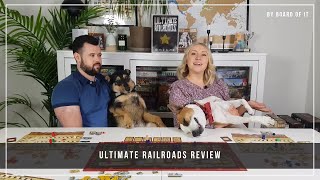







Ultimate Railroads Deep Dive
What the Community Thinks About Ultimate Railroads
Ultimate Railroads has captured the attention of dedicated board gamers who appreciate abstract euro design combined with deeply satisfying mechanical progression. The game arrives as a big-box compendium bundling Russian Railroads with German, American, and Asian variants plus a solo mode, but reviewers consistently emphasize that the appeal lies not in its railroad theme but in the elegant track-building engine it offers. Multiple experienced gamers report that this is one of their highest-ranked recent acquisitions, with some placing it immediately in their top three games after only a handful of plays.
Core Mechanics That Define Ultimate Railroads
Track Advancement as the Central Engine
The heart of Ultimate Railroads is deceptively simple: you place workers on a shared board and move markers up three different train tracks on your individual player boards. Hans im Gluck's design creates an elegantly abstracted economy where every action compounds. Early game play produces modest points, but by the final round the scoring explodes into triple-digit turns. Reviewers find themselves constantly searching for those cascading combinations, spotting opportunities like "I have one compass left, what can I chain from this?" The game rewards a specific kind of forward-thinking problem-solving where successful plays feel like discoveries rather than calculations.
Worker Placement and Board Competition
Workers compete for valuable action spaces on a tightly contested board where denial matters deeply. The spaces distribute trains that power your rails and access to the bonuses that unlock gamebreaking combos. Every placement decision carries weight because blocking an opponent from a crucial space can shift the entire game trajectory. The competitive nature of this worker placement creates tension without direct player-on-player conflict, maintaining the euro game aesthetic while keeping attention focused on everyone's engines.
The Ultimate Railroads Experience
The Thrill of Cascading Combos
Players describe an addictive progression of mastery where early attempts feel clumsy and low-scoring, but each successive play unveils more of the puzzle's depth. One reviewer admitted skepticism about early plays, wondering why anyone would need a 300-point token, only to discover after several games exactly how those massive bonuses unlock. The moment when all the pieces align and a single turn produces a hundred-plus points creates what reviewers call a "satisfying puzzle." This is not strategic revelation but mechanical discovery: the game feels more generous and clever the better you understand its hidden paths.
A Game That Makes You Feel Smart
The progression compounds in a way that validates player improvement and rewards deep engagement. Scores climb predictably across plays as players internalize the board's geometry and uncover synergies between tracks. Reviewers consistently note that they find themselves thinking about the game between sessions, mentally rehearsing different engine configurations and exploring what-if scenarios. The game hooks a particular type of puzzle-lover who wants to feel clever through system mastery rather than lucky draws or random events.
What Makes Ultimate Railroads Stand Out
Four Distinct Boards with Radically Different Puzzles
The Ultimate edition includes four boards (German, Russian, American, and Asian), each creating a completely different optimization challenge. Reviewers emphasize that these are not cosmetic variants but substantive redesigns with different bonus distributions and track layouts. One reviewer identified Germany as a personal favorite because its flexibility in train customization creates richer decision trees, while acknowledging that all four deliver memorable puzzle solving. Playing through all four boards feels like discovering four different games nested within the same rule set, multiplying replayability for committed players.
Accessible Learning Curve Hiding Tremendous Depth
The game explains simply in a way that belies its strategic complexity. It is purely about moving markers up tracks and placing workers, mechanics that need little explanation. Yet the interactions between those three tracks, the bonuses hidden in specific sequences, and the timing of worker placement denial create a game that reveals new dimensions with repeated play. This deceptive simplicity means new players can engage meaningfully while veterans continue discovering hidden depths. The game does not punish learning; it invites incremental mastery.
Potential Drawbacks
Abstraction May Alienate Thematic Players
The railroad setting is entirely incidental. Reviewers who expected a map-based game where players build visible rail networks across landscapes report initial disappointment before recognizing the game's actual focus. Players seeking rich thematic integration or narrative flow will find Ultimate Railroads coldly mathematical by contrast. The theme is a thin veneer over a pure optimization puzzle, which is exactly what some players seek and what others find alienating.
Competitive Worker Placement Requires Engagement from All Players
The game demands active attention throughout since optimal play depends on blocking opponent spaces and reacting to their choices. Multiplayer downtime remains minimal, but the tightness of the competition means that any player playing passively or casually can disrupt the experience for others. This is not a game for players who prefer to construct their own engine independently; it is fundamentally about competing for the same resources on the same board.
If You Enjoy Ultimate Railroads
Players who love Ultimate Railroads frequently gravitate toward Gaia Project, which shares the same obsessive focus on stretching limited resources and uncovering engine-building synergies, though in a space-exploration setting with asymmetric factions. The engine-building satisfaction overlaps significantly, though Gaia Project offers more variability through faction powers and asymmetry.
Those drawn to the competitive worker placement and puzzle-solving aspects often appreciate Ark Nova, which combines multiple mechanical languages (card play, tile placement, and track advancement) into a similarly satisfying optimization experience. Like Ultimate Railroads, Ark Nova rewards deep engagement and punishes surface-level play while remaining mechanically intuitive.
Fans also seek out the original Russian Railroads, the spiritual ancestor of Ultimate Railroads, though the Ultimate edition streamlines and refines the design while bundling the expansions that significantly improve the game's strategic breadth.
What Reviewers Are Saying
"This is a track game, this is just you're moving stuff up a track, you're putting your workers out on the board, you're moving stuff up tracks, but oh boy is it satisfying. And all of the different boards feel so different and just all of the different little tweaks you can make feel so different and I can just play it over and over and over it just it's got me so hooked."
— Allies or Enemies
"You really got to focus on something and neither of us are great at focusing so it's been interesting but on the whole it is just it has knocked my socks right off I am literally not wearing socks right now and it's because of this game."
— Allies or Enemies
"This game definitely makes you feel smarter the more that you played. I was like why would anyone ever need that 300 Point token and I think last game I was like oh yeah I get it now. And man it's such a fun challenge."
— Allies or Enemies