




























Scales of Fate Deep Dive
What the Community Thinks About Scales of Fate
Scales of Fate has captivated reviewers across multiple prominent channels in the board gaming community. Dice Tower's Tom Vassel and Mike Delisio praised it as a distinctive two-player experience that elevates the Veiled Fate universe into something focused and strategic. Blackwatch Games featured the game in a full playthrough that highlighted its engaging deduction mechanics. Board Game Buzz's Kari included Scales of Fate among her favorite games released in 2025, noting that it impressed her significantly. Reviewers consistently single out its mastery potential and replay variability as the reasons it earns a permanent spot on the shelf.
Core Mechanics That Define Scales of Fate
Strategic Deduction and Bluffing
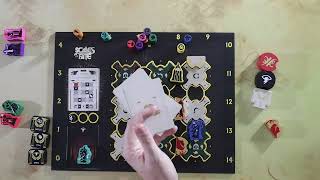
At its heart, Scales of Fate is a game about hidden information and psychological warfare. Each player secretly controls two demigods out of nine in play, then spends three ages manipulating their positions on a renown track while trying to deduce which demigods their opponent champions. The deduction layer is central: players gather clues through information-sharing questions at the end of each age, asking whether opponents have demigods in certain renown ranges. This forces players to balance two competing desires, hiding their own identity while making informed guesses about their opponent's. Tom Vassel explained that the game solves a problem found in Veiled Fate, where opponents become obvious once the game nears its end; Scales of Fate maintains ambiguity throughout all three ages because scoring depends on the difference between two demigods, making many renown configurations viable.
Tactical Placement and Servant Management
Players construct the game state through placement, putting demigod cards onto action spaces, each triggering different effects. The servant system exemplifies the game's mechanical depth: three types of servants affect scoring based on their placement along rows and columns of the board. Placing a feather servant along a column triggers all feather quest tokens adjacent to demigods in that column, adjusting their renown up or down. The scorpion servant activates all scorpion quests in its row, while another servant affects only the single demigod it touches. This cascading interaction creates puzzle-like decisions where placing a single servant ripples across multiple demigods simultaneously. Additionally, three one-time-use god powers offer abilities like smiting, swapping, and stealing, each incurring a one-point penalty at game's end. IV Studio designed these mechanics to interact with the renown track rather than operate in isolation.
The Scales of Fate Experience
Tense Psychological Warfare
Reviewers emphasized that Scales of Fate thrives on the psychological tension between optimal scoring and strategic bluffing. One reviewer noted that if you obviously boost two specific demigods' renown while tanking others, your opponent figures you out immediately; the mastery lies in spreading your manipulations across multiple demigods to create misdirection, sacrificing optimal scoring for better concealment. This trade-off between winning the points game and winning the deduction game defines the skill ceiling. Blackwatch Games' playthrough showcased this tension in real time, with players making gut-feeling notes about which gods were linked to their opponent based on subtle patterns of play. The reviewer from Dice Tower highlighted that this game breaks the typical deduction game mold by making deduction count toward points explicitly, giving the guessing phase real stakes rather than thematic flavor.
Elegant Risk-Reward Tension
The core scoring mechanism creates compelling strategic decisions. Players score based on the difference between their two demigods' renown values, or if both land on the same space, they score that space's value. This means a player can play conservatively by keeping demigods close together for a guaranteed moderate score, or spread them far apart for a potentially massive differential. One reviewer described this as high-risk, high-reward tension that really works: do you hunt for the perfect gap, or accept a safer, smaller margin? The abyss mechanic amplifies this, letting players send demigods out of play temporarily to control whether smited pieces gain or lose renown based on a marker's position. Three ages of board transitions add further unpredictability: age cards randomize the quest token layout and action tile positions, ensuring no two games feel identical.
What Makes Scales of Fate Stand Out
Pure Skill With Zero Randomness in Play
Scales of Fate features no dice rolls or surprise card draws once play begins; every decision is fully in the players' hands. Tom Vassel called this elegant design, and reviewers emphasized that the zero randomness creates a pure skill game where the better player will usually win and your win rate directly reflects actual skill development over time. This stands in sharp contrast to games that rely on luck, making repeated plays against the same opponent genuinely rewarding. The cognitive challenge of managing the renown track, positioning servants, orchestrating age transitions, and concealing intentions exists regardless of opponent, but deepens significantly when playing against someone you know well. Board Game Buzz's reviewer noted that the game impresses through its uniqueness, having not played anything quite like it, calling it a breath of fresh air in a crowded market.
Variable Setup and Long-Term Replayability
The three-age structure with randomized quest tokens and action tile placement ensures genuine variability. Age cards change the board's configuration three times per game, creating new quest layouts and strategic considerations. One reviewer contrasted this directly with games featuring fixed setups, noting that after playing through all identity combinations, such games can feel exhausted, but Scales of Fate's mechanical variability prevents that staleness. With multiple age card variants per age and dozens of possible demigod pairings per player, each session presents distinct tactical landscapes. This built-in variability justifies the investment for couples or dedicated two-player groups who plan extensive play together, offering mastery potential that keeps the game feeling fresh even after many plays.
Potential Drawbacks
Dense Rules and High Barrier to Entry
Tom Vassel acknowledged that Scales of Fate feels like a high-barrier-entry game because it does things in an unusual way. The game mixes deduction, placement mechanics, and scoring systems that do not align with typical abstract game conventions. The iconography and nomenclature, while consistent with the Veiled Fate universe, may confuse newcomers: smiting, the abyss, quest tokens, and servant color-matching require internalization. The player aid cards help, but understanding why certain actions matter requires playing a full game. One reviewer noted a learning curve just to grasp what smite means exactly; another pointed out that players do not immediately understand the value of actions until they experience the game's economy firsthand. First-time players often struggle to evaluate whether using a god power is worth the one-point penalty without seeing how heavily points compress in actual play.
Mechanical Complexity and Cognitive Load
The game layers multiple systems: the renown track, the abyss mechanic, quest tokens triggering based on demigod placement, servant tokens affecting entire rows and columns based on border color matching, age cards that change setup, and god powers. While these systems interact in genuinely fascinating ways, some reviewers noted the interaction is ambitious rather than perfectly elegant. One reviewer suggested the game tries to do a great deal at once, creating complexity that can feel like feature density rather than seamless design. Another described needing to keep track of which demigod scoring patterns they were pursuing while simultaneously tracking opponent behavior, which can overload cognitive resources, especially early in play. The formal guessing phase at game's end, while mechanically sound, felt to one reviewer slightly bolted on rather than seamlessly woven into the deduction.
If You Enjoy Scales of Fate
Scales of Fate occupies a specific but rewarding niche. If you love Veiled Fate, you will find Scales of Fate a compelling alternative that sharpens the deduction mechanics while adding tactile placement depth, sharing thematic elements and iconography but playing as a completely different game. For fans of Mr. Jack, the two-player deduction framework and hidden role guessing will appeal, though Scales of Fate's servant placement system adds strategic layers that go beyond positional puzzles. If you appreciate Cosmic Encounter's bluffing and hidden information, Scales of Fate delivers similar psychological tension in a tighter, head-to-head format. Those drawn to Pillars of Fate, the lighter two-player entry in the same Fate universe, will find Scales of Fate a deeper, more demanding evolution of that bluffing core.
What Reviewers Are Saying
"This is a deduction style game and a bluffing game with some really nice pieces."
— Dice Tower
"The gameplay itself is quite simple. You're going to take a god and you're going to place it on one of these action spots and try to hide your gods from the other player while trying to figure out who their gods are."
— Blackwatch Games
"I found Scales of Fate more interesting than Veiled Fate because it's a really interesting version of that, and it replaced Veiled Fate for me."
— Board Game Buzz