















Off With Their Heads! Deep Dive
What the Community Thinks About Off With Their Heads!
Off With Their Heads! stands out as a thoughtful hybrid that blends three distinct game mechanics into something reviewers find genuinely engaging. The game has earned praise for its clever design decisions and the interactive depth it brings to what is traditionally a solitary genre. Players appreciate that beneath its whimsical Alice in Wonderland theme lies a game that rewards careful planning and reads of the table, while still leaving room for chance and adaptation. The Wonderland aesthetic, developed by the same artist behind Wonderland's War and Mago, creates a cohesive world that appeals to both thematic enthusiasts and serious mechanics-focused players.
Core Mechanics That Define Off With Their Heads!
Simultaneous Trick-Taking with Positioning Control
At its heart, Off With Their Heads! combines trick-taking with a reveal-and-write mechanic in a way that inverts expectations. Each round, players simultaneously play cards from their hands and immediately know whether they have won the highest card, lost with the lowest, or landed somewhere in the middle. Rather than trying to win tricks in the traditional sense, players are often trying to hit a specific position because that position determines where they may write on their sheet. The genius of this system is that the suit rankings shift every single turn as the Red Queen advances around the Wonderland board, meaning the strategic calculus changes constantly. Reviewers note that this makes the game feel fresh throughout play; unlike some games where you can lock in a strategy and execute it, Off With Their Heads! keeps you adapting because you cannot always predict what will matter next.
The Hand Management Decision: Play Now or Save for Later
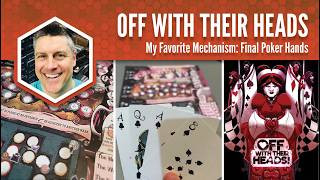
Published by Allplay, Off With Their Heads! introduces a deceptively simple but deeply strategic choice: each round you receive nine cards but only play seven. This means setting aside two cards every round, and since the game runs three rounds, you accumulate six cards total that you hold until the very end. At game's end, those six cards become your poker hand, and you score points based on its strength. This mechanic creates genuine tension between immediate needs and future rewards. Do you use that King right now because you desperately need it in the meadow zone, or do you protect it for your poker hand, hoping to build a full house or better? Reviewers consistently highlight this decision as the emotional core of the game, comparing it to similar mechanisms in games like Dune: Imperium and Libertalia. It forces players to balance what they need to accomplish on their sheet against what they might accomplish in the endgame poker showdown.
The Off With Their Heads! Experience
Surprising Interaction in a Typically Solitary Genre
One of the most striking observations from the reviewing community is how much table interaction Off With Their Heads! generates despite belonging to the reveal-and-write family. Because everyone plays simultaneously and card rankings are public knowledge, you are constantly reading the other players. Are they focusing on the meadow? Trying to build in the keep? You start to predict which cards they might play when, and this prediction becomes part of your own strategy. Reviewers emphasize that unlike traditional roll-and-write games where players largely ignore each other once cards are revealed, Off With Their Heads! keeps everyone engaged and observant. You are not directly attacking opponents' sheets, but you are very much paying attention to what they want and adjusting your plays accordingly.
A Balancing Act Between Control and Chance
Players consistently mention that the game strikes an appealing equilibrium between agency and unpredictability. You have meaningful choices each hand about which card to play, but you do not have complete control over where you end up because other players' decisions matter. One reviewer described it as the game "gently steering you" even as you try to steer it yourself. There is just enough luck in the system, especially at two-player counts where hidden deck cards join the trick, to keep outcomes from feeling predetermined. At the same time, the game never feels random because your careful selection of cards remains the dominant factor in your score.
What Makes Off With Their Heads! Stand Out
A Rich Endgame Payoff Built Into the Entire Game
Many games tack on a poker variant at the end as a tiebreaker. Off With Their Heads! makes the poker hand a genuine scoring pathway from round one. This means every decision to set a card aside is weighted with two competing values: the power of that card right now versus its potential in the poker hand. Reviewers praise this as elegant design because it naturally creates the decision space without feeling bolted on. The poker hand is not a bonus; it is an alternative path to victory that runs parallel to your sheet-filling strategy throughout the entire game.
Scaling That Works Across Player Counts
Off With Their Heads! plays 2 to 4 players, and reviewers note that the design thoughtfully adjusts for each count. At four players, everyone contributes a card to the trick every hand. At three players, one card from the deck participates as a known card that everyone sees first. At two players, two deck cards join the trick (one face-up, one revealed later), balancing information and chaos. Rather than feeling like patches, these variants feel like natural expressions of the same system scaling across player counts. Reviewers were pleasantly surprised that the two-player version, which borrows from trick-taking standards like The Crew, works as well as it does, even though two-player trick-taking is notoriously difficult.
Potential Drawbacks
Limited Combo Frequency May Feel Light
One reviewer noted that while the game includes special spaces like the eat-me cookies, which let you duplicate a card value in another zone, these combo moments happen less frequently than some dedicated roll-and-write players might expect. The spaces are there, and chaining cookies is possible, but you will not be comboing every turn. For players who love the dopamine hit of cascading bonuses in games like Dune: Imperium or Shards of Infinity, Off With Their Heads! may feel more straightforward. That said, the same reviewer acknowledged this might be a feature for others, as it keeps the game accessible and quick-playing rather than getting lost in complex chain reactions.
Strategic Depth Emerges Gradually
The game is easy to teach and learn, but reviewers noted that the true strategy, understanding when to land in the middle versus the top, how to manipulate the queen's position for future rounds, and which cards to sacrifice, reveals itself over multiple plays. New players can play and enjoy it, but the game's depth becomes apparent once you stop simply reacting and start predicting. For some tables, this ramp may be exactly right; for others accustomed to immediate strategic complexity, the early game might feel a bit rote.
If You Enjoy Off With Their Heads!
If Off With Their Heads! appeals to you, you might find similar satisfaction in several other games that blend trick-taking with other mechanics or create meaningful push-your-luck decisions.
Dune: Imperium offers a similar card-saving choice through its worker placement and bottom-ability system, where you must decide which cards to play for their worker placement versus which to hold for combat benefits at the end of the round.
The Crew shares Off With Their Heads!' simultaneous trick-taking roots and works well at two players, though it leans into cooperative storytelling rather than individual point scoring.
Wonderland's War and Mago share the same artist and Alice in Wonderland theme, making them natural companions if you love the aesthetic and want to build a cohesive collection.
Libertalia mirrors the core choice of which cards to play now versus save for later, and adds an intriguing twist: every player gets the same random cards each round, so differentiation comes purely from which cards you held back.
What Reviewers Are Saying
"I really like this mechanism. I like this idea of deciding which cards are really important for you to use now versus setting aside some cards to use later. This decision of which cards to keep, which cards to save for later."
— Jamie, Stonemire Games
"The interesting thing about this game is the trick taking because that really dictates what zone that you can go in. I like that you're not necessarily trying to win the trick. In fact, sometimes you really want to lose the trick."
— Jess and Sean, Allies or Enemies
"There's a lot of good mechanisms in Off with Their Heads, and I particularly enjoyed the decision of which cards to play now versus which cards to save for that poker hand at the end of the game. That's a pretty neat system."
— Jamie, Stonemire Games