








Pulitzer Deep Dive
What the Community Thinks About Pulitzer
Pulitzer, designed by David Vaquero with art by Juan Vargas and first published by Tranjis Games, wins almost universal praise for its look and its idea, then splits reviewers over how its central mechanism plays. Chris Yee of The Dice Tower sums up the pattern: wonderful production, awesome theming and fantastic art, but an evidence system so reliant on card draws that the review lands at 6.5 out of 10, just shy of a recommendation. Board Gaming Ramblings named it the biggest letdown of its month for the same reason, calling it too random. Rahdo Runs Through enjoyed the worker placement and the string gimmick but ranked it low after two-player games that felt brutally swingy. More upbeat takes come from convention coverage: Jess of Allies or Enemies is keen to play it more after Essen Spiel, and Camila of The Dice Tower lists it among 2025's most uniquely themed games. The broad verdict is a beautiful, interactive game whose luck will suit some tables and frustrate others.
Core Mechanics That Define Pulitzer
Worker Placement with Hidden Values
Each player has reporters numbered one through five plus an X worker whose strength can be upgraded to level five over the game. Workers go out face down, and nothing is revealed until everyone has deployed. As Chris Yee explains, placing in the newspaper area earns money from that round's event card for categories like US events, world events, sports, celebrity news and finance, while the highest totals in each row and column claim houses and bonuses. Other spaces let players draw evidence cards, grab overtime cards with points and flexibility, or send request markers for bonus tokens. Rahdo describes the result as worker placement with blind bidding to see who gets to act first, a system seen in games like Lock Up that works great here. Chris Yee particularly enjoys the bluffing that comes from deciding where to spend the strongest workers.
String, Pins and the Evidence Board
The investigation happens on a personal cork board with real push pins, set on a stand to hide it from other players. Each player receives a card showing the trail of evidence they want to highlight, and uses drawn cards to claim evidence in specific columns, pinning it and wrapping red string from one pin to the next. The value of the worker used decides how far the string can reach from the previous piece. Chris Yee loves that the length of string is itself a resource: leap across the board too often and the string runs out, forcing players to undo evidence and rebuild. In the standard rules, a player needs at least five highlighted pieces of evidence connected to be eligible for the Pulitzer and to score at all; an alternate mode instead awards more bonus points for each one collected.
The Pulitzer Experience
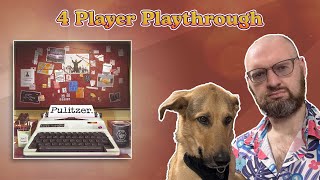
A Conspiracy Board on the Table
Reviewers light up when describing how the game looks mid-play. Chris Yee reports that everyone passing the table does the Charlie Day meme, and calls it some of the best table presence seen in a while without being over the top. Rahdo agrees that the string did not have to exist; the game could have used a flat board and markers, but the string represents the tenuousness of the connection between stories and makes it feel like working at a real corkboard. Jess of Allies or Enemies simply calls the table presence fantastic.
Newsroom Pressure With a Wink
The theme sits in the early 1970s, which TheGameBoyGeek frames around the Vietnam War, the Pentagon Papers and the Watergate crisis. Camila of The Dice Tower highlights its focus on reporting, ethics and newsroom tension as a rare take on newsroom drama. Chris Yee finds humor in the economics: exposing corruption does not pay the bills, while writing about how well the White Sox are doing brings in easy money. The backs of the evidence cards carry headlines and titles of real Pulitzer-winning articles, though Chris Yee wishes the evidence itself had a little more history attached.
What Makes Pulitzer Stand Out
Production Quality
Production is the most consistent point of praise. Chris Yee describes it as phenomenal, with good screen printing apart from white text on the light blue meeples, which can be hard to read in some lighting. Rahdo calls the production quality fantastic. One small theming note comes from a Board Gaymes James livestream, flagged on screen as including paid promotion, where a player wishes the house pieces were something more newspaper-flavored.
A Revised Edition With Fixes
The game is getting a second life. TheGameBoyGeek reports that 25th Century Games is bringing a revised edition to Gen Con with rebalancing, reworked graphic design and logos to make it easier to play, and redone rules, and expects it to be the best edition of the game. Players put off by early reports may want to check which version they are looking at.
Potential Drawbacks
Luck in Collecting Evidence
The biggest criticism is the randomized card draw behind the evidence board. Chris Yee says it almost feels like a push your luck card game without any real push your luck: players can invest in spaces that draw more cards or gain small mitigations, but if the needed evidence never flips, there is little to do. Spending a five-strength worker to reach something distant, then finding a card for evidence right next door, stings. Cards that let a player choose between columns also force them to destroy a piece of evidence, which does not feel good. The conclusion is that results will not always go to whoever outplayed the table. Board Gaming Ramblings found it too much luck as well, while acknowledging that players who don't mind it will find a lot to like. Chris Yee also finds eight rounds a little long, with groups feeling around round seven that the game should already be winding down.
Swingy at Two Players
Rahdo's complaint is specific to lower player counts. At two players, and to a lesser extent three, government agent meeples are deployed through a randomized system, some face up and some face down. Lose to an agent on an action and the reporter gets nothing, no consolation. Because the two-player game stays competitive, one player can be shut out by bad luck while the other gets off scot-free, which Rahdo and Jen found very frustrating. Rahdo suggests the pieces are there for a full co-op mode, or simply keeping all agents face up, and suspects the game would rank much higher at higher player counts, though those were not played.
If You Enjoy Pulitzer
Rahdo points to Lock Up as another game built on placing workers with hidden values and bidding for who acts first. Jess of Allies or Enemies compares the system to Luthier, describing Pulitzer as quite a bit lighter than Luthier with a bit more randomness, which makes it a gentler way into hidden-value worker placement.
What Reviewers Are Saying
"I will say from the get-go, this game has a lot of great things going for it, wonderful production, awesome themeing and fantastic art."
— Chris Yee, The Dice Tower
"It's really neat. It's a lot of fun. It's a great tactile gimmick. It didn't have to be that. It could have just been a flat board and we could have just put markers on the stuff."
— Rahdo Runs Through
"I was interested in this game because it's got these fun texts that you're putting in this information board and then you're connecting strings up. And I really like the look of this."
— Jess, Allies or Enemies