































Excalibur Deep Dive
What the Community Thinks About Excalibur
Excalibur has captured the attention of board game reviewers as a standout in the crowded social deduction space. The game stands out not just for its mechanics, but for the full experience it delivers. Reviewers consistently praise it as a fresh take on a familiar genre, with one noting that the "deduction and suspense of figuring out who has Excalibur makes it so incredibly fun." The game has earned recognition as a definitive party game choice, with players describing it as a favorite party game of the year and positioning it as a staple they reach for often.
Core Mechanics That Define Excalibur
Tile-Based Character Powers and Social Deduction
Unlike traditional social deduction games that rely on card play, Excalibur from Roxley Games uses a tile system where each character has a unique ability. Players start with several tiles in hand and must choose which character power to activate each round. As one reviewer explains, "Each tile has an ability. You could have a special character, which are these gold characters here, or you could have normal characters that don't have golden names on them, but they just still have an ability." The tiles enable actions like stealing from opponents, swapping hands, drawing from the middle, or protecting yourself from theft. This tile-driven approach gives players genuine choice and allows for more tactical decision-making than simpler social deduction games. The variety of character powers creates layers of bluffing and deduction as players work to track not just who holds Excalibur, but what abilities remain in play.
Hand Management and Regional Scarcity
The game divides character tiles into three regions of Avalon, with one region emptying to trigger the game's end. This structure creates escalating tension and forces strategic timing decisions about when to play which characters. As the game progresses and regions deplete, players must manage not just the tiles in their hand but anticipate when the end-game will arrive. The core loop keeps players engaged: each turn you play a tile, everyone in turn order resolves their character abilities, and then you redraw from the middle to refill your hand. This creates a steady cadence where the board state transforms dramatically round by round. One reviewer noted the mechanism works best with larger groups because "with lower player counts, you can tell where Excalibur is. But in larger player counts, you have no clue."
The Excalibur Experience
Chaotic Social Tension in Larger Groups
The magic of Excalibur emerges at four or more players, where the game transforms into organized chaos. A reviewer captured the essence: "It's so easy because you just grab chips and everyone gets a little overwhelmed by the ability so far, but after one round, everyone's just chilling because you play one chip on your turn and you start off with three. So, it's not much to keep up with." The game gets players talking, accusing, and scheming. Character abilities enable stealing and swapping, forcing players to make split-second decisions about who to target. The constant shifting of Excalibur between hands creates unpredictability that keeps everyone invested until the final tile is played.
Bluffing and Betrayal with Legendary Flair
The game explicitly embraces deception and trickery. Reviewers describe loving the bluffing, lying, and backstabbing mechanics, emphasizing that Excalibur delivers on the promise of table talk and social interaction. The metaphorical backstabbing comes from the characters and their powers rather than explicit confrontation rules. This creates a lighter-hearted atmosphere compared to hidden role games with accusation phases. Players laugh as abilities cascade unexpectedly, turning fortunes with a single well-timed character activation. The compressed playtime (around 20 minutes) means that even when someone gets knocked out of contention for the sword, the game ends quickly enough that disappointment doesn't linger.
What Makes Excalibur Stand Out
Beautiful, Thematic Production Design
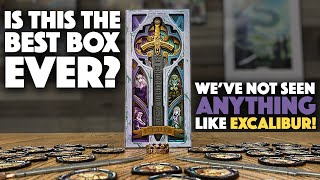
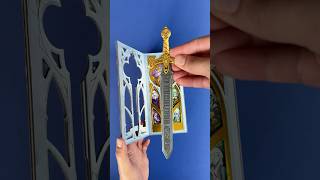
The presentation elevates Excalibur beyond its mechanical core. The game features a striking art style from artist Manny Trembley, known for his work on Dice Throne. The collector's edition includes three metal swords that serve as region markers and create a visual centerpiece. As one reviewer notes, "The table setting for this game is amazing." Whether the deluxe version with wooden components or the collector's edition with metal swords, the game commands attention at the table. The beautiful artwork of the characters and the polished box design make it as much a display piece as a game, appealing to collectors who appreciate production craftsmanship. The Arthurian theme weaves through the character designs and artwork, reinforcing the setting without becoming heavy-handed.
Tile-Driven Design Over Card Games
Excalibur differentiates itself from the mountain of social deduction card games by using tiles instead of cards. One reviewer expressed relief at this choice: "It could have been a card game. But I'm happy it's a tile game because we've got enough social deduction card games." The tiles feel more substantial in hand and create a different tactile experience. The choice to organize tiles into regions adds spatial reasoning to what could have been a purely social game. This hybrid approach appeals to players who enjoy social deduction but want something that engages their brains slightly more through tile management and positioning choices.
Potential Drawbacks
Power Imbalance at Two Players
The game stumbles at lower player counts. With just two participants, certain character abilities become problematic. A reviewer explained, "It works at two. I've played this at two. It was fun at two. I would probably house rule it because there's so many tiles in the box that it outstays its welcome. Some of the abilities in a two-player game kind of break the game a little bit and make it, if you're lucky enough to have that tile in hand, you're almost guaranteed yourself a win." The game design assumes larger groups where information is naturally obscured and abilities balance out across more players. Players wanting a consistent two-player experience would need to implement house rules or accept less competitive balance.
Higher Price Point for the Ruleset Depth
Excalibur costs more than comparable social deduction games like Love Letter or Coup. A reviewer noted the trade-off: "It is a pricier social deduction game where you can get the same level of tactical thinking out of an eleven-pound copy of Love Letter." The increased cost comes largely from production value and component quality. While the tile-based system and Arthurian theme add flavor, the core gameplay loop remains relatively straightforward. Players seeking maximum complexity or rules depth might find themselves paying a premium for what amounts to a lighter experience. The value proposition depends heavily on whether the buyer prioritizes beautiful production and thematic presentation alongside accessible mechanics.
If You Enjoy Excalibur
Reviewers who love Excalibur recommend exploring Coup, Love Letter, The Resistance, and Werewolf as related titles in the social deduction space. These games share the core loop of deduction and hidden information, though they lack Excalibur's tile system and thematic production. Those enchanted by Manny Trembley's artwork should explore Dice Throne, which shares the same artist and offers deeper tactical gameplay. If the Arthurian theme resonates, The Resistance: Avalon provides another classic hidden role experience with fantasy flavor and a similar scheme of secret allegiances.
What Reviewers Are Saying
"The deduction and suspense of figuring out who has Excalibur makes it so incredibly fun. So, I love how this game plays out."
— Wolfpack
"This is the collector's edition. So, in this edition, you will have three completely metal swords in the game. It's cool, right? You're getting one of the most beautiful artwork in a game. And that is Excalibur from Roxley Games."
— Watch Review
"It could have been a card game. But I'm happy it's a tile game because we've got enough social deduction card games."
— Watch Review