







Golem Arcana Deep Dive
What the Community Thinks About Golem Arcana
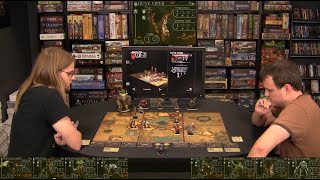
Watch It Played's Rodney Smith has produced an extensive series of instructional videos on Golem Arcana by Harebrained Schemes, exploring everything from the game's unique technology to its tactical depth. His teaching covers the mechanics, army building, and several full playthroughs that reveal how the game balances physical miniatures with digital assistance. Through Smith's presentation, a picture emerges of a game that trusts its app to enforce fairness while placing strategic authority entirely in the players' hands.
Core Mechanics That Define Golem Arcana
App-Assisted Action Economy and Cool-Down Management
Golem Arcana's action system combines resource management with a cooling mechanism that prevents players from spamming powerful abilities. Each turn, players receive action points based on their army's total point value, which they spend to activate their Golems' movement and attack abilities. The genius of the design lies in the cool-down system: the first time a Golem uses an ability, it gains cool-down points; using that ability again immediately doubles its action point cost until cool-down resets. The Harebrained Schemes team relies entirely on the companion app to track these escalating costs and automatically reduce cool-down points during the upkeep phase of each turn. This creates constant decision-making tension, as players must weigh whether using an ability twice in one turn is worth its doubled cost or whether to wait and let it cool. The app handles all the calculations, meaning players never need to track spreadsheets; they simply see whether they can afford the action and plan accordingly.
Bluetooth Stylus and Modular Combat Resolution
The Bluetooth stylus is the physical interface that binds the tabletop to the digital ruleset. Players hold the stylus at specific angles to select game elements: straight down for terrain and cards, at an angle for miniature bases. The stylus then communicates back to the app, which automatically calculates attack accuracy by comparing the attacker's base accuracy against the target's dodge value, factoring in terrain cover, intervening obstacles, and unit size. Damage calculations follow the same pattern: the app subtracts the defender's armor from the attack's base damage and shows the final result before the die roll. This design reduces rules disputes by making illegal moves difficult; if a move violates line-of-sight rules or a charge would overfill a space, the app simply darkens those spaces and prevents the action. The stylus is also a practical tournament tool, as players can pair multiple styluses to the same game instance and change their default pins to prevent accidental interference at crowded play tables.
The Golem Arcana Experience
Tactical Positioning Meets Digital Automation
The act of playing Golem Arcana feels like commanding armies while the app handles bookkeeping. Miniatures move across modular tile layouts, occupying spaces constrained by unit size (War Sprites and Ogres are smaller, Titans and Colossi take up more room), with obstacles further limiting capacity. Movement costs vary by terrain: plains and water cost one point, elevated terrain and deep water cost two, and flying units pay a flat one point regardless of terrain. Charging allows a melee unit to move and attack in a single action, but only when the target is within movement range, adding a layer of positioning skill. Mana wells scattered across scenarios provide ongoing resource generation if a Golem stands on them without enemies present. This blend of tactical positioning and resource gathering creates scenarios where holding territory and denying the opponent access to Mana wells matter as much as direct combat.
Army Building as Meaningful Customization
Rather than using fixed army lists, players build custom armies within point budgets set by each scenario, choosing Golems from different factions, assigning knights with passive and activated abilities, equipping relics that persist for the match, and selecting ancient ones whose powers cost Mana to invoke. A knight might provide bonus damage to successful hits or allow spending Mana for a risky high-damage attack. A relic might create a stationary totem that attacks enemies or temporarily disable an opponent's movement. These choices snowball into emergent army identities: one player brings heavily armored units with shield-wall abilities to protect allies, while another fields a fast striking force with evasion-focused units. Because the app manages all these interactions, players focus on strategy rather than tracking special ability text, and new scenarios added over time keep army building fresh.
What Makes Golem Arcana Stand Out
The Digital Enforcer That Never Errs
The app's role as a rules arbiter is quietly transformative. Because every legal move is highlighted and many illegal moves are prevented, players cannot easily cheat through forgetfulness or deception. A unit cannot move through blocking terrain, target outside line of sight, or exceed its movement allowance; the app simply does not offer these choices. This design philosophy means less rules overhead for new players and more consistent fairness for competitive play. It also means the rulebook can be more complex than traditional miniatures games would permit, because players can rely on the app rather than memorizing interaction modifiers. This creates breathing room for elegant mechanics like the cool-down system, which would become bookkeeping hell without digital support but feels intuitive when the app tracks it.
Continuous Content Updates and Faction Diversity
Scenarios are not static. The app is updated with new scenarios that support different army sizes, ensuring players always have fresh strategic puzzles to solve. Multiple factions with cross-faction army building rules mean players can experiment with hybrid forces, each Golem type bringing unique abilities and stat distributions. Knights offer specialization layers; ancient ones add game-wide buffs or regional effects. The game evolves as the app evolves, and no additional product line needs to be purchased to access new scenarios or balance changes.
Potential Drawbacks
App Dependency Creates Accessibility and Longevity Concerns
Golem Arcana cannot be played without a charged stylus, a Bluetooth-enabled device (tablet or smartphone), and the companion app. If the app goes offline or Harebrained Schemes stops supporting it, the physical components become expensive miniatures with no rules context. This differs from traditional miniatures games, which remain playable through the rulebook alone. For tournament organizers or players in areas with poor connectivity, this creates friction. The app also requires account creation and login, which adds a step for casual play and raises questions about long-term access if the service closes.
Learning the Tech Before Learning the Game
New players must first master the Bluetooth stylus: pairing it, holding it at the correct angles, using its buttons to navigate app screens, and understanding how the stylus reads miniature bases versus terrain tiles. Only after this tech tutorial can they begin learning cool-down math, Mana economics, and positioning tactics. The stylus itself is an additional component to manage, and if its batteries deplete at the wrong moment or the Bluetooth connection drops, play halts. Experienced miniatures gamers may find this technological middleman intrusive, preferring to roll their own dice and manage their own ability tracking without a digital witness.
If You Enjoy Golem Arcana
Players drawn to Golem Arcana typically appreciate games where technology solves complexity rather than adding to it. Those interested in tactical miniatures combat with streamlined bookkeeping should explore Warhammer 40,000: Kill Team, which uses smaller model counts and faster turns than traditional Warhammer but still rewards positioning. Fans of customizable army building might enjoy Star Wars: X-Wing, which offers miniature-on-miniature skirmish combat with dozens of specialized units and dial-driven movement. For those who prefer app-driven gameplay with miniatures, Descent: Journeys in the Dark offers an app-assisted fantasy dungeon crawler where the app controls monsters and players manage hero abilities and resource spending.
What Reviewers Are Saying
"The game of Golem Arcana utilizes miniatures and modular boards, but also a stylus that communicates with an app to assist the players with rules, combat resolution, and army building along with a host of other features."
— Watch It Played
"Cheaters are really not going to like this game because there is no way to conveniently forget something."
— Watch It Played
"The application can be updated so some of the rules may change slightly over time but the general principles should stay the same."
— Watch It Played