





















Labyrinth: Chronicles Deep Dive
What the Community Thinks About Labyrinth: Chronicles
Labyrinth: Chronicles receives a cautiously enthusiastic welcome, though opinions diverge sharply between the standalone and campaign modes. The Dice Tower found the competitive standalone game disappointing, comparing it unfavorably to the classic Labyrinth, but discovered the cooperative campaign mode substantially better. Independent reviewers have praised the cooperative reimagining more warmly, with one calling it "a stellar reimplementation of an age-old classic" and comparing its visual presence to Rising Sun as one of the most beautiful games in recent memory. Yet even admirers acknowledge practical frustrations with setup time and the persistent tile-jamming issue inherited from the original. The consensus leans positive, but it is a nuanced enthusiasm: players recognize Labyrinth: Chronicles as a bold evolution of a beloved game that doesn't entirely escape its legacy constraints.
Core Mechanics That Define Labyrinth: Chronicles
The Shifting Board and Corridor Manipulation
At the heart of Labyrinth: Chronicles lies a mechanic that reviewers describe as a constant source of spatial puzzle-solving. The modular board consists of movable corridors, three vertical and three horizontal, that reshape the maze layout each turn. On your turn, you roll dice, trigger events or activate goblins, then you move and shift: you can move as far as you want along unblocked paths, and you can shift one corridor in either direction, pushing the spare piece into the labyrinth and taking out another. This creates what one reviewer termed "a moving target." The Dice Tower players reflected that unlike the original game, where you knew where to go from a card in hand, here the path itself transforms under your feet, forcing constant recalculation. The board never settles; walls that were open suddenly block, passages appear elsewhere. Reviewers noted this demand for spatial imagination to move the walls around and create new passages is central to the experience.
Cooperative Campaign with Unlocking Mechanics
The campaign layer transforms Labyrinth from a competitive race into a shared puzzle. Each mission gives you explicit objectives: collect items, push goblins from portals, manipulate corridors a certain number of times. As you progress, you unlock mission boxes that add new cards, abilities, and surprises. One reviewer captured the pacing perfectly: "this game builds itself up brick by brick, rewarding your patience in spades." Between missions you rebuild Fairy Veil by spending crystals earned from collected items, buying hammers to repair buildings and unlocking their corresponding boxes. The campaign structure means that failure, missing mission objectives by even one component, feels more consequential than in many legacy games. Yet this also makes success feel earned rather than automatic.
The Labyrinth: Chronicles Experience
A Puzzle You Solve Together
Multiple reviewers emphasized the cooperative dynamic as a breath of fresh air. Where the original game pits players against each other in isolation, Chronicles asks you to coordinate: you are going to be trying to coordinate with your peers as to which of the labyrinth columns or rows needs to be moved. Players sit around the table discussing strategy, setting each other up for success, debating the best tile to shift. One reviewer noted this creates a moving puzzle that the group tackles collaboratively. The experience is lighter on confrontation and heavier on shared problem-solving, making it accessible for family play while remaining engaging for experienced gamers.
A Sense of Discovery and Mounting Wonder
The unlock mechanic generates genuine excitement. Reviewers described moments of anticipation before opening mission boxes, eager to see what new mechanics or story developments await. One enthusiast praised how the game reveals surprises gradually rather than all at once, preventing early overwhelm while maintaining long-term engagement. Another remarked that even when you fail a mission and must replay it, the replayability of the modular board ensures the experience feels fresh. The 3D components, miniatures with colored washes, and hand-crafted details throughout reinforce a sense that each session is an occasion.
What Makes Labyrinth: Chronicles Stand Out
Visual and Physical Design Excellence
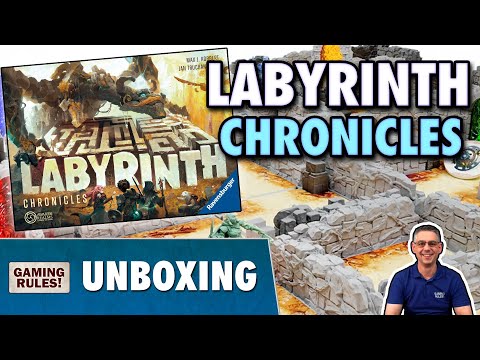
Reviewers were nearly unanimous in praise for the production quality. One critic called it "one of the most beautiful games we have ever seen," noting that it retains all of the charm of the original whilst amplifying the wow factor on the table. The 3D board, colored miniatures, and interlocking systems create what another described as an intricately woven design where everything seems to make sense. The use of a metal box lid to hold magnetic building tokens as you reconstruct Fairy Veil is a clever touch that makes progress visible at a glance. Compared to Rising Sun, which set a high bar for ambitious component design, Labyrinth: Chronicles holds its own as a feast for the eye.
Campaign Depth with Surprising Twists
The campaign structure avoids feeling like a thin veneer over the base game. Each mission introduces new rules, events, or enemy types that escalate the challenge. Reviewers noted that the first boxes introduce new skills for your heroes, quest cards with objectives, and event modifiers. Later, larger opponents and even a dragon emerge. One reviewer shared their struggle to restrain themselves from tearing open all the boxes at once, driven by genuine curiosity about what awaited. This slow reveal, combined with the high stakes of mission failure, gives the campaign weight. The narrative framing, rebuilding a village destroyed by a dragon, provides thematic coherence that lifts the mechanical puzzle into something more resonant.
Potential Drawbacks
Lengthy Setup and Tile Jamming Issues
Setup is substantial. One reviewer bluntly called it a real chore, noting that assembling all components for even a relatively short game demands significant table space and patience. The 3D board with its shifting mechanism also inherits a problem from the original: tiles sometimes get stuck, misalign, or jam if pushed carelessly. One reviewer observed that you are going to have to push the tiles one way and then you find out that one is not in line and the maze can get a little bit messy. The manual does not solve this for you; careful realignment after each push falls to the players. For a game marketed as family-friendly, this friction point can interrupt flow and frustrate younger players.
Mission Failures Feel Punishing, and Walls Can Obscure Paths
When you fail to meet mission objectives, even by one component, you cannot unlock the next mission and must replay. One reviewer found this emotionally taxing: when you are looking back at what you've already unlocked, thinking about what is next, then failing that mission leaves you feeling dejected. The game teases you with promise and delivers consequence, which is intentional design but not for everyone. Additionally, the 3D walls on the tiles, while visually striking, can be confusing to read. The Dice Tower player struggled to visually see which way a tile will slide when pushed, finding that the walls were actually hurting rather than helping. One reviewer acknowledged this complaint as perspective-dependent, saying the issue did not bother them as much, but the friction exists for some players.
If You Enjoy Labyrinth: Chronicles
If Labyrinth: Chronicles resonates with you, consider exploring Rising Sun, which reviewers cited as a comparable achievement in lavish, interlocking component design and table presence. You might also enjoy Gloomhaven and other cooperative campaign games that emphasize spatial puzzles and narrative progression, where the game itself evolves as you play through it. The original Labyrinth (also included in this box) offers a lighter, less punishing competitive alternative when you want quick family play without the commitment of a campaign mission. For shifting-maze fans who want a purely competitive race, the classic Labyrinth remains the benchmark that Chronicles builds upon.
What Reviewers Are Saying
"This game is like an intricately woven design. Everything seems to make sense. Everything has been thought about and there's no loose ends in the narrative and in the gameplay."
— Watch Review
"It's already better than the last one. This is a good family cooperative game. Way better than the standalone version."
— The Dice Tower
"This game builds itself up brick by brick, rewarding your patience in spades. I guarantee you are going to be blown away with what you are going to find."
— Watch Review